
How Can You Tell When a Book Has Been Silently Revised?
What evidence can reveal substantial differences between versions of the same work?
Direct Answer Start with the copyright page and any edition statement, then examine the publisher’s notes, table of contents, pagination, and selected passages. Compare these details with another copy and with library catalog records. No single clue is conclusive, but several differences together can establish that the text has changed. Introduction A new cover or printing does not necessarily mean that the text has changed. Conversely, meaningful alterations are not always announced prominently. Revised wording, removed passages, corrected information, and editorial work completed after an author’s death may be disclosed only in the opening pages—or may become apparent only through direct comparison. The most reliable approach combines evidence from the physical or digital copy, bibliographic records, and the text itself. This can establish which version is in hand and whether the differences are merely cosmetic or affect what the work says. Begin with the publication details Inspect…
Direct Answer
Start with the copyright page and any edition statement, then examine the publisher’s notes, table of contents, pagination, and selected passages. Compare these details with another copy and with library catalog records. No single clue is conclusive, but several differences together can establish that the text has changed.
Introduction
A new cover or printing does not necessarily mean that the text has changed. Conversely, meaningful alterations are not always announced prominently. Revised wording, removed passages, corrected information, and editorial work completed after an author’s death may be disclosed only in the opening pages—or may become apparent only through direct comparison.
The most reliable approach combines evidence from the physical or digital copy, bibliographic records, and the text itself. This can establish which version is in hand and whether the differences are merely cosmetic or affect what the work says.
Begin with the publication details
Inspect the copyright page rather than relying on the cover. Record the publisher or imprint, publication year, place of publication if shown, identifier, edition statement, printing line, and the names of editors, translators, or other contributors.
Terms such as revised, expanded, corrected, abridged, restored, or anniversary edition are strong signals, but their absence does not prove that the text is unchanged. A printing number generally helps identify a production run; it should not automatically be treated as proof of a new textual edition.
- Photograph or transcribe the complete copyright page before comparing copies.
- Distinguish the original publication date from the date of the copy in hand.
- Note whether the publisher, imprint, format, translator, editor, or introduction has changed.
- For an electronic copy, record the displayed publication information and the platform’s version details, if available.
Read the introductory material carefully
Publishers may describe changes in an editor’s note, preface, foreword, afterword, acknowledgments section, or note on the text. These statements can clarify whether spelling was modernized, facts were updated, passages were restored, or material was shortened.
Read the wording precisely. A claim that an edition includes a new introduction does not necessarily indicate changes to the main text. Likewise, phrases such as newly edited or based on original sources deserve further investigation because they may refer to substantial textual decisions.
- Look for explanations of editorial principles and source materials.
- Check whether the note identifies omissions, restorations, corrections, or modernization.
- Determine whether a preface belongs to the author, an editor, or the publisher.
- Compare the front and back matter as well as the main text.
Compare the texts systematically
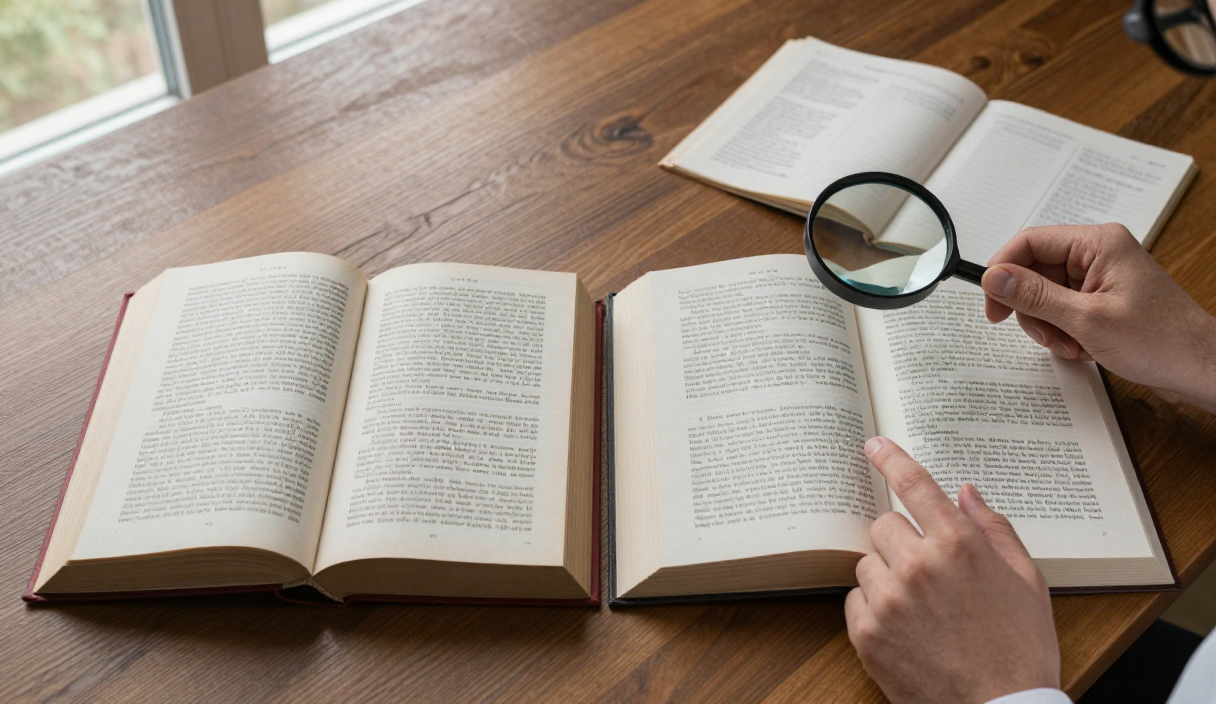
A side-by-side comparison is the clearest way to detect altered language and missing material. Use copies whose publication details are known, and compare stable locations such as chapter openings, controversial passages, factual discussions, and the ending.
Pagination alone is unreliable because type size, page dimensions, illustrations, and layout can change. Instead, compare wording and structure. For searchable digital texts, distinctive phrases can help locate corresponding passages, but errors introduced by scanning or conversion should not be mistaken for deliberate revision.
- Compare the table of contents and chapter titles first.
- Check whether chapters, paragraphs, footnotes, appendices, illustrations, or references have disappeared or moved.
- Select multiple passages from the beginning, middle, and end rather than relying on one example.
- Classify differences as typographical, stylistic, factual, structural, or substantive.
- Preserve page images or exact transcriptions so that each difference can be checked again.
Recognize altered language
Changes in vocabulary, names, dialogue, descriptions, or tone may reflect authorial revision, copyediting, translation choices, modernization, or intervention by someone else. The surrounding publication information is needed before assigning responsibility.
- Compare complete sentences and paragraphs, not isolated words.
- Check whether changes recur consistently throughout the work.
- For translated works, confirm whether the copies use the same translation.
Detect omissions and additions
Missing text may result from abridgment, censorship, editorial selection, production error, or a different source text. Added text may include restored passages, later authorial material, annotations, or editorial supplements. The copies themselves may reveal the difference without explaining why it occurred.
- Watch for abrupt transitions or unexplained numbering gaps.
- Compare chapter counts, paragraph breaks, notes, and appendices.
- Do not assume that a shorter page count proves that material was removed.
Identify updated factual material
Reference works, textbooks, guides, and nonfiction may be revised to reflect later information. Compare dates, statistics, terminology, legal references, scientific statements, recommendations, maps, and bibliographies.
A few corrected details may represent routine maintenance, while rewritten conclusions or replaced chapters may materially change the work’s argument. The significance depends on the extent and purpose of the alterations.
- Check claims that were likely to become outdated.
- Compare citations and bibliographies for newer sources.
- Look for language indicating correction, updating, supplementation, or replacement.
Investigate work completed after the author’s death
A version prepared after an author’s death may contain material selected, arranged, completed, standardized, or reconstructed by editors or an estate. Examine title pages and editorial notes for explicit attribution, and separate the author’s surviving words from later framing or reconstruction where the edition provides that distinction.
Posthumous involvement is not inherently improper, but readers should know whose decisions shaped the available text. If the edition does not explain its method, avoid assuming that every word or arrangement represents the author’s final preference.
- Record the named editor, compiler, translator, introducer, or estate representative.
- Look for descriptions of manuscripts, drafts, typescripts, proofs, or prior editions used as sources.
- Check whether brackets, notes, typography, or appendices distinguish editorial additions.
- Treat claims about authorial intention cautiously unless documentary evidence is identified.
Use library records as supporting evidence
Library catalogs can help distinguish editions by date, publisher, format, identifier, pagination, contributors, and edition statements. Records for the same work may reveal an abridged version, a new translation, an edited text, or a differently paginated printing.
Catalog records are aids rather than final proof. Descriptions may be incomplete, copied from another record, or inconsistent between institutions. Compare several records when possible, then confirm their details against the copy itself.
- Search by author and title, then narrow by publisher, year, and format.
- Use the identifier only as one matching element, not as a substitute for inspecting the copy.
- Compare contributor fields and notes for translators, editors, abridgers, or compilers.
- Consult a library’s special-collections or rare-books staff when ordinary records do not distinguish the versions.
Reach a cautious conclusion
Separate what the evidence proves from what it merely suggests. Different wording proves a textual difference; it does not by itself identify who made the change or why. A publisher’s note may explain the intervention, but an unsupported inference should remain an inference.
A useful record includes complete publication details, photographs of identifying pages, exact examples of textual differences, and the catalog records consulted. This makes the conclusion reproducible and helps prevent layout changes or digitization errors from being misclassified as deliberate revision.
- Strong conclusion: the copies contain demonstrably different text.
- More limited conclusion: the publication details differ, but textual revision has not yet been established.
- Unresolved question: the responsible person, date, or purpose cannot be determined from available evidence.
Conclusion
Identification is an evidence-gathering process rather than a judgment based on covers, dates, or page counts alone. Begin with publication data and editorial notes, verify the wording through direct comparison, and use library records to place each copy in context.
When the evidence establishes a difference but not its origin, describe the change without assigning motive or responsibility. That distinction is especially important when dealing with abridgment, modernization, disputed editorial decisions, and work issued after an author’s death.