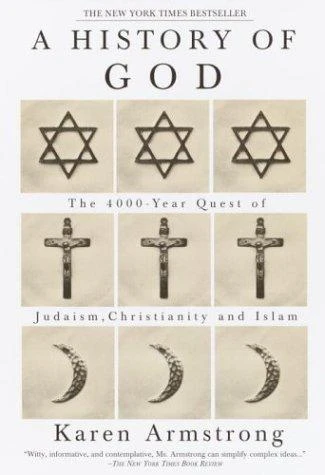
Book cover
A History of God
The 4,000-Year Quest of Judaism, Christianity and Islam
Karen Armstrong traces changing ideas and experiences of God across Judaism, Christianity, and Islam, beginning in the ancient Near East and continuing through classical philosophy, medieval mysticism, the Reformation, the Enlightenment, modern atheism, and twentieth-century theology. Rather than attempting to prove or disprove God’s existence, the book examines how communities repeatedly reformulated the divine in response to intellectual, political, and spiritual change.
About this book
A History of God is a comparative intellectual history of monotheism. Karen Armstrong follows the development of Jewish, Christian, and Islamic conceptions of God while emphasizing that none of the three traditions has possessed a single, unchanging theology. Biblical authors, church councils, Muslim philosophers, Jewish thinkers, Christian theologians, mystics, reformers, scientists, and skeptics all contribute to the story.
The book is organized both chronologically and thematically. Its chapters move from ancient Israelite religion and the emergence of monotheism to Christianity’s doctrines of incarnation and Trinity, Islam’s affirmation of divine unity, philosophical attempts to reason about God, mystical traditions that stress divine unknowability, Reformation conflicts, Enlightenment criticism, and modern declarations of the “death of God.” Armstrong’s central subject is therefore not God as an independently verifiable being, but the history of human language, thought, practice, and experience concerning God.
Its broad comparative perspective makes the book a useful introduction to relationships among the Abrahamic religions. At the same time, its enormous chronological and geographical scope requires compression. It is best approached as an interpretive map of religious history rather than as a substitute for specialized scholarship on ancient Israel, Christian doctrine, Islamic theology, Jewish philosophy, or modern secularism.
The book is organized both chronologically and thematically. Its chapters move from ancient Israelite religion and the emergence of monotheism to Christianity’s doctrines of incarnation and Trinity, Islam’s affirmation of divine unity, philosophical attempts to reason about God, mystical traditions that stress divine unknowability, Reformation conflicts, Enlightenment criticism, and modern declarations of the “death of God.” Armstrong’s central subject is therefore not God as an independently verifiable being, but the history of human language, thought, practice, and experience concerning God.
Its broad comparative perspective makes the book a useful introduction to relationships among the Abrahamic religions. At the same time, its enormous chronological and geographical scope requires compression. It is best approached as an interpretive map of religious history rather than as a substitute for specialized scholarship on ancient Israel, Christian doctrine, Islamic theology, Jewish philosophy, or modern secularism.
From Ancient Israel to the Modern “Death of God”
Armstrong begins in the religious world of the ancient Near East, where Israelite ideas about Yahweh developed amid cultures that recognized many divine beings. She presents monotheism as the outcome of a long historical transformation rather than a complete system appearing at a single moment. Prophetic religion, exile, scripture, ritual, and changing political circumstances all contribute to the emergence of a universal God associated with ethical demands.
The narrative then turns to Christianity. Jesus of Nazareth, the apostle Paul, the Gospel writers, and the early church become part of a prolonged debate over how Christians could worship Jesus while retaining monotheism. The doctrines of incarnation and Trinity are treated as historically developed attempts to preserve both divine unity and the religious significance attributed to Christ. Figures such as Augustine of Hippo illustrate how Christian reflection absorbed and reshaped Greek philosophical ideas.
Islam enters the account through the Qur’an’s proclamation of divine unity and the prophetic mission of Muhammad. Armstrong places Islamic monotheism in conversation with Jewish and Christian traditions while stressing its distinctive understanding of revelation, worship, and community. Later disputes involving theology, philosophy, and mysticism show that Muslim thought, like Jewish and Christian thought, produced multiple approaches to divine transcendence and human reason.
The later chapters reorganize the comparison around shared intellectual forms. Philosophers in all three religions use inherited Greek concepts to discuss God; mystics explore forms of experience that resist ordinary language; reformers challenge established religious authority; and Enlightenment thinkers subject revelation and doctrine to new standards of evidence. The final chapters consider atheism, secularization, modern theology, and whether inherited images of God remain spiritually or intellectually viable.
The narrative then turns to Christianity. Jesus of Nazareth, the apostle Paul, the Gospel writers, and the early church become part of a prolonged debate over how Christians could worship Jesus while retaining monotheism. The doctrines of incarnation and Trinity are treated as historically developed attempts to preserve both divine unity and the religious significance attributed to Christ. Figures such as Augustine of Hippo illustrate how Christian reflection absorbed and reshaped Greek philosophical ideas.
Islam enters the account through the Qur’an’s proclamation of divine unity and the prophetic mission of Muhammad. Armstrong places Islamic monotheism in conversation with Jewish and Christian traditions while stressing its distinctive understanding of revelation, worship, and community. Later disputes involving theology, philosophy, and mysticism show that Muslim thought, like Jewish and Christian thought, produced multiple approaches to divine transcendence and human reason.
The later chapters reorganize the comparison around shared intellectual forms. Philosophers in all three religions use inherited Greek concepts to discuss God; mystics explore forms of experience that resist ordinary language; reformers challenge established religious authority; and Enlightenment thinkers subject revelation and doctrine to new standards of evidence. The final chapters consider atheism, secularization, modern theology, and whether inherited images of God remain spiritually or intellectually viable.
Monotheism as a Changing Historical Tradition
A major theme is that monotheism has never been intellectually static. Communities preserve scriptures and rituals while interpreting them through new philosophical languages, political circumstances, and spiritual needs. Judaism, Christianity, and Islam consequently contain internal disagreements about divine personality, transcendence, justice, mercy, revelation, and human knowledge.
A second theme is the tension between speaking about God and recognizing the limits of religious language. Philosophers seek coherent definitions and arguments, while mystics frequently insist that ultimate reality exceeds concepts. Armstrong gives particular attention to apophatic or negative theology—the practice of approaching God by stating what cannot adequately be said about the divine.
The book also examines relationships among religion, power, and social order. Conceptions of God can legitimate institutions and hierarchies, but prophetic, reforming, and mystical movements can also criticize established authority. Religious ideas emerge here through interaction with history rather than in isolation from it.
Finally, the book repeatedly presents Judaism, Christianity, and Islam as interconnected traditions. They share people, narratives, philosophical sources, and theological problems, yet they develop these inheritances in different ways. Comparison reveals both their kinship and the danger of treating “the monotheistic tradition” as uniform.
A second theme is the tension between speaking about God and recognizing the limits of religious language. Philosophers seek coherent definitions and arguments, while mystics frequently insist that ultimate reality exceeds concepts. Armstrong gives particular attention to apophatic or negative theology—the practice of approaching God by stating what cannot adequately be said about the divine.
The book also examines relationships among religion, power, and social order. Conceptions of God can legitimate institutions and hierarchies, but prophetic, reforming, and mystical movements can also criticize established authority. Religious ideas emerge here through interaction with history rather than in isolation from it.
Finally, the book repeatedly presents Judaism, Christianity, and Islam as interconnected traditions. They share people, narratives, philosophical sources, and theological problems, yet they develop these inheritances in different ways. Comparison reveals both their kinship and the danger of treating “the monotheistic tradition” as uniform.
A Comparative History Published at the End of the Twentieth Century
First published in 1993, A History of God appeared in an intellectual climate shaped by secularization debates, renewed public attention to religious identity, and growing interest in comparative approaches to Judaism, Christianity, and Islam. Armstrong’s synthesis challenged accounts that treated the three religions as isolated civilizations or reduced their histories to fixed creeds.
The book’s broad arc extends from the ancient Near East through late antiquity, the medieval Jewish, Christian, and Islamic worlds, the Protestant Reformation, the Scientific Revolution, the Enlightenment, and modern European philosophy. Among the historical developments essential to its account are the Babylonian exile, the emergence of Christianity from a Jewish setting, the formation of Christian orthodoxy through doctrinal controversy, the rise of Islam in seventh-century Arabia, the translation and reception of Greek philosophy, and the intellectual disruptions associated with modern science and secularism.
Because scholarship in biblical studies, archaeology, late antiquity, Islamic studies, and religious history has continued to develop since the early 1990s, readers should distinguish Armstrong’s enduring comparative questions from individual historical interpretations that may require consultation with more recent specialized research.
The book’s broad arc extends from the ancient Near East through late antiquity, the medieval Jewish, Christian, and Islamic worlds, the Protestant Reformation, the Scientific Revolution, the Enlightenment, and modern European philosophy. Among the historical developments essential to its account are the Babylonian exile, the emergence of Christianity from a Jewish setting, the formation of Christian orthodoxy through doctrinal controversy, the rise of Islam in seventh-century Arabia, the translation and reception of Greek philosophy, and the intellectual disruptions associated with modern science and secularism.
Because scholarship in biblical studies, archaeology, late antiquity, Islamic studies, and religious history has continued to develop since the early 1990s, readers should distinguish Armstrong’s enduring comparative questions from individual historical interpretations that may require consultation with more recent specialized research.
Who Will Benefit Most from A History of God
The book is well suited to general readers seeking an ambitious introduction to the intellectual history of Judaism, Christianity, and Islam. It may be especially useful to readers interested in comparative religion, theology, philosophy of religion, interfaith relations, mysticism, secularization, or the history of ideas.
Believers may find that the book expands their understanding of how their own tradition changed over time and interacted with others. Agnostic and atheist readers may value its historical approach because it does not require religious commitment. Students can use it as an orientation to major periods, debates, and thinkers before moving to more specialized works.
Readers looking for a devotional defense of faith, a systematic proof or refutation of God, or a comprehensive social history of religious communities may find it less suitable. Its principal concern is the evolution of ideas and experiences associated with God.
Believers may find that the book expands their understanding of how their own tradition changed over time and interacted with others. Agnostic and atheist readers may value its historical approach because it does not require religious commitment. Students can use it as an orientation to major periods, debates, and thinkers before moving to more specialized works.
Readers looking for a devotional defense of faith, a systematic proof or refutation of God, or a comprehensive social history of religious communities may find it less suitable. Its principal concern is the evolution of ideas and experiences associated with God.
A Long but Accessible Work of Intellectual History
Armstrong writes for nonspecialists, but the subject is demanding. The narrative covers thousands of years and introduces a large number of scriptures, theologians, philosophers, mystics, movements, and doctrinal disputes. Readers must frequently shift among Jewish, Christian, Islamic, Greek, and modern European contexts.
Terms such as monotheism, transcendence, incarnation, Trinity, Neoplatonism, kalam, falsafa, Sufism, Kabbalah, deism, pantheism, and atheism are central to the discussion. The book provides explanatory context and includes a glossary, yet readers unfamiliar with religious studies may need to pause and review names or concepts.
The thematic chapters on philosophers and mystics can be more conceptually difficult than the narrative accounts of religious origins and reform. Reading chapter by chapter, with brief notes on major figures and recurring concepts, is likely to be more productive than treating the book as a fast chronological survey.
Terms such as monotheism, transcendence, incarnation, Trinity, Neoplatonism, kalam, falsafa, Sufism, Kabbalah, deism, pantheism, and atheism are central to the discussion. The book provides explanatory context and includes a glossary, yet readers unfamiliar with religious studies may need to pause and review names or concepts.
The thematic chapters on philosophers and mystics can be more conceptually difficult than the narrative accounts of religious origins and reform. Reading chapter by chapter, with brief notes on major figures and recurring concepts, is likely to be more productive than treating the book as a fast chronological survey.
Helpful Preparation in Scripture, Philosophy, and Religious History
No formal theological training is required. Basic familiarity with the Hebrew Bible, the New Testament, and the Qur’an will nevertheless make the comparisons easier to follow. Readers will also benefit from knowing that these collections were formed, interpreted, and transmitted over long historical periods.
A simple timeline of the ancient Near East, classical Greece, the Roman Empire, late antiquity, the early Islamic caliphates, medieval Europe, the Reformation, and the Enlightenment can prevent the many transitions from becoming disorienting. Introductory knowledge of Plato and Aristotle is particularly useful because later Jewish, Christian, and Muslim thinkers repeatedly adapted Greek philosophical vocabulary.
It is also helpful to begin with a distinction between theology and religious history. Armstrong investigates what people have said and experienced concerning God and why particular formulations became meaningful. Historical explanation does not by itself decide whether those beliefs are true.
A simple timeline of the ancient Near East, classical Greece, the Roman Empire, late antiquity, the early Islamic caliphates, medieval Europe, the Reformation, and the Enlightenment can prevent the many transitions from becoming disorienting. Introductory knowledge of Plato and Aristotle is particularly useful because later Jewish, Christian, and Muslim thinkers repeatedly adapted Greek philosophical vocabulary.
It is also helpful to begin with a distinction between theology and religious history. Armstrong investigates what people have said and experienced concerning God and why particular formulations became meaningful. Historical explanation does not by itself decide whether those beliefs are true.
Why Read This Comparative History of Judaism, Christianity, and Islam
The book offers a single narrative in which readers can compare three major monotheistic religions without reducing them to a list of doctrines. It shows how shared questions—whether God can be described, how revelation relates to reason, why suffering exists, and whether divine unity permits mediation—receive different answers across periods and communities.
Its treatment of philosophers and mystics is particularly valuable for readers whose idea of religion is limited to literal belief or institutional doctrine. The book introduces traditions in which disciplined practice, symbolic interpretation, contemplation, and acknowledgment of uncertainty are central.
A History of God also provides historical perspective on contemporary disputes. It demonstrates that arguments over scriptural interpretation, science, reform, atheism, and religious identity have long and complicated genealogies. That perspective can make current positions appear less timeless and inevitable.
Its treatment of philosophers and mystics is particularly valuable for readers whose idea of religion is limited to literal belief or institutional doctrine. The book introduces traditions in which disciplined practice, symbolic interpretation, contemplation, and acknowledgment of uncertainty are central.
A History of God also provides historical perspective on contemporary disputes. It demonstrates that arguments over scriptural interpretation, science, reform, atheism, and religious identity have long and complicated genealogies. That perspective can make current positions appear less timeless and inevitable.
What Readers May Understand Differently Afterward
A careful reader may leave with a stronger understanding that “God” has not meant precisely the same thing to every monotheist. The personal God of biblical narrative, the metaphysical first principle of philosophers, the triune God of Christian theology, the uncompromising divine unity emphasized in Islam, and the ineffable reality approached by mystics overlap without being identical.
Readers may also recognize that religious traditions develop through interpretation. Councils, schools, commentators, philosophers, reformers, and devotional communities do not merely repeat an original message; they decide how inherited sources should address new circumstances.
The comparison encourages attention to internal diversity. Judaism, Christianity, and Islam each contain rationalist, traditionalist, mystical, legal, philosophical, and reforming tendencies. Disagreement within a religion can be as historically important as disagreement between religions.
Finally, the book invites readers to ask whether a religious symbol remains meaningful when the worldview that once supported it changes. Armstrong treats this as an open historical and existential question rather than one with a simple universal answer.
Readers may also recognize that religious traditions develop through interpretation. Councils, schools, commentators, philosophers, reformers, and devotional communities do not merely repeat an original message; they decide how inherited sources should address new circumstances.
The comparison encourages attention to internal diversity. Judaism, Christianity, and Islam each contain rationalist, traditionalist, mystical, legal, philosophical, and reforming tendencies. Disagreement within a religion can be as historically important as disagreement between religions.
Finally, the book invites readers to ask whether a religious symbol remains meaningful when the worldview that once supported it changes. Armstrong treats this as an open historical and existential question rather than one with a simple universal answer.
The Strength of Armstrong’s Cross-Traditional Synthesis
The book’s principal strength is its comparative scale. Armstrong places ancient Israelite religion, Christian doctrinal development, Islamic theology, medieval philosophy, mysticism, Reformation conflict, Enlightenment criticism, and modern unbelief within one sustained inquiry. This structure helps readers see relationships that narrower histories may leave implicit.
Another strength is the attention paid to religious experience and language alongside formal doctrine. Philosophical proofs, scriptural interpretation, ritual practice, mystical silence, political authority, and personal longing all influence how God is imagined and discussed.
The organization also gives readers useful intellectual pathways. Chapters devoted to the God of philosophers, mystics, and reformers permit comparisons across religious boundaries. The result is an effective starting map for further reading, especially when readers use its notes, glossary, and bibliography to pursue individual thinkers or traditions.
Another strength is the attention paid to religious experience and language alongside formal doctrine. Philosophical proofs, scriptural interpretation, ritual practice, mystical silence, political authority, and personal longing all influence how God is imagined and discussed.
The organization also gives readers useful intellectual pathways. Chapters devoted to the God of philosophers, mystics, and reformers permit comparisons across religious boundaries. The result is an effective starting map for further reading, especially when readers use its notes, glossary, and bibliography to pursue individual thinkers or traditions.
Scope, Compression, and Interpretive Cautions
No single-volume account can represent four millennia of Jewish, Christian, and Islamic history evenly. Armstrong necessarily selects certain writers, controversies, and movements while compressing or omitting others. Readers should not treat the narrative as a complete history of any one religion.
The emphasis falls heavily on theological and intellectual development. Local religious practice, material culture, economic life, ordinary worshippers, and regional diversity receive less sustained attention than influential texts and thinkers. The book’s subject is also more accurately the history of conceptions of God than a general history of world religion; traditions outside Judaism, Christianity, and Islam appear mainly when they illuminate the central monotheistic story.
Some historical and theological interpretations have been contested, and the work predates more than three decades of subsequent scholarship. Readers conducting academic research should compare its synthesis with current specialist studies, especially on ancient Israelite religion, early Christianity, Islamic intellectual history, gender, and the relationship between monotheism and earlier polytheistic cultures.
The emphasis falls heavily on theological and intellectual development. Local religious practice, material culture, economic life, ordinary worshippers, and regional diversity receive less sustained attention than influential texts and thinkers. The book’s subject is also more accurately the history of conceptions of God than a general history of world religion; traditions outside Judaism, Christianity, and Islam appear mainly when they illuminate the central monotheistic story.
Some historical and theological interpretations have been contested, and the work predates more than three decades of subsequent scholarship. Readers conducting academic research should compare its synthesis with current specialist studies, especially on ancient Israelite religion, early Christianity, Islamic intellectual history, gender, and the relationship between monotheism and earlier polytheistic cultures.
Key People, Movements, and Concepts in Armstrong’s Account
**Yahweh and ancient Israelite religion:** Armstrong treats the God of Israel as emerging within the wider religious environment of the ancient Near East. The transition from devotion to a national deity toward universal monotheism is one of the book’s foundational historical developments.
**The biblical prophets and the Babylonian exile:** Prophetic demands for justice and the experience of exile contribute to changing understandings of divine power, covenant, judgment, and universality.
**Jesus of Nazareth, Paul, and the Trinity:** The Christian chapters examine how interpretations of Jesus produced debates about incarnation and divine identity. The doctrine of the Trinity developed as Christians attempted to relate Father, Son, and Holy Spirit without abandoning monotheism.
**Muhammad, the Qur’an, and tawhid:** Islam’s doctrine of divine unity, commonly expressed through the concept of tawhid, stands at the center of Armstrong’s account of Muslim belief. Muhammad’s prophetic mission is placed in relation to earlier Abrahamic traditions while retaining its distinct Arabian and Qur’anic setting.
**Plato, Aristotle, and Neoplatonism:** Greek philosophy supplied concepts used by Jewish, Christian, and Muslim thinkers to discuss causation, divine simplicity, creation, intellect, and the highest reality. These borrowed frameworks could clarify doctrine but could also make the philosophers’ God seem remote from scripture and worship.
**Kalam and falsafa:** Islamic theologians and philosophers debated revelation, reason, divine attributes, creation, and human freedom. These debates also affected later Jewish and Christian intellectual life through translation and cross-cultural exchange.
**Moses Maimonides:** The Jewish philosopher exemplifies rigorous reflection on divine unity and the limits of positive statements about God. His work connects Aristotelian philosophy, Jewish scripture, and negative theology.
**Sufism, Kabbalah, and Christian mysticism:** Mystical traditions seek transformative knowledge or experience while frequently warning that God exceeds literal description. Armstrong uses them to compare symbolic, contemplative, and apophatic approaches across the three religions.
**The Protestant Reformation:** Martin Luther and John Calvin represent challenges to established authority and major reformulations of scripture, faith, salvation, and divine sovereignty. Their movements also contributed to the fragmentation of Western Christianity.
**The Enlightenment and deism:** New confidence in reason, natural law, and scientific explanation encouraged some thinkers to replace the scriptural God with a rational creator and others to reject traditional theism altogether.
**The “death of God”:** Associated with modern philosophical and cultural criticism, this phrase concerns the declining plausibility or authority of inherited conceptions of God. Armstrong asks whether older images can be revised, replaced, or recovered through less literal forms of religious understanding.
**The biblical prophets and the Babylonian exile:** Prophetic demands for justice and the experience of exile contribute to changing understandings of divine power, covenant, judgment, and universality.
**Jesus of Nazareth, Paul, and the Trinity:** The Christian chapters examine how interpretations of Jesus produced debates about incarnation and divine identity. The doctrine of the Trinity developed as Christians attempted to relate Father, Son, and Holy Spirit without abandoning monotheism.
**Muhammad, the Qur’an, and tawhid:** Islam’s doctrine of divine unity, commonly expressed through the concept of tawhid, stands at the center of Armstrong’s account of Muslim belief. Muhammad’s prophetic mission is placed in relation to earlier Abrahamic traditions while retaining its distinct Arabian and Qur’anic setting.
**Plato, Aristotle, and Neoplatonism:** Greek philosophy supplied concepts used by Jewish, Christian, and Muslim thinkers to discuss causation, divine simplicity, creation, intellect, and the highest reality. These borrowed frameworks could clarify doctrine but could also make the philosophers’ God seem remote from scripture and worship.
**Kalam and falsafa:** Islamic theologians and philosophers debated revelation, reason, divine attributes, creation, and human freedom. These debates also affected later Jewish and Christian intellectual life through translation and cross-cultural exchange.
**Moses Maimonides:** The Jewish philosopher exemplifies rigorous reflection on divine unity and the limits of positive statements about God. His work connects Aristotelian philosophy, Jewish scripture, and negative theology.
**Sufism, Kabbalah, and Christian mysticism:** Mystical traditions seek transformative knowledge or experience while frequently warning that God exceeds literal description. Armstrong uses them to compare symbolic, contemplative, and apophatic approaches across the three religions.
**The Protestant Reformation:** Martin Luther and John Calvin represent challenges to established authority and major reformulations of scripture, faith, salvation, and divine sovereignty. Their movements also contributed to the fragmentation of Western Christianity.
**The Enlightenment and deism:** New confidence in reason, natural law, and scientific explanation encouraged some thinkers to replace the scriptural God with a rational creator and others to reject traditional theism altogether.
**The “death of God”:** Associated with modern philosophical and cultural criticism, this phrase concerns the declining plausibility or authority of inherited conceptions of God. Armstrong asks whether older images can be revised, replaced, or recovered through less literal forms of religious understanding.
Questions About God, History, and Human Interpretation
The book explores whether monotheism arose suddenly or developed gradually from older religious worlds. It asks how political crisis, exile, empire, philosophical exchange, and scientific change affected what communities believed about God.
Why did Christianity develop the doctrines of incarnation and Trinity, and how did Christians understand those doctrines as compatible with one God? How does Islam’s insistence on divine unity respond to the Jewish and Christian traditions that preceded it? What happens when philosophers describe God through abstract metaphysics while scriptures speak through narrative, law, poetry, and symbol?
Armstrong also investigates why mystics so often distrust ordinary religious language. Can silence, paradox, ritual, or contemplation express the divine more responsibly than literal propositions? Do reform movements recover earlier faith, or do they create new forms of religion under historical pressure?
The closing question is whether the idea of God has a future. If inherited images lose credibility, must belief disappear, or can religious language be transformed again as it has been repeatedly in the past?
Why did Christianity develop the doctrines of incarnation and Trinity, and how did Christians understand those doctrines as compatible with one God? How does Islam’s insistence on divine unity respond to the Jewish and Christian traditions that preceded it? What happens when philosophers describe God through abstract metaphysics while scriptures speak through narrative, law, poetry, and symbol?
Armstrong also investigates why mystics so often distrust ordinary religious language. Can silence, paradox, ritual, or contemplation express the divine more responsibly than literal propositions? Do reform movements recover earlier faith, or do they create new forms of religion under historical pressure?
The closing question is whether the idea of God has a future. If inherited images lose credibility, must belief disappear, or can religious language be transformed again as it has been repeatedly in the past?
How to Discuss A History of God in a Reading Group
Because the book covers an unusually long period, groups may benefit from dividing it into four conversations: ancient Israel and the rise of monotheism; Christianity and Islam; philosophers and mystics; and reform, Enlightenment, atheism, and the future of God.
At each meeting, identify one conception of God that differs from familiar modern assumptions. Discuss the historical conditions that made it persuasive and compare it with an approach from another religion. A shared timeline and a running list of terms—such as Trinity, tawhid, Neoplatonism, negative theology, mysticism, deism, and secularization—can help participants follow recurring ideas.
Groups should distinguish three kinds of response: what Armstrong reports historically, how she interprets the evidence, and whether participants find that interpretation persuasive. Readers from different religious or nonreligious backgrounds can contribute personal perspectives, but the discussion should avoid treating any participant as a representative of an entire tradition.
At each meeting, identify one conception of God that differs from familiar modern assumptions. Discuss the historical conditions that made it persuasive and compare it with an approach from another religion. A shared timeline and a running list of terms—such as Trinity, tawhid, Neoplatonism, negative theology, mysticism, deism, and secularization—can help participants follow recurring ideas.
Groups should distinguish three kinds of response: what Armstrong reports historically, how she interprets the evidence, and whether participants find that interpretation persuasive. Readers from different religious or nonreligious backgrounds can contribute personal perspectives, but the discussion should avoid treating any participant as a representative of an entire tradition.
Discussion Questions for A History of God
1. How does the book change the meaning of the word “monotheism”? Does Armstrong present it as a belief, a practice, a historical achievement, or some combination of these?
2. Which historical crisis appears to have had the greatest effect on a community’s conception of God, and why?
3. Does comparing Judaism, Christianity, and Islam clarify their relationships, or does a single narrative risk minimizing important differences?
4. How do the God of scripture and the God of the philosophers differ? Can those conceptions be reconciled?
5. Why do mystical writers in multiple traditions emphasize the inadequacy of language? Is negative theology intellectually satisfying?
6. How does the Christian doctrine of the Trinity illustrate the interaction between worship, scripture, philosophy, and institutional authority?
7. What role does tawhid play in distinguishing Islamic theology while connecting Islam to the broader monotheistic tradition?
8. Do reformers restore an earlier religion, or do they inevitably produce something new?
9. How did the Scientific Revolution and the Enlightenment alter the questions people asked about God?
10. Is atheism in the book primarily a rejection of all possible ideas of God or of particular historically formed ideas?
11. Where does Armstrong’s emphasis on major thinkers leave ordinary believers, local practices, and popular religion?
12. After reading the final chapter, what qualities would a conception of God need to remain meaningful in the modern world?
2. Which historical crisis appears to have had the greatest effect on a community’s conception of God, and why?
3. Does comparing Judaism, Christianity, and Islam clarify their relationships, or does a single narrative risk minimizing important differences?
4. How do the God of scripture and the God of the philosophers differ? Can those conceptions be reconciled?
5. Why do mystical writers in multiple traditions emphasize the inadequacy of language? Is negative theology intellectually satisfying?
6. How does the Christian doctrine of the Trinity illustrate the interaction between worship, scripture, philosophy, and institutional authority?
7. What role does tawhid play in distinguishing Islamic theology while connecting Islam to the broader monotheistic tradition?
8. Do reformers restore an earlier religion, or do they inevitably produce something new?
9. How did the Scientific Revolution and the Enlightenment alter the questions people asked about God?
10. Is atheism in the book primarily a rejection of all possible ideas of God or of particular historically formed ideas?
11. Where does Armstrong’s emphasis on major thinkers leave ordinary believers, local practices, and popular religion?
12. After reading the final chapter, what qualities would a conception of God need to remain meaningful in the modern world?
Edition and Content Verification
The selected paperback edition was verified through the publisher’s bibliographic record and corroborated by a public-library catalog. The chapter structure was checked against library table-of-contents data, while the profile’s description of scope was informed by the publisher record, bibliographic sources, and contemporary critical responses. Interpretive assessments of strengths, difficulty, and limitations are editorial judgments based on the book’s documented structure and subject matter.
Comments
No published comments yet.
Available editions
Paperback
paperback
- ISBN-13
- 9780345384560
- Publication date
- Pages
- 496