
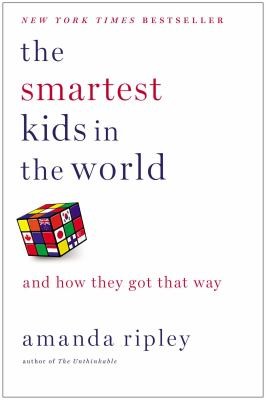
The Smartest Kids in the World
And How They Got That Way
Amanda Ripley investigates why students in some countries demonstrate stronger academic skills than their American counterparts—and what their schools, families, and societies do differently. Rather than treating education as a contest between abstract policy models, she follows three American exchange students attending schools in Finland, South Korea, and Poland. Their experiences reveal sharply contrasting systems: Finland emphasizes selective teacher preparation and professional autonomy; South Korea produces formidable results through an intensely competitive culture; and Poland illustrates how national reform can raise expectations within a relatively short period. Ripley connects these stories to international assessment data, interviews, classroom observations, and the experiences of foreign students in the United States. Her central concern is not intelligence in a narrow sense but whether schools expect young people to master demanding material. The result is an accessible w…
Where to buy or borrow
Are you selling this book? Bookstores, publishers, authors and libraries can be listed here for free. Request a listing
About this book
Deep Overview
To investigate, Ripley follows three American teenagers abroad. Kim leaves Oklahoma for Finland, attracted by the country’s academic reputation. Eric travels from Minnesota to South Korea, where he encounters an exhausting cycle of school, independent study, and private tutoring. Tom leaves Pennsylvania for Poland, a country whose schools had improved after reforms that raised common expectations and postponed the separation of students into different academic and vocational tracks. Ripley also draws on the reverse perspective of international students attending American schools, where they often notice comparatively easy work, generous grading, and the prominent social role assigned to athletics.
The contrasts among the three destination countries prevent the book from recommending a single classroom model. Finland’s system rests partly on highly selective teacher education, extensive professional preparation, and confidence in teachers’ judgment. Its atmosphere can appear relatively relaxed, but that informality coexists with demanding academic expectations. South Korea represents a more troubling route to high performance. Education is treated as essential to social advancement, but competition surrounding university admission contributes to long hours, fatigue, private tutoring, and severe pressure. The Korean example demonstrates that strong test results do not automatically create a healthy or humane educational culture.
Poland provides the book’s clearest case against fatalism. Its progress is connected to national reforms that established a more coherent curriculum, delayed early tracking, created a new middle-school stage, and asked more students to attempt challenging work. For Ripley, this history suggests that educational outcomes are not permanently fixed by culture or wealth.
Across these different cases, she identifies a shared commitment to academic seriousness. Students generally understand that school exists first to help them master difficult material. Teachers are expected to possess strong subject knowledge, and parents tend to communicate the importance of sustained effort. Ripley contrasts this orientation with American practices that can confuse encouragement, facilities, technology, extracurricular prestige, or self-esteem with learning itself. Her argument is not that the United States should reproduce another country’s system wholesale. It is that effective reform begins with a clear purpose: schools must treat students as capable of complex thought, recruit and prepare teachers accordingly, and align adult behavior with those expectations.
Key Themes
Teacher quality is another central concern. The Finnish example allows Ripley to examine what happens when entry into teacher preparation is selective and teaching is treated as intellectually demanding professional work. This contrasts with reform strategies that try to compensate after weak recruitment or preparation has already occurred.
The relationship between expectations and student identity recurs throughout the exchange-student narratives. Young people respond to the signals sent by adults, peers, grading systems, and institutions about what deserves effort. The book asks what students learn when academic achievement is secondary to athletics, social status, or superficial measures of confidence.
A further theme is the possibility of change. Poland’s experience supports Ripley’s argument that national education performance is not an immutable expression of culture. Policy design, curriculum, tracking, teacher preparation, and public consensus can alter what schools expect and accomplish.
Finally, the book explores the difference between achievement and well-being. South Korea complicates any simple celebration of test scores by revealing the personal costs that can accompany excessive competition.
Historical and Educational Context
Ripley’s three principal examples had distinct historical paths. Finland transformed teacher education and built a system that granted substantial responsibility to carefully prepared educators. South Korea’s education culture developed alongside rapid economic growth and fierce competition for access to prestigious universities and careers. Poland’s post-communist reforms reorganized secondary education, introduced common curricular expectations, and delayed the division of students into academic and vocational routes.
These histories matter because the book rejects the idea that national results are timeless products of ethnicity or culture. Its international data and policy discussions primarily reflect conditions before its 2013 publication. Subsequent reforms and assessment cycles may have changed particular rankings or practices, but the comparative questions about rigor, teacher preparation, student pressure, and institutional priorities remain relevant.
Intended Audience
It can also serve readers who want to question assumptions about educational spending, classroom technology, extracurricular activities, parental involvement, and teacher recruitment. Because the book compares multiple national systems without declaring any one of them perfect, it provides productive material for readers considering the tradeoffs among achievement, equity, autonomy, competition, and student well-being.
Those seeking a comprehensive academic treatment of comparative education may find the sample of countries and students too limited. The book is also not a step-by-step guide for choosing a school, teaching a particular subject, or raising an academically successful child.
Reading Difficulty
The principal challenge is interpretive rather than linguistic. Readers must distinguish between individual observations, broader national patterns, and conclusions drawn from assessment data. The alternation among personal stories, historical explanation, interviews, and policy arguments also requires attention to the kind of evidence being used at each point.
Helpful Background Knowledge
Readers may benefit from distinguishing equality from equity, recognizing academic tracking as the practice of directing students into different levels or educational pathways, and understanding that South Korean hagwons are privately operated tutoring academies. Familiarity with the broad differences between centralized national systems and decentralized school governance can make the comparisons more meaningful.
Why Read This Book?
The book is valuable because it places three very different high-performing or rapidly improving systems beside one another. Finland prevents the discussion from reducing rigor to relentless competition; South Korea prevents high scores from being mistaken for an unqualified social good; and Poland offers evidence that large systems can improve without waiting for generations of cultural change.
It also encourages skepticism toward attractive but incomplete solutions. More technology, smaller classes, higher spending, greater parental visibility, and stronger self-esteem may have benefits, but Ripley argues that they cannot substitute for capable teachers, coherent standards, demanding work, and a shared belief that students can learn difficult material.
Reader Takeaways
Readers may also reconsider parental involvement. Ripley’s discussion suggests that modeling intellectual curiosity and communicating serious expectations can matter more than visible participation in school activities alone. Another takeaway is that educational culture is created by institutions as well as inherited from society; policies can change incentives, professional standards, and beliefs about what students are capable of doing.
At the same time, South Korea’s example demonstrates the need to judge education by more than performance. Achievement should be considered alongside sleep, autonomy, motivation, mental strain, and the broader purposes of childhood.
Strengths
The selection of Finland, South Korea, and Poland creates a useful comparative design because their systems do not share one obvious formula. This allows Ripley to identify common commitments while acknowledging sharply different costs and methods. Her treatment of South Korea is especially important because it resists equating high academic performance with an ideal education system.
The book is also effective at challenging fixed cultural explanations. Poland’s reform history helps show that systems can change, while the foreign students’ reactions to American schools turn familiar practices into subjects of examination. The accessible narrative structure makes difficult policy questions available to a broad readership.
Limitations and Cautions
The book gives particular weight to PISA performance. These assessments can reveal meaningful differences in applied academic skills, but they do not measure every purpose of education, including civic development, creativity, emotional health, vocational competence, or the quality of student relationships.
The national comparisons also risk compressing internally diverse systems into recognizable models. Finland, South Korea, Poland, and the United States contain socioeconomic, geographic, linguistic, and institutional variation that cannot be fully covered in one narrative. Finally, because the book was published in 2013, its rankings, policy details, and descriptions of current practice should not automatically be treated as present-day conditions.
Important Concepts, People, Places, and Institutions
Kim, Eric, and Tom are the three American exchange students whose experiences organize much of the book. Kim attends school in Finland, Eric encounters South Korea’s intensely competitive system, and Tom studies in Poland during a period associated with significant educational improvement.
Finland represents a model built around selective teacher education, professional trust, broad expectations, and support for struggling students. Its importance lies in demonstrating that academic rigor need not resemble constant visible pressure.
South Korea illustrates both the power and danger of treating educational achievement as a primary route to social mobility. Its system raises questions about examinations, private spending, fatigue, and the human cost of competition.
Poland serves as the book’s major example of system-level change. Reforms to curriculum, school structure, teacher practice, and academic tracking support Ripley’s claim that national performance can improve.
The Programme for International Student Assessment, or PISA, is the international assessment framework Ripley uses to compare how fifteen-year-olds apply reading, mathematics, and science knowledge.
The Organisation for Economic Co-operation and Development administers PISA and supplies much of the comparative data behind the book’s central puzzle.
Hagwons are South Korean private tutoring academies. They matter because they reveal how much learning, competition, and family expenditure can occur outside the formal school day.
Academic tracking is the division of students into different educational levels or pathways. Poland’s decision to postpone such separation is presented as an important element of its reforms.
Rigor is the book’s central concept: the expectation that students will wrestle with challenging academic material, supported by adults who believe they are capable of mastering it.
Questions the Book Explores
What does academic rigor look like when it is separated from excessive homework or punitive pressure?
How does the selectivity and quality of teacher preparation affect classroom learning?
Can a country substantially improve its schools through policy reform, or are educational outcomes determined mainly by culture and wealth?
Which forms of parental involvement support learning, and which may have little relationship to academic growth?
Do spending, technology, facilities, and smaller classes produce better learning when expectations remain weak?
What can the United States learn from other countries without importing practices that depend on different institutions or impose unacceptable costs?
How should societies balance measurable academic achievement against student health, independence, creativity, and well-being?
Reading Group Guide
Track moments when an exchange student notices something that local students take for granted. These scenes are useful for discussing how outsiders expose hidden assumptions about grading, effort, athletics, teacher authority, and school purpose.
Consider separating the book’s evidence into four categories: international assessment data, historical or policy analysis, interviews, and personal observation. Discuss where these forms of evidence reinforce one another and where the argument depends heavily on interpretation.
Give special attention to the tension between Finland and South Korea. Both are used to discuss strong academic performance, but they complicate any claim that there is one necessary relationship among rigor, time spent studying, competition, and well-being.
Finally, invite participants to name practices in their own schools or communities that signal what adults genuinely value. Compare those signals with official statements about educational priorities.
Discussion Questions
2. Which of the three exchange-student narratives most strongly supports the book’s central argument? Which introduces the greatest complications?
3. What does Finland’s approach suggest about the relationship between selective teacher preparation and professional autonomy?
4. Does South Korea’s academic performance justify the personal and social costs described in the book? What alternative measures of success should be considered?
5. Why is Poland so important to Ripley’s rejection of educational fatalism?
6. How do grading practices communicate expectations to students, even when teachers do not state those expectations directly?
7. What does the book suggest American schools communicate through their investment in athletics, technology, and facilities?
8. Which conclusions are well supported by multiple kinds of evidence, and which rely most heavily on a few individual experiences?
9. How should readers account for developments in education policy and international assessment since the book appeared in 2013?
10. If a community accepted Ripley’s argument about rigor, what would it need to change first: teacher preparation, curriculum, assessment, parental behavior, school culture, or something else?
Sources and Verification
Comments
No published comments yet.
Available editions
Hardcover
hardcover
- Publisher
- Simon & Schuster
- ISBN-13
- 9781451654424
- Publication date
- Pages
- 320