
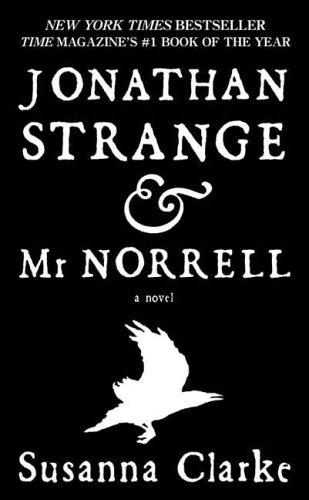
Jonathan Strange & Mr Norrell
In an alternative version of early nineteenth-century England, magic survives mainly as an antiquarian subject discussed by gentlemen who cannot perform it. That changes when the private, possessive Gilbert Norrell proves that practical magic still exists. Seeking respectability and political influence, he takes English magic to London and offers his services during the Napoleonic Wars. His rise depends, however, on a secret bargain with a dangerous fairy. Jonathan Strange soon emerges as a second practicing magician. More intuitive, sociable, and adventurous than Norrell, Strange becomes first his pupil and then his rival. Their dispute over how magic should be studied, controlled, and restored draws in the Duke of Wellington, Lord Byron, the legendary Raven King, and people trapped by enchantments the magicians do not fully understand. Susanna Clarke combines historical fantasy, social comedy, Gothic unease, and an invented scholarly record to examine authority, ambition, knowledge,…
Where to buy or borrow
Are you selling this book? Bookstores, publishers, authors and libraries can be listed here for free. Request a listing
About this book
The Return of English Magic During the Napoleonic Wars
Norrell moves to London, where political patronage offers a path to public legitimacy. His intervention in the death of Lady Emma Pole makes him famous, but the act creates obligations to a fairy known as the gentleman with the thistle-down hair. Norrell's desire to present magic as rational, patriotic, and socially respectable prevents him from acknowledging the full consequences of this bargain.
Jonathan Strange begins as an unfocused gentleman searching for a profession. His natural aptitude makes him Norrell's pupil, and his work with the Duke of Wellington carries practical magic into the Peninsular War and the wider conflict against Napoleon Bonaparte. Strange's experiences persuade him that Norrell's careful methods cannot explain the deepest sources of English magic.
Their eventual break becomes an intellectual and personal struggle over books, experimentation, the Raven King, and access to magical knowledge. Around that rivalry, Clarke develops equally important stories involving Arabella Strange, Lady Pole, Stephen Black, John Childermass, Vinculus, and the inhabitants of Faerie. These characters reveal costs and possibilities that the two celebrated magicians repeatedly fail to see.
Knowledge, Power, Englishness, and Enchantment
Control of information is also control of a profession. Norrell buys books, suppresses competing accounts, influences publications, and decides who may be called a magician. The novel therefore treats libraries, reviews, histories, and scholarly reputations as instruments of institutional power rather than neutral containers of truth.
Clarke's alternative England is haunted by what respectable society excludes. Fairy history, northern landscapes, oral traditions, servants, women under social constraint, and the legacy of the Raven King remain active even when elite authorities dismiss them. The return of magic becomes a return of repressed histories.
Enchantment frequently resembles captivity. Lady Pole and Stephen Black are compelled to participate in fairy society while appearing to continue their ordinary lives. Their experiences expose the limited perception of socially powerful men and connect supernatural domination with class, race, gender, and service.
The novel also questions national ownership. Characters repeatedly speak of English magic, but magic is tied to land, nonhuman powers, fairy kingdoms, and a medieval ruler whose authority does not fit modern political boundaries. England wants magic as a national asset even though magic resists becoming a manageable institution.
Regency Britain, Napoleon Bonaparte, and an Alternative National History
London society, publishing, patronage, country estates, and gentlemanly institutions are as important as the battlefield. Magic must be introduced through social networks and government offices, making its revival partly a struggle for recognition among political and cultural elites.
The novel's medieval counterhistory centers on John Uskglass, the Raven King, who is said to have ruled northern England and fairy territories for centuries. Although absent from conventional histories within the novel, his legacy survives in roads, trees, stories, prophecies, and forms of magic that cannot be reduced to modern scholarship.
Clarke also draws upon British fairy traditions in which fairies are neither tiny, benevolent creatures nor straightforward villains. They are powerful beings governed by alien desires and unstable conventions. This older, darker conception of Faerie gives the novel much of its beauty and menace.
Who Is Most Likely to Enjoy Jonathan Strange & Mr Norrell?
Readers drawn to Jane Austen's social observation, Charles Dickens's broad social canvases, Gothic fiction, or the darker traditions of fairy tales may recognize related techniques and atmospheres, though Clarke's novel has its own narrative voice and magical system.
It may be less suitable for readers who want a short adventure, a tightly compressed plot, a romance-centered fantasy, or a clearly explained rule-based system of magic. The book values mystery, digression, atmosphere, and unresolved historical depth.
An Expansive Novel with Period Prose and Substantial Footnotes
The prose imitates aspects of nineteenth-century narration without becoming a strict reproduction of Regency writing. Long sentences, formal dialogue, historical vocabulary, and shifts between irony and Gothic intensity require attention but are generally supported by clear storytelling.
The footnotes are an essential part of the reading experience. Some provide brief references to imaginary scholarship; others contain legends or self-contained narratives extending across much of a page. They can be read as they appear, although their interruptions are intentionally part of the novel's scholarly texture.
A reader does not need prior knowledge of the Napoleonic Wars, British folklore, or nineteenth-century literature, but familiarity with those subjects can deepen the comedy and historical contrasts.
Useful Preparation Before Entering Clarke's Magical England
It also helps to recognize the social importance of rank, property, reputation, patronage, and gentlemanly professions in Regency Britain. Norrell's wealth and Strange's social position allow them access that equally knowledgeable people might be denied.
Readers accustomed to modern portrayals of friendly or romantic fairies should expect something different. Clarke's Faerie belongs to a tradition of bargains, abductions, altered time, compulsions, and perilous hospitality. Beauty offers no guarantee of moral goodness.
No preparation is strictly necessary. The invented footnotes and historical explanations provide the information required to follow the central story.
Why Choose This Historical Fantasy?
The rivalry between Strange and Norrell gives intellectual disagreement dramatic force. Their arguments concern teaching, publication, experimentation, national service, and responsibility—not simply which magician possesses greater power.
The novel also rewards rereading. Early jokes, minor legends, prophecies, and apparently incidental characters acquire new significance as the story develops. Its central mystery expands rather than contracts the world, leaving the impression that the recorded events occupy only one part of a much longer magical history.
What Readers May Reconsider After the Novel
The story encourages skepticism toward attempts to make dangerous power respectable without confronting its consequences. Norrell wants official approval, while Strange wants discovery and freedom. Both ambitions can obscure the harm experienced by people with less social authority.
The novel also presents place as a form of memory. Roads, trees, cities, battlefields, and northern landscapes carry histories that human institutions have forgotten. Magic returns not merely because two men rediscover techniques, but because the country itself remains connected to an older order.
Major Editorial Strengths
Clarke balances several modes: comedy of manners, military adventure, Gothic horror, fairy tale, political satire, and scholarly parody. The shifts allow polite drawing rooms and bureaucratic conversations to coexist with images of profound supernatural danger.
The two title characters are convincing intellectual rivals because each possesses genuine insight as well as serious limitations. Norrell's caution is not entirely cowardice, and Strange's openness is not always wisdom. Their relationship can therefore support disagreement without collapsing into a simple contest between good and evil.
The supporting characters widen the moral field beyond the famous magicians. Lady Pole, Stephen Black, Arabella Strange, Childermass, and Vinculus reveal how magic affects people who do not control its public narrative.
Scope, Pacing, and Perspective
The narrative initially gives far more space and authority to privileged male magicians than to people harmed by their choices. The imbalance is thematically meaningful, but some readers may still wish that Lady Pole, Arabella Strange, and Stephen Black received more direct narrative interiority.
Race, slavery, and social hierarchy are materially present through Stephen Black's history and treatment. The novel critiques the inability of white English society to recognize him fully, but it approaches much of that critique through an ironic narrator and a fairy plot rather than sustained historical examination.
Readers who prefer fully codified magical systems may find Clarke's magic resistant to explanation. Its operation is associated with stories, landscape, relationships, and forgotten traditions, and many of its boundaries remain uncertain.
The Raven King, Faerie, and the Institutions of Magic
**Jonathan Strange:** Norrell's gifted pupil and eventual rival. His military work and experimental temperament lead him toward forms of magic that his teacher considers uncontrollable.
**John Uskglass, the Raven King:** A legendary magician and ruler associated with northern England and Faerie. He represents an older magical order grounded in landscape, prophecy, and relationships between human and nonhuman worlds.
**The gentleman with the thistle-down hair:** A powerful fairy whose elegant appearance and elaborate hospitality conceal possessiveness, cruelty, and an inability to understand human freedom.
**Stephen Black:** Sir Walter Pole's Black servant, whose unwanted connection to Faerie develops into one of the novel's most significant examinations of dignity, hierarchy, race, and overlooked power.
**Lady Emma Pole and Arabella Strange:** Women whose experiences reveal the consequences of bargains and experiments made by men. Their apparent silence is repeatedly misread by the society around them.
**John Childermass:** Norrell's capable man of business. His practical intelligence and ambiguous social position allow him to perceive aspects of English magic that fashionable gentlemen overlook.
**Vinculus:** A street magician and bearer of prophecy. He connects oral, bodily, and popular forms of knowledge with the supposedly more authoritative world of books.
**The King's Roads:** Magical routes associated with the Raven King. They embody an older geography beneath ordinary England and challenge the assumption that modern maps describe the whole country.
**The Learned Society of York Magicians:** An organization devoted to discussing the history of magic while denying that its members can practice it. The society introduces the novel's satire of expertise without experience.
The Central Questions Behind the Rivalry
Planning a Group Discussion of an 864-Page Novel
For the first discussion, compare the Learned Society of York Magicians with Norrell's private model of expertise. The second can focus on Strange's military career and the development of his conflict with Norrell. A third can examine the Raven King, Faerie, enchantment, and the experiences of Lady Pole, Stephen Black, and Arabella Strange. The final meeting can consider whether the novel resolves its major conflicts or deliberately opens a larger history.
Groups should agree in advance on spoiler boundaries. Several apparently minor legends and prophecies gain importance late in the book, so discussion of the footnotes can reveal more than first-time readers expect.
Discussion Questions
2. How does Jonathan Strange's experience of war change his understanding of what magic is for?
3. Do the footnotes strengthen the authority of the narrator, or teach readers to distrust supposedly authoritative histories?
4. How do Lady Pole and Stephen Black experience enchantment differently from the people who claim to help or protect them?
5. What does the gentleman with the thistle-down hair misunderstand about human beings, freedom, and affection?
6. Why is John Uskglass more powerful as an absence, legend, and disputed historical figure than he might be as a conventional character?
7. How does social class determine who is believed, heard, educated, or permitted to act?
8. Are Strange and Norrell genuine opposites, or do their ambitions make them more alike than either recognizes?
9. What is gained and lost when magic becomes useful to the British government during the Napoleonic Wars?
10. Does the novel ultimately favor books, lived experience, folklore, or some combination of all three as paths to knowledge?
11. How does the setting change when England is treated not simply as a nation but as a landscape containing forgotten roads, agreements, and sovereignties?
12. Which supporting character most effectively challenges the title characters' understanding of power?
Sources and Edition Verification
Comments
No published comments yet.
Available editions
Hardcover
20th-anniversary hardcover edition
- Publisher
- Bloomsbury Publishing
- ISBN-13
- 9781526681553
- Publication date
- Pages
- 864