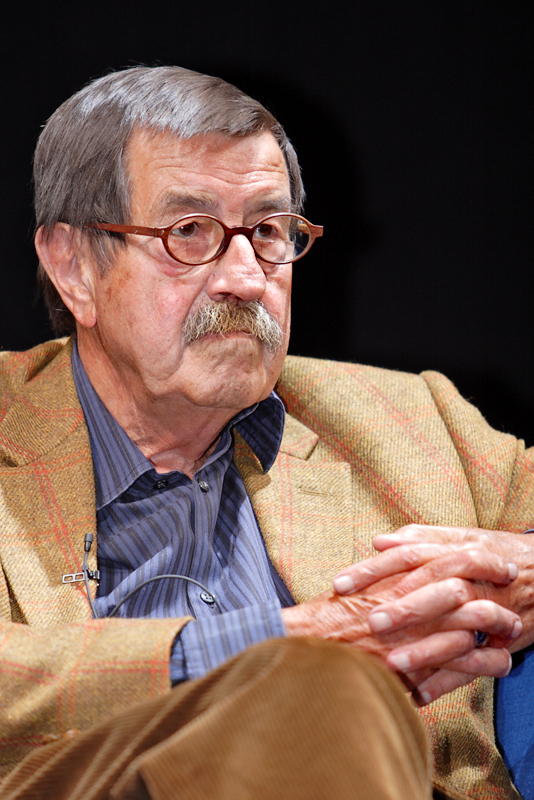
Photo of Günter Grass
Photo: Blaues Sofa from Berlin, Deutschland · CC BY 2.0 · via source

Author profile

Günter Grass

German novelist, poet, playwright and artist from Danzig, Nobel laureate of 1999. His first novel, The Tin Drum, turned Nazi-era and postwar Germany into a grotesque, darkly funny fable.

1 published book 0 published articles

About Günter Grass

Günter Grass was born in 1927 in the Free City of Danzig, today's Gdańsk, and came of age under the Nazis. He joined the Hitler Youth, was drafted during the war, and was wounded and taken prisoner in 1945. Afterwards he trained as a sculptor and draughtsman, and he went on drawing and printmaking alongside his writing. He was also a committed supporter of the Social Democratic Party. He died in Lübeck in 2015.

His fiction mixes plain realism with fable, farce and the grotesque, and it keeps returning to German guilt, memory and the lost Danzig of his childhood. Several books were openly political: Local Anaesthetic protested the Vietnam War, The Flounder staged a long quarrel between the sexes, and The Rat imagined the end of humanity. In 2006 his memoir Peeling the Onion revealed that he had served in the Waffen-SS as a teenager. Some critics urged him to give back his Nobel Prize; others pointed to how long his books had confronted German guilt.

The Tin Drum (1959) was his first novel and the opening part of the Danzig Trilogy, followed by Cat and Mouse and Dog Years. He received the Georg Büchner Prize in 1965 and the Nobel Prize in Literature in 1999, cited for "frolicsome black fables" that portray the forgotten face of history. Volker Schlöndorff's 1979 film of The Tin Drum won both the Palme d'Or and the Oscar for Best Foreign Language Film.

Begin with The Tin Drum. Its narrator, Oskar Matzerath, decides as a small boy to stop growing and answers the adult world with a toy drum, telling his story from a psychiatric hospital in the early 1950s. If it grips you, Cat and Mouse and Dog Years complete the Danzig trilogy.

Published books

Author

The Tin Drum

The Tin Drum is Günter Grass's first novel, published in German in 1959 as Die Blechtrommel. It is narrated by Oskar Matzerath, who is confined to a mental institution at thirty and looks back on his life. As a child in the Free City of Danzig, Oskar decides on his third birthday to stop growing. He keeps a toy drum and has a voice that can shatter glass. Through his distorted view, the book follows a lower-middle-class family through the rise of Nazism, the Second World War and the uneasy West German recovery. It mixes historical fiction with grotesque comedy and fable. It is also one of the most discussed examples of translated fiction from postwar Europe, and it helped win Grass the Nobel Prize in Literature in 1999.

View book