
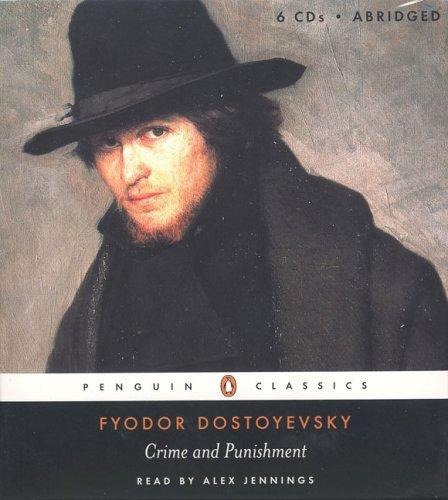
Crime and Punishment
Crime and Punishment follows Rodion Raskolnikov, an impoverished former student in 1860s St. Petersburg. He persuades himself that a murder can be justified by the good it might do, then finds that this argument cannot protect him from his own conscience. Dostoevsky turns what could have been a whodunit into a study of motive, guilt and the pressure an idea can put on one mind, set against urban poverty and family obligation. This edition is a shortened audio reading by the actor Alex Jennings, released by Penguin Audio. It runs a little over five hours and offers the core story and atmosphere of a landmark of Russian literature in a single listening project.
Where to buy or borrow
Are you selling this book? Bookstores, publishers, authors and libraries can be listed here for free. Request a listing
About this book
The book breaks from the detective tradition in one respect. The reader sees the crime early, so the central question is why Raskolnikov did it and what it does to him, not who did it. Dostoevsky wanted to examine the moral and psychological dangers of fashionable radical ideas, and he tests those ideas inside a character instead of arguing them in the abstract. The setting is a crowded, hot, impoverished St. Petersburg of rented corners, taverns, pawnshops and bridges.
The edition profiled here is a different kind of object from a full print text. It is an abridged recording on six CDs, read by Alex Jennings, and library records link it to David McDuff's English translation. For anyone building a list of classic novels to read, it works as an introduction that foregrounds voice, tension and atmosphere. It cannot replace the full text, which has the digressions, side characters and slow-building pressure that abridgment compresses.
Deep Overview
What follows is less a chase than a series of encounters that press on his conscience from different sides. Marmeladov, a drunken clerk whose family is sinking into destitution, shows him poverty without philosophy. Marmeladov's daughter Sonya has been pushed into prostitution to feed her siblings, and she holds a faith that Raskolnikov finds both maddening and magnetic. His mother and sister arrive from the provinces, carrying their own sacrifices and a troubling engagement. His loyal friend Razumikhin offers warmth and common sense. The investigating magistrate Porfiry Petrovich plays a psychological game of cat and mouse with him. Svidrigailov, a wealthy and morally unmoored man, seems to show Raskolnikov what a life without limits might become.
Dostoevsky does not set up a simple debate between a bad theory and a good conscience. Raskolnikov's motives are tangled. He is moved by pity, vanity, resentment, hunger and an appetite for self-testing, and he cannot say which motive is the real one. The narration stays close to his fevers, hallucinations and sudden generosities, so the reader experiences his reasoning as something that both persuades and unsettles. Characters who speak for utilitarian calculation, rational egoism or religious humility are not mere mouthpieces. Each is placed in a concrete situation where the ideas cost something.
Structurally, the book alternates between claustrophobic interior scenes and public ones. Raskolnikov's room, a police office, a tavern and a street crowd give the novel its sense of a city as a pressure chamber. The epilogue relocates the story to a Siberian prison and offers a quieter, more contested resolution about suffering, confession and renewal. Readers disagree about how fully that ending earns its hope.
The abridged audio edition keeps this arc but shortens it. In a spoken performance, the novel's repeated rhythms of fever, argument and sudden confrontation come through as voice and pacing.
Key Themes
The seductions and dangers of ideas are a second theme. Dostoevsky shows how a clever, internally consistent theory can license cruelty when it is cut off from compassion. His treatment of the self-appointed "extraordinary man" is a study of vanity as much as of ethics.
Poverty and social pressure run through the whole story. Rent, debt, hunger, family sacrifice and the humiliations of the poor shape the characters' choices. The book does not treat Raskolnikov's idea as a purely abstract mistake, because it grows in a particular economic and social setting.
Suffering, confession and redemption are the moral center, especially in the figure of Sonya. Whether redemption must pass through suffering, and whether it can be shared with another person, are questions the novel presents as open.
The novel also looks at isolation and human connection. Raskolnikov's withdrawal from other people is part of the problem, and the characters who reach him do so through patience, stubborn attention or simple presence.
Historical Context
His own biography matters. He had been arrested in the late 1840s for involvement in a progressive discussion circle and sentenced to prison labor and exile in Siberia, a punishment that deeply marked his later work. When he came to write Crime and Punishment, he had known prison, debt and gambling trouble. He first proposed the project to the editor Mikhail Katkov of The Russian Messenger, and wrote it while also rushing to complete another commitment, The Gambler.
The story's storyline is also tied to the real St. Petersburg, with its crowded rented rooms, taverns and canal-side streets. Napoleon looms in the background as the era's model of the "great man" who bends rules. Britannica notes that utilitarian logic is among the motives drawn into Raskolnikov's decision. Dostoevsky's later novels, including The Idiot and The Brothers Karamazov, extend the argument. This one is often treated as the first of his major mature novels.
Intended Audience
It may be less suitable for anyone who wants every episode, secondary character and philosophical argument, for close textual study, or for classroom work that needs exact quotations and page references. Because the recording is abridged and on CD, it is also harder to search, annotate or cross-check than a print or digital text. Listeners who dislike dark, claustrophobic subject matter, including violence, poverty, illness and moral torment, should know what to expect.
Reading Difficulty
The abridgment, at roughly five hours and fifteen minutes across six discs, reduces the pace problem of a very long book but compresses its detail. Listeners should expect a dense, intense story rather than a light one. Pausing between discs and keeping a short list of characters nearby can help. The recording format does not provide footnotes, maps or the explanatory apparatus found in annotated print editions.
Helpful Background Knowledge
Some familiarity with Dostoevsky's life, especially his Siberian imprisonment and his interest in Christian ideas of suffering, is useful but not necessary. Listeners who plan to move on to the full novel can treat this recording as preparation and then compare what the abridgment keeps and leaves out.
Why Read This Book?
This audio edition adds a particular advantage: a single trained actor's voice carrying the book's nervous energy, its dialogues and its changes of mood. For listeners who have been intimidated by the printed length of nineteenth-century fiction, a shortened recording can be a reasonable way in. Those who want to know why the book has such a reputation among critics and general readers may find that even a condensed version conveys its pull.
Reader Takeaways
They may also notice how the novel uses secondary figures to test its central question, how its city setting shapes behavior, and how little the book relies on conventional detection. Those who go on to the full text may notice what the abridgment compresses, and what that says about the choices involved in adaptation.
Strengths
The audio edition has its own strengths. The performance by Alex Jennings, a respected English actor, gives distinct voices to the novel's argumentative scenes, and the runtime makes the story manageable. It offers a coherent narrative line from the crime to its aftermath for listeners who want the overall shape of the book.
Limitations and Cautions
The novel itself reflects a particular worldview. Dostoevsky was writing partly against radical and rationalist currents, and his treatment of them, and of Christian suffering as the route to renewal, is the author's perspective and has been debated by readers. The epilogue in particular divides opinion. The novel also contains violence, poverty, illness and depictions of exploitation that some listeners may find distressing. Female characters are often defined by sacrifice or victimhood, which some modern readers critique.
Important Concepts, People, and Places
The "extraordinary man" theory: Raskolnikov's idea that exceptional individuals may overstep ordinary moral limits. The novel tests it against what he actually experiences.
Napoleon: the model of the great man in Raskolnikov's mind and a symbol of power justified by results.
Sonya Marmeladova: a young woman driven to prostitution by family poverty, who becomes Raskolnikov's moral counterpart through her faith and compassion.
Semyon Marmeladov: Sonya's father, a drunken former clerk whose self-abasement shows the human cost of poverty.
Porfiry Petrovich: the investigating magistrate, who pursues Raskolnikov through psychological pressure rather than hard evidence.
Arkady Svidrigailov: a wealthy, amoral figure connected to Raskolnikov's sister Dunya, who offers a darker version of life without restraint.
Dmitri Razumikhin: Raskolnikov's loyal friend, who represents warmth, practicality and a distaste for ideological extremes.
Avdotya (Dunya) Raskolnikova and Pulcheria Alexandrovna: Raskolnikov's sister and mother, whose sacrifices and arrival intensify his guilt.
St. Petersburg: the city as setting, whose crowded rooms, bridges and taverns shape the novel's mood.
The Russian Messenger: the Moscow journal in which the novel appeared in monthly installments in 1866, under the editor Mikhail Katkov.
Siberia: the location of the epilogue, linking the book to Dostoevsky's own imprisonment and to ideas of punishment and renewal.
Questions the Book Explores
Reading Group Guide
Groups could track a single thread across the whole story, such as Raskolnikov's relationship with Sonya, his encounters with Porfiry Petrovich, or the role of money. Members who have read the full text can note scenes they missed. A short character list helps with Russian names. Content notes about violence, poverty and exploitation are worth sharing at the start. Since the epilogue invites disagreement, plan to leave generous time for it.
Discussion Questions
2. How does the story use Porfiry Petrovich to explore guilt differently from a conventional detective story?
3. Does Sonya function as a character in her own right, or mainly as a moral force for Raskolnikov? What does your answer depend on?
4. In what ways does poverty shape the actions of Raskolnikov, Marmeladov and Dunya?
5. Svidrigailov and Raskolnikov are in some ways alike. What does the comparison reveal?
6. How did hearing the novel read aloud affect your sense of Raskolnikov's mental state?
7. If you noticed what felt like gaps in this abridgment, which parts did you want more of, and why?
8. Is the ending convincing? What would a more or less hopeful ending have changed?
9. Is a work of this kind still meaningfully a crime story when the reader knows the culprit from the start?
Sources and Verification
Comments
No published comments yet.
Available editions
Audiobook
Abridged audio CD edition, read by Alex Jennings (6 discs, about 5 hours 15 minutes)
- Publisher
- Penguin Audio
- ISBN-13
- 9780143058144