
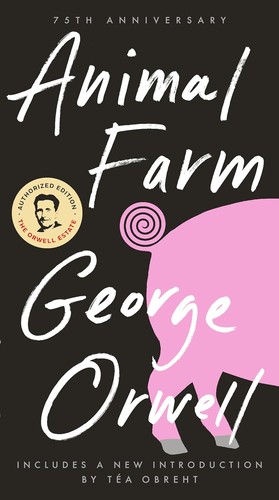
Animal Farm
Animal Farm is George Orwell's short political fable, first published in 1945, about farm animals who expel their human owner and try to run the place on principles of equality. Once the pigs take charge, commandments are quietly rewritten, rivals are driven out, and hardship returns under new management. Orwell drew on the Russian Revolution and Stalin's rise, yet he told the story so plainly that it also works as a study of how propaganda and unchecked power can turn ideals into their opposite. It is brief enough to read in an afternoon and is frequently assigned in schools. This Signet paperback adds an introduction by Téa Obreht and an afterword by Russell Baker, and it suits anyone who likes classic books or dystopian novels and wants a sharper, shorter satire.
Where to buy or borrow
Are you selling this book? Bookstores, publishers, authors and libraries can be listed here for free. Request a listing
About this book
Deep Overview
Orwell then shows how the arrangement erodes. The pigs, who can read and plan, appoint themselves supervisors. Snowball and Napoleon quarrel over the windmill project and over how to defend the farm, and Napoleon ends the dispute by using dogs he has secretly raised to chase Snowball away. From that point Snowball becomes a convenient scapegoat for every setback. Squealer, the pigs' spokesman, explains each change with statistics, threats of Jones's return and the claim that the animals' memories are mistaken. The commandments are altered one at a time, always after the fact, until the final slogan declares that some animals are more equal than others.
The book works because Orwell keeps the human cost visible. Boxer, the immensely strong cart-horse whose answer to every problem is to work harder, is the clearest case: his loyalty is exploited, and the farm's leaders reward it with betrayal. Clover, Benjamin the donkey and the sheep show other responses to power, including doubt without action, cynicism, and unthinking repetition. Public confessions and executions, forced labour on the windmill, and trade and diplomacy with neighbouring human farmers fill out a picture of a state that has copied the methods of the regime it replaced.
The allegory maps onto the Soviet experience without being a strict one-to-one code. Old Major recalls the founding thinkers of socialism, Napoleon stands in for Joseph Stalin, Snowball for Leon Trotsky, and Squealer for state propaganda. The rival farmers Pilkington and Frederick evoke the pressures and deals of European diplomacy, and the closing scene of pigs and men sharing a table echoes the uneasy wartime alliances of the 1940s. Orwell's larger aim is to show that a revolution can be betrayed from within, and that language, memory and literacy are the tools by which that betrayal is made acceptable.
In this Signet edition the novella is framed by commentary from Téa Obreht and Russell Baker, which can help new readers place the book's reception, but the core experience is the short fable itself.
Key Themes
Language as an instrument of control: slogans, songs, revised commandments and Squealer's reassurances show how repetition and redefinition can replace argument. Whoever controls the wording of the rules controls what the rules mean.
Manipulated memory and history: the animals cannot check the past, because records are rewritten and the literate few decide what happened. The book links political power to control of the record.
Class, labour and exploitation: the animals' complaint against Jones is economic, and the new regime reproduces the same extraction under a different name. Boxer's fate puts the human cost of that continuity in a single character.
Fear, scapegoating and violence: invented enemies and public punishments hold the community together, and they discourage dissent.
Complicity and passivity: the book does not blame only the pigs. Ignorance, deference and tired acceptance on the part of the other animals make the takeover easier, which is why readers can see themselves in the flock as well as in the leaders.
Historical Context
Orwell's own experience shaped his stance. He had served with the Imperial Police in Burma, and he fought with Republican forces during the Spanish Civil War, where he saw leftist factions suppressed from within. He described himself as a socialist and wrote the fable as an argument against totalitarianism, not against equality.
The timing created publishing trouble. By 1943 the Soviet Union was a wartime ally of Britain against Nazi Germany, and a satire of its regime made many editors uneasy. Orwell's own account, in a proposed preface later published as "The Freedom of the Press", says that four publishers refused the manuscript and that only one had a plainly ideological reason. Secker and Warburg finally issued the book in August 1945, and it became a commercial success as the wartime alliance gave way to the Cold War. That later context also meant the book was quickly used by many sides in debates that Orwell had not necessarily intended, so readers should keep both the original moment and the later reception in mind.
Intended Audience
People who want realistic character psychology, detailed plotting or a balanced historical treatment of the Soviet Union may find it less satisfying. It is a polemical fable, so it simplifies on purpose. Very young children may enjoy the animals but will miss the political point, and the closing chapters include violence and cruelty.
Reading Difficulty
This edition is a small mass-market paperback, so the type is compact. A modern introduction and an afterword accompany the text, and it is worth deciding whether to read them before or after the fable, since they may reveal how the book is usually interpreted.
Helpful Background Knowledge
None of this is required. A reader can begin cold and return to the history afterwards, and many people do exactly that.
Why Read This Book?
The book also has a place in the history of political writing. It helped establish Orwell's reputation and, together with Nineteen Eighty-Four, it supplied vocabulary people still use when they talk about propaganda and power. Reading it also lets you decide for yourself how far its lessons extend beyond the Soviet case, which has been argued over since 1945. This particular edition adds a contemporary introduction and a journalist's afterword, giving new readers some orientation.
Reader Takeaways
It may also leave readers thinking about how any institution, whether a state, a workplace or a club, protects itself against its own leaders. Orwell offers few formal answers, but he does suggest the value of literacy, shared records, and the habit of questioning claims about the past. Finally, the book shows how a simple narrative form can carry a serious political argument.
Strengths
The book is also versatile. It can be read as a historical allegory, a general fable about power, a study of propaganda, or a primer on political rhetoric, and it works in classrooms and at home. The Signet edition's added introduction and afterword give readers extra framing at a modest size and price.
Limitations and Cautions
Readers should also note that the book has been claimed by many political camps, so interpretations in prefaces and commentary reflect the commentator's own view. Finally, bibliographic details for this ISBN vary: the same number has been listed with different anniversary labels, page counts and dates, and the paperback's front matter may differ between printings.
Important Concepts, People, and Places
Manor Farm / Animal Farm: the setting, renamed after the rebellion. It stands in for a state whose structures survive its revolution.
Old Major: the prize boar whose speech launches the rebellion, and a figure that evokes the intellectual founders of socialism.
Napoleon: the pig who takes sole control, widely read as a stand-in for Joseph Stalin.
Snowball: the more inventive pig driven out by Napoleon, widely read as an echo of Leon Trotsky.
Squealer: the persuasive pig who explains every reversal, representing state propaganda.
Boxer, Clover and Benjamin: the cart-horse, the mare and the donkey, who respectively represent devoted labour, anxious loyalty and cynical detachment.
Mr. Jones, Mr. Pilkington and Mr. Frederick: the human farmers, who stand for the old regime and for rival neighbouring powers.
Animalism and the Seven Commandments: the farm's founding doctrine and its written rules, whose rewriting is the book's main device.
"Beasts of England": the revolutionary song, later suppressed, which shows how culture is managed.
The windmill: a project that drives conflicts over progress, labour and authority.
Secker and Warburg: the London publisher that issued the first edition in 1945 after other houses declined.
Téa Obreht and Russell Baker: the writers of this edition's introduction and afterword.
Questions the Book Explores
Reading Group Guide
The book discussion questions below can be used in any order. Consider a two-stage conversation: first discuss the story on its own terms, then discuss the Soviet parallels. If the group is mixed in background, one member might bring a short historical timeline for 1917 to 1945. Groups reading this edition can also compare the introduction and afterword with their own readings, and decide whether those frames help or limit interpretation. It can be valuable to read some of Orwell's proposed preface, "The Freedom of the Press", to see how he thought about censorship, though it may not appear in every printing of this book.
Discussion Questions
2. How does Orwell use the Seven Commandments to show the manipulation of meaning?
3. Is Squealer more dangerous than Napoleon? What does each contribute to the regime?
4. Boxer says he will work harder whenever there is a problem. Is his loyalty a virtue, a flaw, or both?
5. What responsibility do Benjamin, Clover and the sheep carry for what happens?
6. Why might Orwell have chosen a fairy story, with animals, rather than a realistic novel?
7. Where does the allegory fit the Soviet Union closely, and where does it start to lose precision?
8. Can the book be applied to organizations or governments other than the one Orwell had in mind? What are the risks of doing so?
9. Does the ending offer any hope, or only a warning?
10. What does the book suggest about the relation between literacy, power and truth?
Sources and Verification
Comments
No published comments yet.
Available editions
Paperback
75th Anniversary Edition
- Publisher
- Signet
- ISBN-13
- 9780451526342