
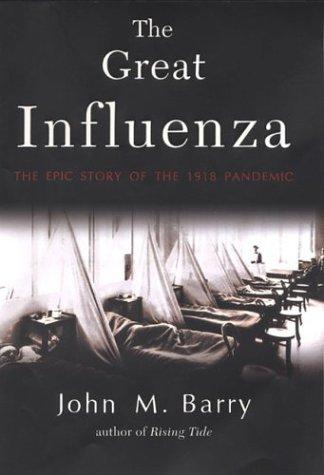
The Great Influenza
The Epic Story of the Deadliest Plague in History
John M. Barry’s The Great Influenza is a history of the 1918–1919 influenza pandemic, with particular attention to the United States. It follows the disease through military camps, cities, hospitals, laboratories, and public institutions while explaining why a modernizing society proved so vulnerable. Barry places the catastrophe within two intertwined stories: the transformation of American medical education and research, and the pressures created by World War I. Scientists struggled to identify an agent they could not yet see, physicians faced overwhelming numbers of patients without antiviral drugs or antibiotics, and officials often subordinated candid public communication to wartime priorities. The result is more than a chronicle of mass illness. It is an examination of scientific uncertainty, institutional capacity, political leadership, and public trust—forces that shape whether societies can recognize and contain a fast-moving emergency.
Where to buy or borrow
Are you selling this book? Bookstores, publishers, authors and libraries can be listed here for free. Request a listing
About this book
Deep Overview
That progress created confidence but not mastery. Viruses remained difficult to study, and many investigators treated Richard Pfeiffer’s bacillus—now called Haemophilus influenzae—as the likely cause of influenza. The pandemic therefore became a severe test of the new medicine. Researchers could observe clinical patterns and culture bacteria, yet they could not readily isolate the influenza virus or produce a reliably effective vaccine against it. Barry presents the laboratory race as both admirable and cautionary: disciplined scientists worked urgently, but incomplete tools and uncertain assumptions constrained what they could accomplish.
The narrative then joins medicine to World War I. Mobilization gathered young adults into crowded camps, transported them through ports, and carried infection across the Atlantic. Barry gives special attention to outbreaks associated with Kansas and Camp Funston, while also following later, more lethal waves through military and civilian populations. The unusual mortality among healthy young adults made the disease especially frightening. Influenza damaged the respiratory tract, and secondary bacterial pneumonia contributed heavily to fatal outcomes at a time when antibiotics did not exist.
Philadelphia supplies one of the book’s starkest civic examples. Officials permitted a large Liberty Loan parade to proceed while infection was spreading; hospitals, morgues, and essential services were soon overwhelmed. Barry contrasts such institutional failure with the work of physicians, nurses, volunteers, and researchers who continued despite exhaustion, illness, and limited resources.
A further strand concerns truth under wartime conditions. The federal Espionage Act and the broader culture of propaganda discouraged information that might weaken morale. Public reassurances could therefore diverge sharply from lived experience. Barry argues that this gap deepened fear and damaged credibility. The pandemic’s enduring political lesson, in his account, is not that authorities can eliminate uncertainty. It is that they must acknowledge uncertainty honestly, communicate evidence without manipulation, and preserve trust before compliance becomes essential.
The closing movement considers the pandemic’s retreat and its strangely muted place in collective memory. Barry does not portray science as having conquered the outbreak. Rather, he shows knowledge advancing through error, persistence, institutional support, and later research. The pandemic becomes a case study in the relationship among microbes, mass movement, medical capacity, leadership, and social confidence.
Key Themes
• Truth as public-health infrastructure: Accurate communication is treated as an operational necessity. Once official reassurance becomes visibly unreliable, fear and rumor acquire greater power.
• War as an epidemic accelerator: Mobilization concentrates people, moves them rapidly, strains hospitals, and encourages secrecy. Military policy is therefore part of the disease environment.
• Institutions and individuals: Barry foregrounds remarkable researchers and clinicians but repeatedly shows that outcomes depend on universities, laboratories, public agencies, hospitals, and political systems.
• The vulnerability of modern societies: Scientific advancement did not protect the world automatically. Density, transportation, bureaucracy, and mass communication created both defensive capacity and new pathways for harm.
• Memory and forgetting: The pandemic’s limited place in popular memory raises questions about how societies absorb catastrophes that lack a simple victory, villain, or concluding ritual.
Historical Context
Treatment options were correspondingly limited. There were no influenza antivirals and no antibiotics for the bacterial pneumonias that followed many infections. Hospitals and nursing services could be overwhelmed rapidly, while much public-health authority remained local. The label “Spanish flu” did not establish a Spanish origin; neutral Spain’s press reported the disease more openly than the censored press of combatant nations, making its outbreaks unusually visible.
Intended Audience
Those seeking a short introduction may find the extensive opening history of American medical education and research demanding. Readers wanting a fully global, region-by-region history should also know that the United States receives the most sustained attention. The full adult edition contains disturbing descriptions of respiratory illness, death, overcrowded hospitals, and social breakdown.
Reading Difficulty
The structure alternates between broad institutional history and urgent epidemic narrative. Some readers may experience the scientific prehistory as slow; its purpose becomes clearer once the pandemic tests the people and institutions previously introduced. Keeping brief notes on major scientists and organizations can make the later sections easier to follow.
Useful Background Knowledge
It is useful to approach estimates of worldwide mortality cautiously. Records were incomplete, diagnostic standards varied, and later historians have produced a range rather than one uncontested total. No prior knowledge of epidemiology is required, but familiarity with terms such as transmission, immunity, mutation, morbidity, and mortality will reduce interruptions.
Why Read This Book?
It is also a study of decision-making when evidence is incomplete. Barry shows how experts choose hypotheses, how institutions communicate uncertainty, and how political incentives can distort risk. Readers interested in why technically advanced societies still fail during emergencies will find the book particularly useful.
Reader Takeaways
The book also encourages a more realistic view of science. Research advances through disciplined uncertainty rather than instant certainty; capable investigators can be wrong without their work being worthless. Finally, the history suggests that public trust cannot be improvised after a crisis has begun. It is accumulated—or depleted—through earlier habits of candor, competence, and accountability.
Strengths
The book also excels at explaining why events unfolded as they did. Military movement, scientific limitations, public messaging, and hospital overload are presented as interacting causes rather than unrelated episodes. Its large scale allows readers to see both the slow construction of medical capacity and the speed with which a crisis can outrun it.
Limitations and Scope
Some scientific interpretations and numerical estimates available when the book was written have since been refined. Later research has strengthened understanding of the role of secondary bacterial pneumonia and continues to examine the pandemic’s origins, evolution, and mortality. Barry’s emphasis on an emergence pathway through Kansas is influential but should not be mistaken for universally settled consensus.
The extended attention to elite institutions and prominent investigators can also leave community-level disparities and many ordinary experiences less fully developed. Readers should treat the book as a major narrative synthesis, not as the final word on every global or scientific question.
Important Concepts, People, Places, and Institutions
• William Henry Welch: A major architect of American scientific medicine whose influence helps Barry explain the institutional transformation preceding the pandemic.
• Johns Hopkins University School of Medicine: A model for rigorous, research-oriented medical education and a key setting in the rise of American laboratory medicine.
• Rockefeller Institute for Medical Research: A leading research institution whose investigators pursued the causes and complications of infectious disease.
• Oswald Avery: A Rockefeller researcher central to the investigation of pneumococcus and pneumonia, complications crucial to understanding many influenza deaths.
• William Hallock Park and Anna Wessels Williams: New York laboratory scientists whose work illustrates the expanding public-health laboratory system and the race to understand the epidemic.
• Paul A. Lewis: A prominent researcher whose influenza investigations represent both the ambition and hazards of early infectious-disease science.
• Richard Pfeiffer and Pfeiffer’s bacillus: Pfeiffer identified a bacterium later named Haemophilus influenzae. Its suspected role in influenza shaped research, even though influenza is caused by a virus.
• Loring Miner and Haskell County, Kansas: A physician and community associated in Barry’s reconstruction with an early severe respiratory outbreak and his argument about the pandemic’s possible origin.
• Camp Funston at Fort Riley: A crowded Kansas military camp where a large influenza outbreak occurred, illustrating how mobilization could amplify transmission.
• Philadelphia Liberty Loan parade: The September 1918 mass gathering that Barry uses to demonstrate the consequences of delayed action and misplaced official reassurance.
• World War I mobilization: The movement and concentration of troops that connected local outbreaks to national and international transmission routes.
• Secondary bacterial pneumonia: A frequent and often fatal complication after influenza, particularly devastating before antibiotics.
• Nonpharmaceutical interventions: Measures such as isolation, limits on gatherings, ventilation, masks, and closures used when specific medicines or vaccines were unavailable.
• Public trust: The book’s central civic concept—the willingness to follow guidance depends substantially on whether authorities communicate truthfully and acknowledge uncertainty.
Questions the Book Explores
• Why were capable scientists unable to identify the cause quickly or produce a dependable vaccine?
• How did military mobilization turn outbreaks into an international catastrophe?
• Why did influenza kill so many young adults who would ordinarily be considered resilient?
• What happens when political leaders place morale, reputation, or wartime goals above candid risk communication?
• Which responsibilities belong to national agencies, local officials, hospitals, researchers, and individual citizens during an epidemic?
• Why did an event of such magnitude recede so quickly from public memory?
• What can historical evidence legitimately teach about future pandemics, and where do comparisons become misleading?
Reading Group Guide
Compare the treatment of scientists with the treatment of political and public-health leaders. Notice when uncertainty is presented as an honest limitation and when it becomes an excuse for inaction or misleading reassurance. The Philadelphia chapters provide a useful case study for examining warning signs, competing incentives, and accountability.
Groups may also track Barry’s recurring language of war, invasion, and combat. Consider whether that vocabulary clarifies collective action or oversimplifies the biological and social realities of disease. Finally, compare the opening institutional history with the final lessons about trust: does the book suggest that knowledge, capacity, communication, or leadership is the most important defense?
Discussion Questions
2. Which failure appears most consequential: scientific misidentification, wartime crowding, limited medical capacity, delayed civic action, or dishonest communication?
3. How does the book distinguish reasonable scientific error from institutional negligence?
4. What does the Philadelphia episode reveal about leadership under uncertainty?
5. Does focusing on prominent researchers clarify the history, or does it obscure the contributions and experiences of less powerful people?
6. How does World War I change the scale, speed, and politics of the epidemic?
7. Why might societies forget a catastrophe that affected so many households?
8. Which lessons in the book are broadly transferable to other emergencies, and which are specific to influenza in 1918?
9. How should authorities communicate when evidence is changing and certainty is impossible?
10. After finishing the book, did your view of scientific progress become more optimistic, more cautious, or both?
Sources and Verification
Comments
No published comments yet.
Available editions
Hardcover
hardcover
- Publisher
- Viking
- ISBN-13
- 9780670894734
- Pages
- 546