
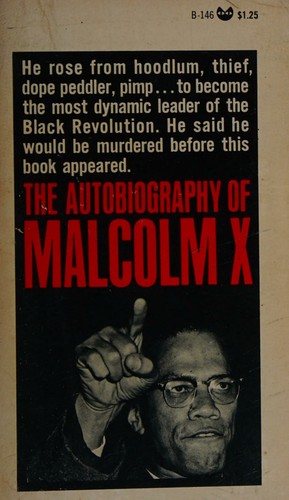
The Autobiography of Malcolm X
The Autobiography of Malcolm X recounts the successive transformations of Malcolm Little into a street hustler, prisoner, Nation of Islam minister, Black nationalist leader, Sunni Muslim, and international advocate for human rights. Told to journalist Alex Haley during the final years of Malcolm X’s life, the book joins personal testimony to a forceful examination of racism, religious conversion, education, crime, incarceration, political awakening, and Black self-determination. Its narrative moves from Malcolm’s childhood in the Midwest through Boston and Harlem, his years in prison, his rise under Elijah Muhammad, and his eventual break with the Nation of Islam. His pilgrimage to Mecca and travels through Africa and the Middle East initiate another major revision of his thinking without ending his commitment to Black dignity and self-defense. Published after his assassination in 1965, the book preserves both the power of his public voice and the unfinished character of his political…
Where to buy or borrow
We don’t list any stores or libraries for this book yet.
Are you selling this book? Bookstores, publishers, authors and libraries can be listed here for free. Request a listing
About this book
Deep Overview
Imprisonment becomes the narrative’s decisive turning point. Malcolm’s conversion is intellectual as well as religious. Through correspondence, disciplined reading, dictionary study, debate, and the teachings of Elijah Muhammad, he reconstructs his understanding of history and his place within it. Literacy becomes a form of liberation because it gives him language for interpreting experiences that previously seemed disconnected or merely personal. His adoption of “X” rejects the inherited surname Little and symbolizes an African family name erased by slavery.
After prison, Malcolm rises rapidly within the Nation of Islam. His intelligence, discipline, organizational energy, and rhetorical skill help make him one of the movement’s most visible ministers. The autobiography explains the attraction of the Nation’s message: it offers moral order, racial pride, communal belonging, economic self-reliance, and an uncompromising explanation of white supremacy. At the same time, Malcolm’s loyalty to Elijah Muhammad eventually collides with evidence, personal conscience, and his desire for more direct political action.
The break with the Nation of Islam is not presented as a simple abandonment of everything Malcolm previously believed. He continues to defend Black self-respect, independent organization, and the right of self-defense. What changes is the breadth of his religious and political vision. During the hajj, he encounters Muslims of varied racial backgrounds worshipping together. His travels in Africa and the Middle East further encourage him to view the condition of Black Americans within anticolonial and international human-rights struggles.
The final chapters therefore resist an easy conclusion. Malcolm establishes Muslim Mosque, Inc. and the Organization of Afro-American Unity, adopts the name El-Hajj Malik El-Shabazz, and begins reconsidering earlier generalizations about race. Yet his political program remains in development when he is assassinated. Alex Haley’s epilogue shifts the perspective outward, recounting the collaboration and the threats surrounding Malcolm’s last months. The book’s enduring force comes partly from this incompleteness: it records a thinker revising himself publicly, without the retrospective stability that a longer life might have supplied.
Key Themes
Religious faith functions as discipline, community, and a source of political interpretation. The Nation of Islam gives Malcolm a framework for recovery and Black pride, while his later embrace of Sunni Islam expands his understanding of racial fellowship. Other recurring themes include Black nationalism, self-defense, masculinity, leadership, loyalty, betrayal, media representation, and the tension between organizational obedience and independent judgment. The book continually asks how an oppressed people can achieve dignity without allowing an oppressor to define either their identity or their methods.
Historical Context
The Nation of Islam offered a religious and nationalist alternative to integrationist politics. Under Elijah Muhammad, it emphasized moral discipline, economic independence, separation from white society, and a recovery of Black identity. Malcolm X became its best-known national spokesman before leaving in 1964. His later development coincided with African decolonization and the growth of Pan-African politics, encouraging him to connect the Black American struggle with international campaigns against colonial rule. The autobiography was published in 1965, after his assassination and during a period when Black Power and Black nationalist ideas were becoming increasingly influential.
Intended Audience
Readers seeking a detached scholarly biography should approach it as one major source rather than a complete historical account. Those uncomfortable with descriptions of racial violence, crime, drug use, imprisonment, religious polemic, and assassination may find parts demanding. Its greatest rewards come to readers prepared to engage critically with Malcolm X’s evolving positions instead of reducing him to either a flawless hero or a fixed symbol of militancy.
Reading Difficulty
Helpful Background Knowledge
Why Read This Book?
Reader Takeaways
Strengths
Limitations and Considerations
Malcolm’s death prevented him from reviewing his entire life from a later vantage point or fully developing the political direction visible in his final year. Some claims about individuals, institutions, and historical events should therefore be checked against archival records and later scholarship. The book’s enormous cultural influence can also encourage readers to treat it as the definitive account of Malcolm X, when it is better understood as an indispensable but constructed primary text.
Important Concepts, People, and Organizations
Alex Haley is the journalist and collaborator who shaped extensive conversations into the published first-person narrative. His epilogue explains aspects of their working relationship and Malcolm’s final period.
Elijah Muhammad led the Nation of Islam and became Malcolm’s religious teacher and organizational superior. Malcolm’s devotion to him drives his rise within the movement, while their eventual rupture becomes one of the autobiography’s central crises.
The Nation of Islam is the religious and Black nationalist organization that provides Malcolm with discipline, purpose, and a public platform. Its teachings in the book must be distinguished from mainstream Sunni Islam.
Betty Shabazz, Malcolm’s wife, is connected to his family life, religious community, and the dangers surrounding his final months, although her perspective receives comparatively limited attention.
Ella Little-Collins, Malcolm’s half-sister, plays an important role in his exposure to Boston and later supports his pilgrimage to Mecca.
The hajj is Malcolm’s pilgrimage to Mecca in 1964. His experience of multiracial Muslim fellowship there changes his understanding of race without ending his opposition to racism.
Muslim Mosque, Inc. and the Organization of Afro-American Unity are organizations Malcolm founded after leaving the Nation of Islam. They reflect his attempt to pursue religious work and a broader political struggle for Black freedom and human rights.
Harlem, Boston, Lansing, prison, Mecca, and several African and Middle Eastern countries function as more than settings. Each environment expands or restricts what Malcolm believes to be possible and contributes to a new stage of his identity.
Questions the Book Explores
Reading Group Guide
When discussing the Nation of Islam period, separate the movement’s appeal from the later conflict between Malcolm and Elijah Muhammad. Readers can then compare Malcolm’s statements before and after the hajj without assuming that every earlier belief disappears. Finally, examine Haley’s epilogue alongside the first-person narrative. Consider how the change in narrator affects authority, intimacy, pacing, and the reader’s understanding of Malcolm’s final days.
Discussion Questions
2. How does the narrative divide responsibility between Malcolm’s choices and the social conditions surrounding him?
3. What does prison make possible for Malcolm that his formal schooling did not?
4. How does the book distinguish racial pride from racial hatred?
5. Why is loyalty to Elijah Muhammad so powerful, and what finally makes that loyalty unsustainable?
6. Which beliefs survive Malcolm’s departure from the Nation of Islam?
7. How does international travel change the scale on which Malcolm understands the Black freedom struggle?
8. Does the hajj represent a complete reversal, a refinement, or another stage in an unfinished development?
9. How does Haley’s involvement complicate the label “autobiography”?
10. What perspectives are missing from the narrative, and how might their inclusion alter it?
11. How should readers evaluate provocative statements made during a particular stage of an evolving life?
12. What does the book suggest about the relationship between changing one’s mind and maintaining political integrity?
Sources and Verification
Comments
No published comments yet.
Available editions
Other format
First published edition
- Publisher
- Grove Press