
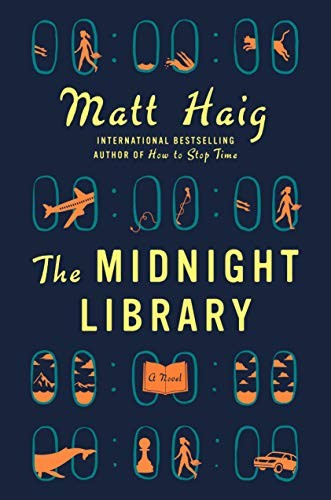
The Midnight Library
A Novel
After a succession of losses and disappointments, Nora Seed concludes that her life has become unbearable. She awakens in the Midnight Library, a realm between life and death where every volume contains a life she might have led had she chosen differently. Guided by her former school librarian, Mrs. Elm, Nora enters alternate realities shaped by abandoned ambitions, relationships, and opportunities. Yet success, love, adventure, and recognition prove more complicated than they appeared from a distance. Matt Haig uses this speculative premise to examine regret, depression, possibility, and the difficulty of judging a life from imagined alternatives. The novel is ultimately less interested in finding a flawless existence than in asking how a person might recover curiosity about an unfinished one.
Where to buy or borrow
Are you selling this book? Bookstores, publishers, authors and libraries can be listed here for free. Request a listing
About this book
Deep Overview
Mrs. Elm, the librarian Nora trusted at school, explains that the surrounding books contain possible lives arising from other decisions. Nora can enter these realities and remain in one if she genuinely belongs there. This arrangement transforms the story into an investigation rather than a conventional quest: Nora tests the assumptions behind her regrets.
Some alternatives seem to satisfy recognizable fantasies of correction. She can continue swimming and attain elite success, pursue glaciology in the Arctic, sustain her musical career, preserve a romantic relationship, or follow paths that place her closer to family and friends. Each experiment exposes missing information. A decision Nora blamed herself for may not have caused the harm she imagined; fulfilling another person’s ambition may not fulfill her; professional achievement does not erase loneliness; and changing one choice alters networks of lives rather than producing an isolated personal improvement.
The alternate worlds therefore challenge Nora’s habit of comparing her actual life with idealized possibilities. Before entering them, she sees only what each abandoned path appears to promise. Once inside, she inherits its obligations, griefs, compromises, and relationships without having formed the memories that would ordinarily make that life feel like hers. This estrangement is crucial: identity emerges not simply from circumstances but from sustained participation, attachment, and accumulated experience.
The library’s rules also complicate the fantasy of total control. Infinite options do not give Nora complete knowledge, and no life can be evaluated like a product selected from a catalogue. Her encounters gradually shift the central question away from “Which life is best?” toward “What makes any life inhabitable and meaningful?” The movement is from optimization to engagement—from attempting to eliminate pain and error to recognizing value within uncertainty.
Haig frames this development through chess, books, roots, music, and scientific possibility. Chess suggests that a position with few apparent moves may still contain options. Books represent narratives that seem fixed until they are lived. The branching-life premise externalizes counterfactual thinking: the common habit of imagining that happiness resides behind a single missed decision. By confronting Nora with the full complexity of alternatives, the novel argues that regret is often based on incomplete stories. Its hopeful conclusion rests not on proving that Nora’s original circumstances are secretly perfect, but on restoring her capacity to act within a life that remains unfinished.
Key Themes
- **The fantasy of a perfect life:** Achievement, romance, fame, adventure, and family can all carry value, but none guarantees freedom from sorrow, conflict, or uncertainty.
- **Identity through participation:** A life is more than its visible circumstances. Memory, commitment, habit, and relationships help create the person who can belong within it.
- **Interdependence:** Choices affect other people in unpredictable ways. Nora learns that she cannot calculate her worth solely from her assumptions about being useful or burdensome.
- **Possibility within limitation:** The novel distinguishes having infinite theoretical alternatives from recognizing workable possibilities in the present.
- **Meaning and ordinary existence:** Grand accomplishments are repeatedly set against modest forms of connection, attention, care, and continued involvement.
- **Perspective and incomplete knowledge:** Nora’s harsh judgments depend on information she lacks, including what others feel, what caused past events, and what future change remains possible.
Historical Context
The book also participates in modern public conversations about depression, suicidal ideation, loneliness, and emotional resilience. Matt Haig had already written openly about mental health in nonfiction, especially Reasons to Stay Alive, so contemporary readers often encounter this novel in relation to that larger body of work. Literarily, its structure resembles a moral or philosophical fable: a distressed protagonist enters an extraordinary realm, observes versions of existence unavailable in ordinary life, and returns with altered understanding. Its emphasis on regret additionally connects it to long-standing philosophical questions about freedom, determinism, the good life, and whether human beings can reliably know what would have made them happy.
Intended Audience
It may be less suitable for readers seeking hard science fiction, intricate world-building, stylistic experimentation, or a clinically detailed account of depression. People currently vulnerable to material involving suicide should know that suicidal ideation and an attempt are central to the premise, even though the overall trajectory is hopeful.
Reading Difficulty
The main difficulty is emotional rather than linguistic. The opening deals directly with depression, isolation, death, and attempted suicide. Repetition is part of the design: Nora repeatedly enters a life, discovers its hidden costs, and returns. Some readers will appreciate this fable-like pattern, while others may find it predictable.
Helpful Background Knowledge
Why Read This Book?
It is also a practical book-club selection. The premise is immediately understandable, the episodes offer contrasting models of fulfillment, and the book supports disagreement about whether its hopeful message is persuasive or overly simple. Readers interested in the boundary between speculative fiction and self-reflective parable will find a clear example of how fantasy can externalize an inward crisis.
Reader Takeaways
The story may prompt reflection on small choices that remain available even when large parts of life cannot be changed. It suggests that meaning is less likely to arrive through identifying one flawless path than through attention, connection, revision, and continued participation. Readers may also become more alert to the limits of perspective: a person in crisis may interpret present pain as a complete forecast of the future when it is neither complete nor final.
Strengths
- The episodic design permits comparison among different definitions of success without requiring a sprawling plot.
- Short chapters and straightforward prose keep philosophical material approachable.
- Recurring images—books, chess, roots, music, and branching possibilities—give cohesion to the novel’s argument.
- Nora’s experiments reveal the informational weakness of hindsight: she repeatedly discovers that the past was not as simple as her self-blaming account suggested.
- The premise generates productive discussion about agency, identity, relationships, and whether a meaningful life must be exceptional.
Limitations and Cautions
The alternate lives are designed primarily to advance Nora’s realization, so several settings and supporting characters receive limited development. The repeated lesson structure can make outcomes feel predetermined, and philosophical ideas are presented broadly rather than examined with sustained complexity. The many-worlds concept is imaginative scaffolding, not an accurate explanation of established physics. Content cautions include depression, suicidal ideation, a suicide attempt, death, grief, substance misuse, and panic or acute distress.
Important Concepts, People, and Places
- **Mrs. Elm:** Nora’s former school librarian and guide in the liminal library. She combines emotional mentorship with the role of explaining its rules.
- **The Midnight Library:** A space between life and death whose books allow Nora to enter lives arising from different choices. It is both the speculative setting and a metaphor for counterfactual imagination.
- **The Book of Regrets:** A changing record of Nora’s self-reproach. Its instability suggests that regret depends on interpretation rather than functioning as an objective account of failure.
- **The root life:** Nora’s original existence, against which she measures every alternative. The term emphasizes that branching possibilities remain connected to a common history.
- **Joe Seed:** Nora’s brother and former musical collaborator. Their damaged relationship links her regrets about family to her abandoned career in music.
- **Dan:** Nora’s former fiancé. The life built around his dream of owning a pub tests her assumption that preserving their engagement would have guaranteed happiness.
- **Izzy:** Nora’s friend, associated with an unrealized plan to move to Australia and with the unknowability of alternate consequences.
- **Ash:** A doctor whose small role in Nora’s original life becomes significant when she investigates an overlooked relational possibility.
- **Hugo Lefèvre:** Another traveler among alternate lives. He offers a contrasting response to infinite possibility: continued searching can become its own form of avoidance.
- **Bedford, England:** Nora’s ordinary home environment and the setting from which many of her fantasies of escape arise.
- **Svalbard:** The Arctic setting of Nora’s glaciologist life, combining a once-abandoned vocation with isolation, danger, and a crucial confrontation with her desire to survive.
- **Counterfactual thinking:** The mental construction of alternative outcomes. The novel examines how it can create insight but also sustain distorted self-judgment.
- **Many-worlds interpretation:** The scientific-philosophical inspiration for branching realities; Haig adapts it freely as a fictional device.
- **Chess:** A recurring image for constrained but continuing possibility: an apparently bad position may still contain moves not yet perceived.
Questions the Book Explores
- How much of regret comes from facts, and how much from incomplete or self-punishing interpretation?
- Does fulfillment depend on achievement, relationships, service, freedom, or some changing combination of these?
- If identity is shaped by accumulated experience, could someone simply enter an ideal life and belong there?
- How do individual choices alter the lives of other people in ways that cannot be predicted?
- Can endless possibility become paralyzing rather than liberating?
- What is the difference between wanting pain to stop and wanting existence itself to end?
- Is meaning discovered in exceptional circumstances, or created through attention to an ordinary life?
Reading Group Guide
A second discussion can focus on form. Consider whether the recurring enter-discover-return pattern deepens the argument through accumulation or makes the lesson too predictable. Map the novel’s repeated symbols, especially the library, the Book of Regrets, chess, roots, and music.
Because the story involves suicide and depression, establish a respectful tone and avoid asking participants to disclose personal experiences. Discuss the book as fiction rather than therapy. A useful closing activity is to identify one claim the group finds convincing and one it finds too simple, supporting both judgments with specific episodes.
Discussion Questions
2. Which alternative life most effectively challenges her assumptions, and which feels least persuasive?
3. What does Mrs. Elm contribute beyond explaining the library’s rules?
4. How does the Book of Regrets change the way guilt and memory operate in the story?
5. Does the novel distinguish clearly enough between external success and internal fulfillment?
6. Why is it difficult for Nora to belong immediately in lives that seem desirable from the outside?
7. What does Hugo Lefèvre reveal about the danger of limitless options?
8. How does the Svalbard episode change Nora’s understanding of death and survival?
9. Does the episodic structure create meaningful development, or does it make the conclusion feel inevitable?
10. How responsibly does the novel handle depression and suicidal crisis?
11. In what ways is the library a place of freedom, and in what ways is it another form of confinement?
12. Does the ending support the idea that perspective changes life, or that life must also be changed through action?
13. What does the novel suggest people owe one another when they cannot see the full effects of their choices?
14. Would the book’s argument work without the multiverse premise? Why or why not?
Sources and Verification
Comments
No published comments yet.
Available editions
Hardcover
U.S. hardcover edition
- Publisher
- Viking
- ISBN-13
- 9780525559474
- Publication date
- Pages
- 304