
How Can You Read a Novel With Multiple Timelines Without Getting Lost?
### How do I follow a story that moves between different time periods, viewpoints, or versions of events without ruining the suspense? The easiest approach is to keep a simple mental—or written—map of three things: **who is speaking, when the scene is happening, and what new information the scene gives you**. Only treat something as fact when the story has clearly confirmed it. If two events seem connected but you are not sure how, leave that connection open instead of forcing an explanation. As the story reveals more, you can adjust your understanding. Most importantly, do not worry if you feel temporarily confused. In many nonlinear stories, that confusion is intentional. The author may want you to experience uncertainty alongside the characters. Instead of trying to solve every mystery immediately, pay attention to the emotional and cause-and-effect connections between scenes. ### Why do stories jump around in time? A nonlinear story does not always present events in the order
How Do I Follow a Story That Moves Between Different Time Periods or Viewpoints?
When a story moves between different periods, narrators, or versions of events,
the easiest way to stay oriented is to keep track of who is speaking, when the
scene takes place, and what changes because of it.
Record only what the story has clearly confirmed. Treat uncertain connections
as questions rather than facts, and update your understanding as the story
reveals more information.
Some temporary confusion is intentional. Rather than trying to solve every
mystery immediately, focus on the emotional connections and the cause-and-effect
relationships between scenes.
Why Stories Rearrange Chronology
A nonlinear story can reveal information in the order that creates the strongest
suspense, contrast, or emotional impact rather than simply showing events in the
order they happened.
An author might place a consequence beside an event that caused it years earlier,
show how memory changes a person's interpretation of the past, or allow several
characters to describe the same event from very different perspectives.
This structure can also reflect a character's limited understanding. Missing dates,
unexplained transitions, and apparent contradictions may allow the reader to
experience the same uncertainty as the characters before later scenes provide
more context.
That does not mean every confusing moment is a puzzle with one hidden answer.
Sometimes uncertainty is simply part of the experience the author wants to create.
Track Only the Information You Actually Need
At each major transition, try to identify four basic things:
- The approximate time period
- The narrator or viewpoint character
- The location
- The event that changed the situation
Avoid summarizing every scene in detail. A short note such as
"Earlier period — Mara — train station — finds the unopened letter"
is usually much more useful than a page of notes.
It also helps to separate what the story confirms from what you are guessing.
Labels such as confirmed, possible, and
unknown can prevent an early theory from gradually becoming
something you accidentally treat as fact.
Use a Simple Timeline
For a particularly complex story, create one entry for each major scene or chapter.
You only need a few pieces of information:
- Scene: Chapter number or a short identifying phrase
- Period: Exact date, relative date, or unknown
- Viewpoint: Narrator or focal character
- Key event: What changes during the scene
- Consequence: What later choice, discovery, or conflict it appears to cause
If the story does not give you an exact date, use relative descriptions such as
"before the departure," "three years later," or
"after the trial."
Do not force uncertain scenes into an exact position. If you are not sure where
something belongs, mark it as position unclear until the story
provides more evidence.
This allows you to remember the scene without destroying the ambiguity the author
may have intentionally created.
Keep Track of Narrator Changes
If a novel has several narrators, give each one a simple initial, symbol, or color.
Beside the narrator's name, note what that person knows at that point in the story.
This becomes especially useful when one character describes an event that another
character remembers or understands differently.
Remember that knowledge and chronology are not the same thing. A scene that occurs
later may reveal less information, while an earlier scene may finally explain
something you have already seen.
Sometimes the better question is not
"When is this happening?" but
"What does this character know right now?"
Notice Repeated Details Without Assuming Too Much
Repeated objects, phrases, locations, photographs, injuries, weather conditions,
or habits can help connect scenes that are separated by time or viewpoint.
Notice when these details return, but avoid deciding too quickly what they mean.
A repeated object could be symbolic, important to the plot, a deliberate
misdirection, or simply part of the setting.
A simple recurrence note can track:
- The repeated detail
- Where it appears
- What has changed since its previous appearance
This lets you recognize patterns without forcing an interpretation too early.
Follow Cause and Effect, Not Just Time
Chronological order and causal order are not always the same thing.
When the narrative jumps between periods, ask what decision, discovery, mistake,
or loss might explain something you see later.
For example:
Letter discovered → meeting canceled
Only treat that connection as certain if the story supports it. If you merely
suspect the connection, mark it with a question mark.
If a later scene seems to contradict an earlier one, do not immediately decide
that one version is false. There may be several explanations:
- Unreliable memory
- Incomplete information
- Different viewpoints
- An event the story has not revealed yet
Choose a Note-Taking Method That Fits Your Reading Style
You do not need an elaborate tracking system. Choose the smallest method that
helps you enjoy the story.
Margin method:
Write the time period, narrator initial, and one important consequence.
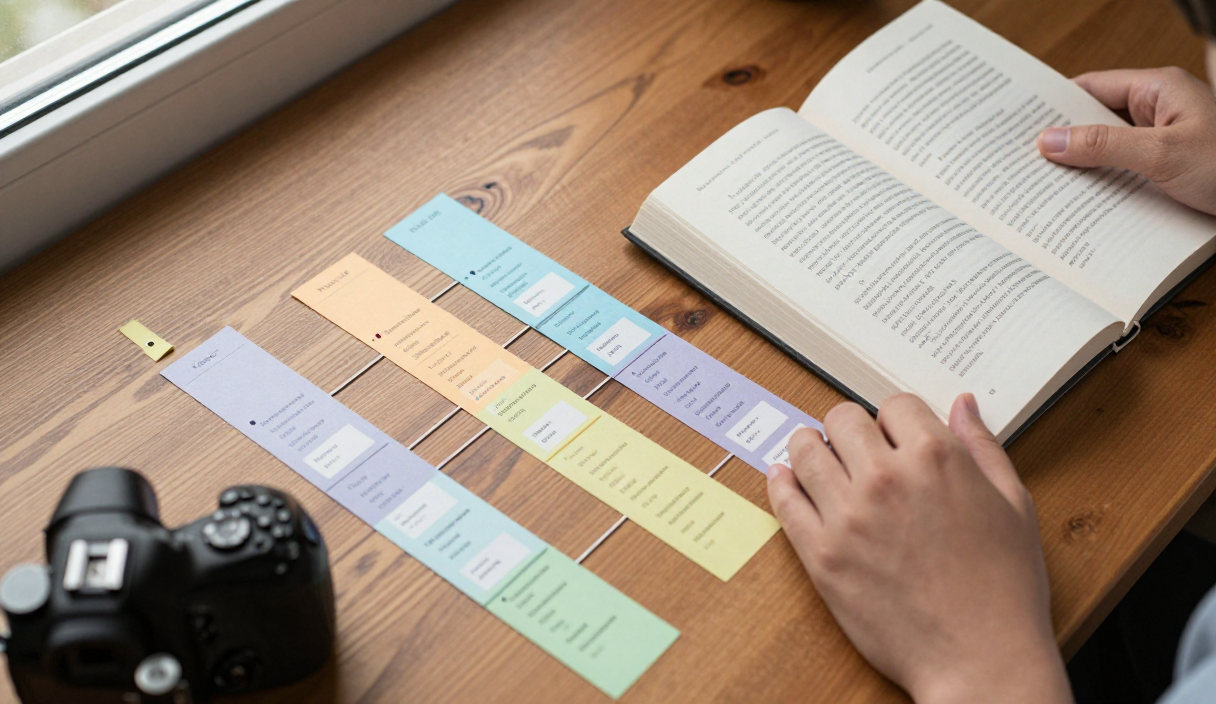
Card method:
Use one index card for each period or viewpoint.
Table method:
Keep sortable rows containing scenes, narrators, and dates.
Thread method:
Keep a separate short summary for each narrative strand.
Question method:
Maintain a short list of unresolved mysteries and cross them out as the story
answers them.
If you dislike stopping while you read, pause only every few chapters and write
three short notes:
- What is certain?
- What is still unresolved?
- What changed?
The goal is to stay oriented, not to reconstruct the entire novel.
Recognize When Confusion Is Intentional
Confusion is more likely to be intentional when the story repeatedly withholds the
same kind of information, emphasizes missing memories, revisits scenes with
meaningful differences, or provides enough emotional context to continue even
though the exact chronology remains uncertain.
You may need to slow down when you cannot identify the current viewpoint despite
clear labels, have forgotten an important relationship that was previously
established, or repeatedly overlook explicit time markers.
Often, rereading only the first and last few lines of the previous chapter is
enough to restore your orientation.
A useful test is to ask yourself:
Do I understand what the character wants, what happened in this scene,
and what changed because of it?
If the answer is yes, uncertainty about the exact timeline may be intentional.
If you cannot identify the viewpoint, conflict, or basic action, reviewing the most
recent transition may help.
Avoid Turning the Book Into Homework
Notes should make reading easier, not interrupt the story.
Track only details that affect identity, chronology, motivation, or consequences.
Let smaller uncertainties remain unresolved, especially when the story appears
likely to explain them later.
Before searching online for an explanation, consider finishing the current section
or chapter first. Summaries, reviews, and discussions can easily reveal connections
that the author intended you to discover gradually.
Final Approach
Think of a nonlinear story as several connected strands rather than one straight
line.
Keep track of the period, viewpoint, recurring clues, and major consequences.
Separate confirmed facts from theories, and allow deliberate gaps in the story
to remain unresolved until the author is ready to reveal them.
The best tracking system is not the most detailed one. It is the smallest system
that allows you to keep reading with curiosity instead of frustration.
Related Reading
- How to Identify an Unreliable Narrator
- A Simple Annotation System for Complex Fiction
- How to Distinguish Plot Order From Chronological Order
- When to Reread a Difficult Chapter