
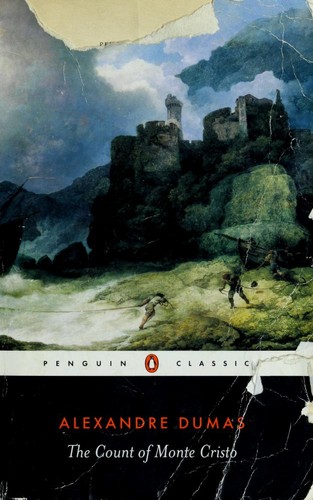
The Count of Monte Cristo
Alexandre Dumas's The Count of Monte Cristo follows Edmond Dantès, a young Marseille sailor whose promising future is wrecked in 1815 when jealous acquaintances and a self-protecting magistrate send him to the Château d'If without trial. After years in prison, a daring escape and a fortune he was not expecting, he reappears in Paris and Rome as a mysterious, wealthy count, patiently dismantling the lives of the men who betrayed him. Serialized in a Paris newspaper in the 1840s, it is a landmark of historical fiction that combines adventure, courtroom intrigue, romance and moral argument about justice and vengeance. This Penguin Classics edition presents Robin Buss's complete English translation, which makes it a practical choice among classic novels to read for anyone ready for a long, absorbing story.
Where to buy or borrow
Are you selling this book? Bookstores, publishers, authors and libraries can be listed here for free. Request a listing
About this book
The book is organized as a long arc rather than a set of episodes. A first movement covers the betrayal, imprisonment and education in the Château d'If. A much longer second movement follows Dantès after he becomes the Count, moving between Italian carnival scenes, Parisian drawing rooms, banking houses and courtrooms. The historical setting is real: it opens as Napoleon's fortunes swing between exile and return, and it continues through the restored Bourbon monarchy and the July Monarchy.
This particular edition matters because earlier English versions were commonly shortened or softened. Robin Buss's translation, first issued by Penguin in 1996, is complete and is accompanied by his introduction and explanatory notes, which help modern readers with French politics, places and period references. That apparatus is one of the main reasons readers choose this edition over free reprints of Victorian translations.
Deep Overview
The prison section is the novel's hinge. Dantès is first consumed by despair, then meets Abbé Faria, a learned fellow prisoner who has been tunnelling toward freedom for years. Faria educates him in languages, science, history and the reading of human motives, and tells him about a treasure on the island of Monte Cristo. When Faria dies, Dantès takes his place in the burial sack and escapes. Prison therefore works as both punishment and school: the naive sailor is gone, and a patient strategist takes his place.
The long middle and later parts show the results. Taking on several identities, including the Count of Monte Cristo, Dantès gathers information, buys influence and lets each enemy's own weakness do the work. Danglars has become a powerful banker, Mondego is now the Count de Morcerf, a celebrated soldier and peer, and Villefort is a leading Paris prosecutor. Dumas keeps these threads moving through side plots involving bandits, a rescued slave named Haydée, a young generation of lovers, poisonings in Villefort's household, and the doomed Caderousse. The scheme is not a clean machine. Innocent people are caught in it, and Dantès's confidence is tested.
That is where the book turns from an adventure of retribution into a moral inquiry. Dantès begins by seeing himself as an instrument of providence, rewarding friends such as the Morrel family and punishing enemies. Later events force him to ask whether a private person can legitimately act as judge, and what the cost is to those who are not guilty. The ending moves toward restraint and a different view of time, hope and patience. Readers who like the plotting will also find a long argument about whether justice that the state fails to deliver can ever be taken into private hands.
Key Themes
Justice and corruption are tied to institutions. Dantès is ruined not by a villain alone but by a legal and political system that is willing to protect careers and reputations over truth.
Self-invention and disguise matter because Dantès does not simply return; he builds new personas, using money, languages and knowledge to enter a society that had no place for him as a sailor.
Providence versus human agency is the moral question underneath the plot: is Dantès fulfilling a higher design, or is he claiming a power that belongs to no individual?
Time, patience and hope appear in his long confinement, his careful planning, and the book's closing emphasis on waiting.
Money, class and social performance are recurring concerns. Banks, titles, credit and appearances open or close doors, and the novel is alert to how fragile and manufactured status can be.
Historical Context
Dumas wrote in the 1840s under the July Monarchy, the regime installed after the 1830 revolution, in which he himself had taken part. The Paris of the later chapters is a society of bankers, speculators, newly made titles and press influence, and the novel reflects growing attention to money and credit.
Literary context matters too. The book appeared in the Journal des Débats between August 1844 and January 1846, in the age of the roman-feuilleton, when serial fiction brought novelists large audiences and shaped narrative style. Dumas also drew on a story from a collection of police-archive cases by Jacques Peuchet, which tells of a Nîmes shoemaker, Pierre Picaud, who was falsely accused and imprisoned. How far that anecdote is documented is debated, and Dumas transformed it considerably. Finally, his work with Auguste Maquet is part of the context: the collaboration was typical of industrial serial publishing, and it complicates the idea of a single author at a desk.
Intended Audience
Because the translation is complete and annotated, it is also well suited to readers who prefer an unabridged text and want help with historical references. Book groups with enough time can use it for extended, multi-session discussion.
Readers who want a short, tightly focused novel, or who find large casts and digressions tiring, may find it demanding. Those who dislike coincidence-heavy plots, or who read mainly for psychological realism, may also be less satisfied, since Dumas works on a larger-than-life scale.
Reading Difficulty
The cast is large and the same person may appear under different names and titles, so a reader may need to pause to track who is who. Occasional digressions on banking, drugs and poisons, Roman custom and political detail can slow the pace, though the notes help. No specialist knowledge is required. The paperback is physically thick, so some readers may prefer a lighter format for commuting, but this edition is the one with Buss's introduction and notes.
Helpful Background Knowledge
It is also useful to know that the book first appeared in installments, which explains its repeated cliffhangers and its wide spread of subplots. Reading Buss's introduction before starting is optional, but it is best read with care by those who do not want plot details spoiled; the notes are more useful when consulted as questions arise. No French is needed.
Why Read This Book?
This edition adds a practical advantage. Because it is complete, you meet Dumas's actual pacing, subplots and characters rather than a shortened plot. For anyone assembling a reading list of major nineteenth-century fiction, it is also a book whose influence can be seen in later stories of wrongful imprisonment, secret identity and calculated retribution, as well as its many stage, film and television adaptations.
Reader Takeaways
They may reconsider the appeal of righteous revenge, noticing how the narrative gradually exposes its costs. They may also notice how institutions such as courts, banks and the press are portrayed as tools that can be used for both justice and injustice, and how much of Dantès's power comes from knowledge, preparation and money rather than violence alone.
Finally, the reader gains a sense of the historical turbulence of post-Napoleonic France, which sits behind the personal drama.
Strengths
Its moral seriousness gives it staying power beyond the adventure. Dumas lets the reader sympathise with Dantès and then, gradually, ask whether that sympathy is deserved.
This edition benefits from a complete text, a modern English style and explanatory notes. The apparatus makes it more helpful than a bare reprint for readers who want to understand the references rather than just follow the story.
Limitations and Cautions
The story's origin is also uncertain in its details: the Picaud anecdote has been repeated in many retellings, but the underlying evidence is thin and not all later accounts can be treated as established fact. Likewise, Dumas's collaboration with Maquet means authorship credit is simplified in the usual presentation.
The notes and introduction in this edition are written for general readers and do not replace scholarly criticism. Because the introduction may discuss plot developments, first-time readers may prefer to read it after the novel. Page counts and some publication details vary between catalogues, so check the edition in hand.
Important Concepts, People, and Places
Abbé Faria: the prisoner who becomes Dantès's teacher and the source of the treasure clue.
Gérard de Villefort: the magistrate who sacrifices Dantès to protect his own position, embodying legal corruption.
Danglars, Fernand Mondego and Caderousse: the three men who bring about Dantès's fall, each representing a different kind of envy or complicity.
Mercédès: Dantès's fiancée, whose later life tests the cost of his long absence.
Haydée, Albert de Morcerf, Maximilien Morrel and Valentine de Villefort: younger figures through whom the story explores consequences for the next generation, loyalty and love.
Château d'If: the island fortress prison off Marseille, which functions as both punishment and school.
Monte Cristo: the Mediterranean island where the treasure is hidden, and the source of the title.
Marseille, Rome and Paris: the three main settings, associated respectively with origins, disguise and social judgment.
Bonapartists and royalists: the political camps whose conflict starts the plot.
Auguste Maquet and Jacques Peuchet: the collaborator and the police-archive compiler tied to the book's making and inspiration.
Journal des Débats and the roman-feuilleton: the newspaper and the serial-fiction form behind the book's original publication.
Robin Buss: the translator whose complete version underlies this edition.
Questions the Book Explores
How much of a person's identity is fixed, and how much can be rebuilt with education, money and disguise?
What do political upheavals do to private loyalty and ambition? What does it mean to claim that events are guided by providence?
And can long suffering produce wisdom, or only harden the sufferer?
Reading Group Guide
Consider asking each member to choose one enemy or ally and track how Dantès's plan affects them. Compare the book's early chapters, which are quick and tragic, with the more social and intricate later ones. A group that includes people who have seen film or television adaptations can also compare how those versions handle the ending and the moral questions. If members are using different translations, comparing a passage or two can be a useful exercise.
If you are choosing book club books for a long season, this is a title that rewards reading in stages with time between sessions.
Discussion Questions
2. How does the Château d'If change Dantès, and what role does Abbé Faria play in that change?
3. Is Dantès an agent of providence, a manipulator, or both? Which scenes support each reading?
4. Where does the plan appear to harm people who did not deserve it, and how does the novel respond?
5. What does the book suggest about the justice system, banking and the press in Parisian society?
6. How do Mercédès, Haydée and Valentine illuminate different sides of the story?
7. How does knowing the book began as a newspaper serial affect how you read its structure?
8. What does the final emphasis on waiting and hoping say about the book's idea of time and mercy?
Sources and Verification
Comments
No published comments yet.
Available editions
Paperback
Penguin Classics paperback, complete translation with introduction and notes by Robin Buss
- Publisher
- Penguin Classics
- ISBN-13
- 9780140449266
- Publication date