
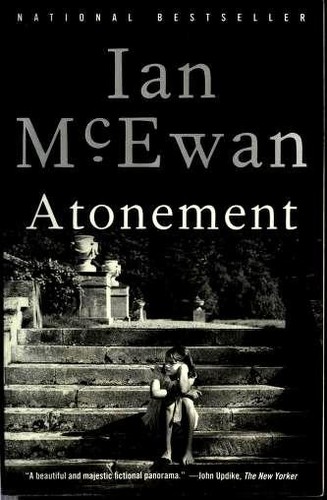
Atonement
A Novel
Ian McEwan's Atonement opens on an oppressively hot day in 1935 at an English country house. Thirteen-year-old Briony Tallis, an aspiring writer, misreads an encounter between her older sister Cecilia and Robbie Turner, a family friend of humbler origins. The accusation she makes, shaped by a vivid imagination and a limited grasp of adult life, alters three lives for good. The novel follows the consequences through the retreat to Dunkirk and the hospital wards of wartime London, then closes with a late-century coda that changes how the earlier sections should be read. First published in 2001 and shortlisted for the Booker Prize, it is a leading example of literary fiction and historical fiction. It asks what stories can repair and what they can conceal.
Where to buy or borrow
Are you selling this book? Bookstores, publishers, authors and libraries can be listed here for free. Request a listing
About this book
Deep Overview
The novel then leaves the country house. The second part follows Robbie in 1940, in the northern French countryside during the British retreat towards Dunkirk. The third follows Briony in London, where she has entered nursing training instead of taking the university place she might have expected. Both parts are shaped by physical hardship, bureaucracy and fear, and the prose is more compressed than in the opening. They show how an act of childhood misjudgement continues to determine what the adults can do, where they can go and whom they can trust.
A short final section, titled "London 1999", changes the reader's relationship to everything before it. This profile does not describe what it does, because the effect depends on reading it unprepared. It is enough to say that the book is organised around the question of who is telling the story and for what reason. Briony's writing matters to the plot, and it also stands as the book's model of the novelist's power. A novelist can arrange events, assign blame and offer comfort, and she answers to no one for any of it.
What McEwan is trying to demonstrate is a tension between two things the novel wants at once. One is an exact, unsparing account of how a single mistaken judgement spreads, aided by class assumptions, adult reluctance to listen to a child, and the instinct to make a tidy story. The other is a recognition that a story can be a form of reparation even though it cannot undo a harm. Throughout, he keeps the reader alert to the gap between a shaped narrative and the messier facts behind it.
Key Themes
Storytelling and its power is the second major theme. Briony's early efforts, her ordering instincts and her later career show how imagination can illuminate other people and also distort them.
Perception and misreading run through all of Part One. Characters repeatedly interpret one another through partial evidence, desire, jealousy and prior assumption.
Class shapes who is believed and who is suspected. Robbie's position in the household, and the way his background affects how others respond to the accusation, matter to the plot as well as to its social meaning.
War is shown as an interruption of ordinary life and also as a continuation of damage that began earlier in private. The novel treats chaos, injury, work and endurance with a concreteness quite different from the opening section.
Memory and the reliability of narration complete the group. The book invites readers to ask how much of any account is reconstruction.
Historical Context
Literary context matters as well. The long, perceptive opening reflects the influence of modernist and earlier English novelists, with their attention to consciousness and domestic detail. McEwan then lets later sections depart from that manner. The book appeared in 2001 and was shortlisted for the Booker Prize that year. It has since been widely taught in schools and universities, and the Booker Prize organisation discusses it as a text on UK school syllabuses. A 2007 film adaptation directed by Joe Wright made the story familiar to a wider audience.
Intended Audience
It may be less satisfying for readers who want fast, constant action. The first part is slow and intricate by design. Readers who dislike formal experiment, or who are sensitive to depictions of wartime injury, a false accusation and a young person's cruelty or misjudgement, should be aware of those elements before starting. Younger teenagers will find some mature content, so it is more often assigned at the upper secondary level and above.
Reading Difficulty
The conceptual challenge is not in following events. It lies in staying alert to how the narration is constructed and noticing what the novel does with that construction. The wartime sections read faster and are more physically harrowing. The 2003 Anchor paperback is a standard print novel of several hundred pages with no apparatus that this profile can confirm, so general readers can pick it up without a study guide.
Helpful Background Knowledge
If you plan to watch the 2007 film, consider reading the novel first. The film is a faithful treatment in many respects, but the novel's effects depend on its form, which a film can only partly reproduce.
Why Read This Book?
It also stands out for its range of tone: the sultry, tense opening, the exhausted and fragmented French retreat, and the clipped routines of a wartime hospital. For readers building a reading list of modern British fiction, it is a frequent and defensible entry point to McEwan's work, and the Booker Prize organisation's guide to his books singles it out as a masterpiece by wide agreement.
Reader Takeaways
The book also gives practice in close reading. Noting who is narrating each passage, and what that narrator can or cannot know, is a transferable skill for reading other novels.
Strengths
Limitations and Cautions
Important Concepts, People, and Places
Cecilia Tallis: Briony's older sister, whose relationship with Robbie is central to the book's emotional life and is the subject of Briony's misunderstanding.
Robbie Turner: the son of a household servant and a childhood friend of Cecilia, whose fate shows how class and suspicion interact.
The Tallis house: the English country home where Part One unfolds in a single day, standing for a social order that appears secure.
The Dunkirk retreat and evacuation (1940): the military withdrawal that supplies the setting for Robbie's section and forms the book's most direct engagement with the war.
Wartime London hospitals: the setting of Briony's nursing work in Part Three, where she confronts casualties and her own conscience.
Metafiction: writing that calls attention to its own construction. The concept is essential to understanding the novel's structure and ending.
Unreliable or limited narration: the narrative practice by which accounts are filtered through partial viewpoints, a key technique in Part One.
The Booker Prize: the literary award for which the novel was shortlisted in 2001.
Jonathan Cape: the British publisher of the first edition in 2001.
Ian McEwan: the author, a British novelist whose other work includes Amsterdam, which won the Booker Prize.
Joe Wright's 2007 film: the adaptation that brought the story to a larger audience.
Questions the Book Explores
Reading Group Guide
Discussion Questions
2. How does the novel balance sympathy for Briony with judgement of her actions?
3. What role does social class play in how the accusation is received?
4. In what ways do the sections set in France and London differ in style from the opening, and what does each style make you notice?
5. How does the title shape your reading before, during and after the book?
6. What is the relationship between Briony's ambitions as a writer and her moral failure?
7. Is an apology possible without the person who was wronged? What other forms might amends take?
8. How does the novel treat war, and does it use it only as a backdrop or as a central subject?
9. After finishing, which earlier scenes did you want to revisit, and why?
10. Do you think the book's ending makes its argument stronger, weaker, or simply different? Explain.
Sources and Verification
Comments
No published comments yet.
Available editions
Paperback
First Anchor Books Edition
- Publisher
- Anchor Books
- ISBN-13
- 9780385721790