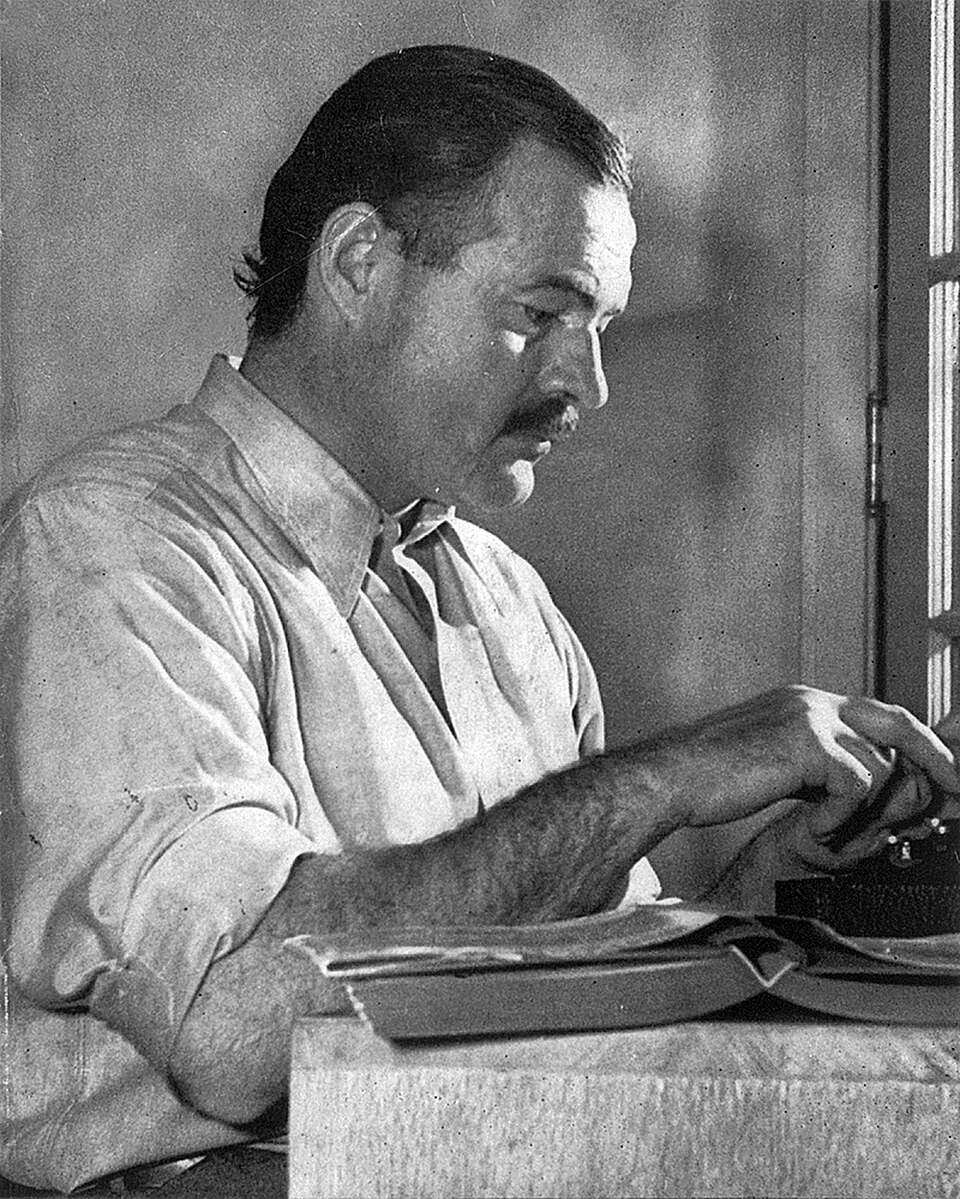
Photo of Ernest Hemingway
Photo: Lloyd Arnold · Public domain · via source

Author profile

Ernest Hemingway

American novelist, short-story writer and journalist (1899-1961). Known for spare, understated prose about war, courage and loss, including A Farewell to Arms, The Sun Also Rises and The Old Man and the Sea. Nobel laureate in Literature, 1954.

1 published book 0 published articles

About Ernest Hemingway

Ernest Hemingway was born in 1899 in Oak Park, Illinois, and began writing for a newspaper in Kansas City at seventeen. In the First World War he joined a volunteer ambulance unit serving with the Italian army. He was wounded at the front and decorated by the Italian government. Afterward he reported for Canadian and American papers and became part of the expatriate American circle in Paris in the 1920s. He died in 1961.

His fiction keeps returning to soldiers, hunters, bullfighters and fishermen, people whose courage and honesty are tested by violence or loss. The prose is economical and understated. Short declarative sentences carry the story, and much of the feeling is left unsaid. That manner shaped a great deal of twentieth-century writing.

The Sun Also Rises (1926) drew on his Paris years. For Whom the Bell Tolls (1940) grew out of his reporting on the Spanish Civil War. The short novel The Old Man and the Sea (1952) won the Pulitzer Prize in 1953, and the Swedish Academy gave him the Nobel Prize in Literature in 1954. A Moveable Feast, his memoir of Paris, appeared posthumously in 1964. A Farewell to Arms reached the screen in 1932, with Helen Hayes and Gary Cooper.

Start with A Farewell to Arms. Published in 1929, it follows Frederic Henry, an American ambulance officer in the Italian army, as the war wears away his faith in it and he ends up a deserter. It is the clearest example of his method at novel length. If you want something shorter afterward, The Old Man and the Sea can be read in an evening.

Published books

Author

A Farewell to Arms

Ernest Hemingway's 1929 novel follows Frederic Henry, an American lieutenant driving ambulances for the Italian army in the First World War. Wounded at the front, he is nursed in Milan by Catherine Barkley, an English nurse, and what begins as a casual flirtation becomes the central commitment of his life. When the Italian line collapses at Caporetto, Frederic is swept into a chaotic retreat and makes a decision that cuts him off from the army. The couple's flight toward Switzerland and a fragile private peace gives the book its second half. Written in plain, restrained prose, it is a war novel, a love story and a study of how people absorb loss. It remains one of the classic novels to read for anyone curious about modern American fiction and the literature of 1914–1918.

View book