
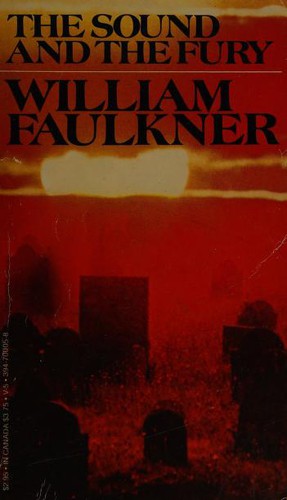
The Sound and the Fury
William Faulkner's 1929 novel traces the decline of the Compson family, once prominent in Jefferson, Mississippi, through four sections that each approach the same wreckage from a different angle. Three brothers, Benjy, Quentin and Jason, narrate in turn, followed by a third-person section centred on the family's Black housekeeper, Dilsey. The absent presence at the heart of it all is their sister Caddy. Known for its broken chronology and stream-of-consciousness prose, the book is both a demanding experiment in how fiction can render memory and a bleak portrait of family, class, race and time in the American South. It remains one of the classic novels to read for anyone curious about literary modernism.
Where to buy or borrow
Are you selling this book? Bookstores, publishers, authors and libraries can be listed here for free. Request a listing
About this book
Deep Overview
The opening section is set on 7 April 1928. It is voiced by Benjy, a thirty-three-year-old man with a profound intellectual disability. He has no tools for sequence or judgment, so his mind drifts between decades on the strength of a smell, a sound or a gate. What he registers is a world of loss. Caddy is gone, the pasture has been sold, and the ordinary rhythms of the household continue without her. Faulkner uses italics and abrupt shifts to signal the time jumps, and the reader must work out which Compson childhood scene is being replayed.
The second section is set on 2 June 1910. Quentin, the eldest brother, spends his last day at Harvard. His thoughts circle his obsession with Caddy's lost virginity, his fixation on honour and family name, and his horror at the passage of time. His language is more elaborate than Benjy's and every bit as fragmented. The scene with his sister's lover, Dalton Ames, is one of several episodes that return in distorted form.
The third section, set on 6 April 1928, belongs to Jason. He is bitter, sarcastic and relentlessly practical, and his prose is easy to follow because he trusts none of the people around him. His resentment of Caddy, his scheming over money meant for her daughter, and his casual cruelty make him the most plainly villainous of the brothers, though the book gives a rationale for his hardness. Caddy's daughter, Miss Quentin, becomes the object of his control.
The last section, set on 8 April 1928, Easter Sunday, moves outside the family's minds. Dilsey, a Black woman who has kept the household running for years, becomes its moral anchor. A church service and an ordinary, laboured walk through town shift the book from private obsession toward endurance and a kind of witness. The ending does not resolve the Compsons' fate. It leaves the reader with order restored in a minimal, ritual sense.
What Faulkner appears to be demonstrating is that no single consciousness can hold a family's story. Truth lies in the gaps among partial accounts. Time, for these characters, is not a line but a pressure. Quentin tries to escape it, Jason tries to monetise it, Benjy lives outside it, and Dilsey calmly moves through it. The book also quietly observes how a household's decline rests on the labour and silence of its Black servants, and how the Compsons' pride in name masks rot in the foundations.
Key Themes
Family decline and inherited pride run through all four sections. The Compsons cling to the memory of status while the household empties of love, money and purpose.
Loss and the figure of Caddy shape the entire structure. She is never given a narrative of her own, so the reader sees her only as the object of her brothers' longing, anger or guilt. That absence is itself a theme about who gets to speak.
Honour, sexuality and control appear in Quentin's anguished code and Jason's policing of his niece. The novel invites readers to question whose idea of purity is actually being defended.
Race and class remain present throughout. Dilsey and her family sustain the house, and the novel's most stable moral perspective comes from them, even as the Compsons treat them as background.
Language and consciousness form a quieter theme. Faulkner asks how far prose can reproduce thought, and what is lost when a mind is made legible.
Historical Context
The book also belongs to the international modernist moment. Writers such as James Joyce and Virginia Woolf had by then shown how interior monologue could replace plot as organising principle, and Faulkner adopted and adapted those methods in an American, regional setting. The title comes from Macbeth's speech about life as a story told by an idiot, full of sound and fury and signifying nothing. Faulkner turns that image against the notion that the Compsons' story is merely noise.
The novel sold modestly at first but gained a larger readership after the 1946 publication of Malcolm Cowley's The Portable Faulkner. Faulkner wrote a lengthy Appendix on the Compson family for that volume, and it was added to the novel in the Modern Library edition of the same year. Faulkner's reputation then rose further, and he received the Nobel Prize in Literature for 1949. The Vintage edition profiled here carries that Appendix, though its main text follows the first printing.
Intended Audience
It will also reward readers interested in narrative technique, unreliable narration and the relation between form and subject.
It may be frustrating for readers who want a clear linear plot, a sympathetic central figure or a fast pace. Anyone seeking light entertainment, or uneasy with painful depictions of disability, suicide, racism and sexual control, should know that the material is bleak and the form deliberately resistant.
Reading Difficulty
No specialist knowledge is needed, but patience is. Many first-time readers find it helpful to read the opening section twice or to check a character list. Notes on the edition's date markers, and the Appendix, can orient a reader, though some prefer to read the Appendix after finishing the novel.
This Vintage paperback reproduces the first printing's text, so a reader who wants the most carefully edited text may prefer a later corrected edition. The book is not long, but it reads more slowly than its length suggests.
Helpful Background Knowledge
It is useful to know the Macbeth passage that gives the book its name. Readers should also know that the book uses period racial language and describes disability in terms of its time, which Faulkner's characters use and the novel does not endorse in its own voice.
A short family tree is a practical aid, since the Compson names repeat. The author's later Appendix summarises the family's history, but it contains details that contrast with the novel itself, so it is best treated as Faulkner's after-the-fact commentary rather than a plot key.
Why Read This Book?
This particular edition also offers something specific. The Vintage V-5 paperback pairs the novel as first printed in 1929 with Faulkner's Appendix, so a reader can see both the original design and the author's later reflections on it. The novel also repays rereading: the second encounter, when the time jumps are no longer opaque, often reveals the emotional logic that the first pass obscured.
Reader Takeaways
They may reconsider how the book treats time, noticing the distinct ways each brother tries to flee, hoard or ignore it.
They may notice how much of the plot is told through objects, smells, weather and repeated phrases rather than events.
They may also reassess Dilsey, Caddy and Miss Quentin, who are essential to the story's moral weight even though they are not its principal narrators.
Strengths
Its structure rewards close reading: images and phrases return with changed meaning, and the order of the sections gradually clarifies earlier ones.
The novel is compact for how much it covers, and the last section provides a measure of shape and release after two demanding monologues.
It is also a rich teaching text, supported by decades of criticism, which makes it easy to extend discussion with outside reading. Its portrait of the Compsons is unsparing without being simplistic.
Limitations and Cautions
The racial dynamics are a matter of continuing critical debate. Some readers see Dilsey as a dignified moral centre, while others argue that the novel still places Black characters in supportive roles around a white family's tragedy. Both views are legitimate topics for discussion.
Caddy never narrates, which some regard as a deliberate comment on silence and others as a limitation of perspective.
The edition profiled here reproduces the first printing's text. Later corrected editions differ in some details, so readers comparing page references or quotations should check which text they are using. The Appendix was written long after the novel and includes details that do not always match it.
Important Concepts, People, and Places
The Compson family: the central household, whose decline links the four sections. Jason Compson III and Caroline Compson are the parents, and their failures shape their children's damage.
Benjamin (Benjy) Compson: the youngest son, whose section opens the novel and whose perception is organised by sensory association.
Quentin Compson: the eldest son, whose 1910 section ends in suicide at Harvard. He is bound to ideas of family honour and his sister's reputation.
Candace (Caddy) Compson: the sister whose life is pieced together through her brothers' memories and who never narrates.
Jason Compson IV: the third brother, whose section exposes bitterness, greed and control.
Miss Quentin: Caddy's daughter, raised in the Compson house, whose rebellion drives the later action.
Dilsey Gibson: the Black housekeeper who anchors the final section and offers the book's steadiest moral perspective.
Dalton Ames: Caddy's early lover, central to Quentin's fixation.
Jefferson, Mississippi, and Yoknapatawpha County: Faulkner's fictional setting for much of his work.
Stream of consciousness: the narrative technique that renders thought as it occurs, central to Benjy's and Quentin's sections.
The Compson Appendix: Faulkner's 1946 account of the family's history, written for Malcolm Cowley's The Portable Faulkner and attached to later editions, including this one.
Macbeth: the Shakespeare play from which the title is taken.
Questions the Book Explores
What happens to a household when its identity depends on pride in a past that no longer supports it?
How do different people live with time: by resisting it, exploiting it, forgetting it or enduring it?
Who is allowed to speak in a family's history, and what does Caddy's silence imply?
How do ideas of honour and purity turn into forms of control?
What does the novel suggest about the labour and moral work of those who sustain a household without owning its story?
How far can prose capture thought, and what does that attempt cost the reader?
Reading Group Guide
Bring a one-page list of the characters and a rough timeline. Each member could track one recurring motif, such as water, shadows, clocks, gates or the smell of rain, and report how it changes between sections.
Some groups find it useful to have one person read a short passage from Benjy's section aloud, then compare it with a similar scene in Quentin's.
Consider saving the Appendix until the group has finished the novel, then discuss whether it clarifies or complicates what the narrators said.
The prompts below work as book discussion questions for groups of different experience levels. Because the novel contains upsetting material, set expectations early that members may want to discuss painful scenes with care.
Discussion Questions
2. Why might Faulkner have chosen to give Caddy no narrative section of her own?
3. Compare how Quentin and Jason each respond to the family's loss of status. What does each want, and what does each fear?
4. In what ways does the final section change the book's tone and moral perspective?
5. How does Dilsey's relationship to time differ from that of the Compson brothers?
6. Which images or phrases recur across sections, and how does their meaning shift?
7. Does the novel invite sympathy for any of the Compsons, even those who behave badly?
8. How do you read the novel's treatment of race and class, and does it challenge or reproduce the household's blind spots?
9. What does the title add to your understanding of the story?
10. If you read the Appendix, did it change your view of any character?
Sources and Verification
Comments
No published comments yet.
Available editions
Paperback
Vintage Books V-5 paperback, with the Appendix
- Publisher
- Vintage Books
- ISBN-13
- 9780394700052