
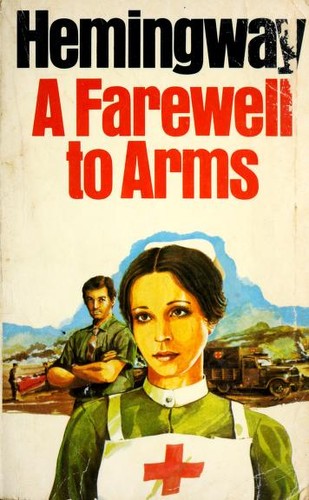
A Farewell to Arms
Ernest Hemingway's 1929 novel follows Frederic Henry, an American lieutenant driving ambulances for the Italian army in the First World War. Wounded at the front, he is nursed in Milan by Catherine Barkley, an English nurse, and what begins as a casual flirtation becomes the central commitment of his life. When the Italian line collapses at Caporetto, Frederic is swept into a chaotic retreat and makes a decision that cuts him off from the army. The couple's flight toward Switzerland and a fragile private peace gives the book its second half. Written in plain, restrained prose, it is a war novel, a love story and a study of how people absorb loss. It remains one of the classic novels to read for anyone curious about modern American fiction and the literature of 1914–1918.
Where to buy or borrow
Are you selling this book? Bookstores, publishers, authors and libraries can be listed here for free. Request a listing
About this book
Deep Overview
Catherine Barkley enters as someone already damaged by the war, because her fiancé was killed on the Somme. The early courtship is a performance, a game played with nervous irony, and both characters half-know it. The turning point comes after Frederic is wounded by a trench-mortar shell. In the Milan hospital, intimacy replaces pretence. Catherine becomes pregnant, the head nurse, Miss Van Campen, disapproves, and the lovers are separated when Frederic is sent back to duty.
The third book is the centre of the novel's moral argument about war. The Austro-German breakthrough at Caporetto turns the army into a mass of exhausted men on clogged roads. Frederic shoots an insubordinate sergeant. He then watches battle police seize and execute officers at a river crossing and escapes by plunging into the water. His decision to leave the army is not presented as a speech or a principle. It happens as a bodily act of survival, followed by the quiet recognition that his obligation to the war is over. In effect this is the farewell of the title, with the idea of a farewell to weapons built into the phrase.
The last two books reverse the pressure. In Stresa and then Switzerland, Frederic and Catherine seem to have escaped history. They live on small pleasures, such as walking, planning and waiting for the child. Yet the book remains alert to threats of another kind: the physical fact of childbirth and the limits of medicine. Hemingway withholds consolation. The ending is brief, undramatic and heavily restrained, which makes it one of the best-known closing scenes in American fiction.
A central tension is between language and experience. Frederic distrusts large abstractions such as glory and sacrifice, and prefers the names of villages, roads and numbers. That scepticism has a cost, because it also makes it hard for him to speak about grief. The novel asks whether plainness is a form of honesty or a way of not looking. Its answer is left to the reader.
Key Themes
A second theme is the private world as a refuge that cannot hold. The lovers build a self-sufficient relationship that treats the war, and later the outside world, as a distraction. The book tests how far that retreat can succeed.
Chance and vulnerability run through the story. Injuries, weather and bureaucratic accidents determine outcomes more than character does, and the narrator repeatedly says that bravery and virtue offer little protection.
The book also explores masculine identity under strain: stoicism, drinking, competence with tasks, and the difficulty of expressing fear or tenderness. Faith appears in muted forms, in the priest's quiet decency and in Frederic's inability to believe in a sustaining order. The pull between duty and desertion gives the third book its ethical weight, and the role of control, in matters from love to childbirth, ties these threads together.
Historical Context
Hemingway served as an ambulance volunteer in Italy in 1918 and was wounded. According to the National Endowment for the Arts' reader resources, he fell in love in hospital with a nurse named Agnes von Kurowsky, who was seven years older and who rejected his marriage proposal. Those events are the personal root of the love plot, though the novel changes them greatly.
The book appeared in 1929, a period when disillusioned war writing was prominent in English, French and German. The text first ran in six installments in Scribner's Magazine, where editors softened some language. According to Scott Donaldson's scholarly study of the novel and censorship, the Boston police chief banned one installment on 20 June 1929. The book was published by Charles Scribner's Sons on 27 September 1929 and sold strongly. A Hollywood version in 1932 starring Gary Cooper and Helen Hayes added a happier ending, and the NEA notes the novel was filmed twice, so those looking for books made into movies will find adaptations that diverge from the book.
Intended Audience
It is also a natural choice for classrooms and reading circles, because the style rewards close reading and the ethical questions invite debate.
Readers who want fast plotting, elaborate interior monologue or detailed military history may be less satisfied. Those uneasy with the book's period attitudes toward women, drinking and casual language, or with its bleak ending, should know what to expect.
Reading Difficulty
Pacing is uneven by design. The first third moves slowly through routines at the front. The retreat is tense and fast, and the Swiss chapters slow again. Chapters are brief, and the five-book structure makes the novel easy to read in short sessions.
This 1977 paperback is a mass-market edition of about 256 pages, so print may be small by modern standards. It has no apparatus of the kind found in annotated editions, so readers wanting notes on Italian place names or military terms will need a reference source.
Helpful Background Knowledge
It also helps to know that Hemingway's style was deliberately minimal and that his fiction often treats feeling as something implied. Readers who know the idea of the so-called Lost Generation, the writers and expatriates shaped by the war, will find useful context. A glance at a map of northern Italy and Switzerland will make Frederic's route clearer.
Why Read This Book?
It offers a distinctive view of the Great War: not the western-front trenches familiar from many English-language accounts but the mountains, hospitals and roads of Italy, where political failure and personal dislocation shaped the narrative. The retreat sequence is among the strongest war writing of the period.
It also rewards comparison. The love story can be read against the war narrative, the final pages against the scandal of the serialization, and the book against the film versions. For readers interested in how texts change, later editions that print the alternative endings reveal how carefully the closing was worked.
Reader Takeaways
Readers may notice how the novel turns a romance into an examination of vulnerability, and how often the characters speak about control while events escape it. They may also notice how rain, rivers, mountains and plains act as a moral map. Finally, the book invites a closer look at how a writer's biography can inform fiction without fixing its meaning.
Strengths
Limitations and Cautions
The book is told only from Frederic's viewpoint, so Italian soldiers and civilians are seen from outside. It is not a technical or comprehensive history of the Italian front, and some episodes are condensed for dramatic effect. Attitudes and language reflect the 1920s, and the ending is painful, with a stillbirth and a death.
This particular 1977 paperback prints the standard text without the scholarly apparatus and alternative endings found in later editions.
Important Concepts, People, and Places
Catherine Barkley: the English nurse whose relationship with Frederic anchors the book. Her grief for a dead fiancé shapes her early behavior.
Rinaldi: Frederic's surgeon friend, who represents the war's cynicism and fatigue.
The priest: a gentle counterweight to the officers' mockery who offers a different idea of faith and endurance.
Miss Van Campen: the head nurse at the Milan hospital, whose disapproval separates the lovers.
Battle of Caporetto: the Italian defeat of 1917 that triggers the retreat and exposes the army's brittleness.
The Tagliamento river: the crossing where battle police interrogate and execute officers, and where Frederic escapes.
Milan and Stresa: the hospital city and lakeside town that mark stages of the romance.
Switzerland: the neutral refuge where the couple's last chapter takes place.
Agnes von Kurowsky: the nurse Hemingway knew in 1918, often cited as the inspiration for Catherine.
Maxwell Perkins and Scribner's: the editor and publisher who shaped the novel's serialization and censorship.
George Peele: the sixteenth-century poet whose poem supplied the phrase used as the title, as noted by some reference sources.
Questions the Book Explores
Reading Group Guide
Participants might compare a passage of dialogue between Frederic and Catherine with one between Frederic and Rinaldi, noting differences in register. Because several editions exist, ask members to note which edition they used. Anyone who has seen a film version can compare how it handles the ending. A short discussion of the censorship history can also help the group consider how context shaped readers' first responses to the book.
Discussion Questions
2. Is Frederic's decision at the river an act of desertion, survival, conscience, or something else? Does the novel ask you to judge him?
3. How does Catherine's early statement about their relationship as a game change as the story goes on?
4. Do you find Catherine a fully realized character? What do you make of the criticism that she exists mainly to serve Frederic?
5. How does Hemingway use weather, rivers and mountains to shape mood and meaning?
6. What role does the priest play, and how does his view of faith compare with Rinaldi's?
7. Why might Hemingway have been so careful about the ending, and what does its brevity do?
8. If a film adaptation softens a tragic ending, what is lost, and what might audiences gain?
9. What does the novel suggest about the possibility of a private peace in a public catastrophe?
Sources and Verification
Comments
No published comments yet.
Available editions
Paperback
1977 paperback reissue (Grafton / Triad imprint); original novel first published 1929 by Scribner
- Publisher
- Grafton
- ISBN-13
- 9780586044711
- Pages
- 256