
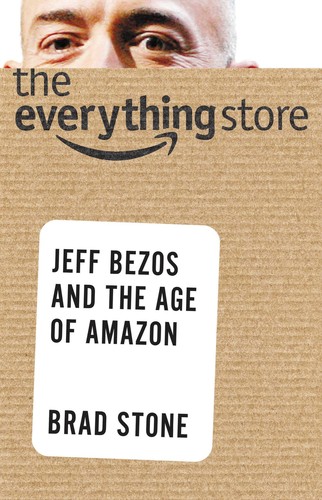
The Everything Store
Jeff Bezos and the Age of Amazon
Brad Stone’s The Everything Store traces Amazon’s transformation from an online bookseller into a company determined to sell, build, and operate nearly everything. Its central figure is founder Jeff Bezos, whose appetite for expansion shapes the company’s strategy, demanding culture, technological ambitions, and dealings with competitors. Stone follows Amazon through early funding crises, the dot-com collapse, the development of its fulfillment network, and major initiatives such as Marketplace, Amazon Prime, the Kindle, and Amazon Web Services. The result is both a company history and a portrait of a leader whose long-term thinking repeatedly pushed Amazon beyond conventional retail. Written before Amazon reached its later scale, the book is best read as an account of the formative decisions, conflicts, and management principles that established its trajectory—and as an investigation of the human and commercial costs accompanying relentless growth.
Where to buy or borrow
Are you selling this book? Bookstores, publishers, authors and libraries can be listed here for free. Request a listing
About this book
Deep Overview
That pursuit required Amazon to survive conditions that repeatedly threatened it. Stone recounts the company’s early dependence on outside capital, its rapid expansion during the internet boom, and the severe pressure it faced after the dot-com collapse. These episodes illuminate an important feature of the company’s development: its willingness to accept present expense and institutional strain in exchange for a stronger future position. Warehouses, software systems, distribution capacity, and new categories could look wasteful before their strategic value became visible.
The narrative also explores the operating culture that formed around Bezos. Amazon’s ideals of customer focus, measurable performance, frugality, speed, and rigorous debate helped it challenge established retailers. Yet Stone does not treat those ideals as uncomplicated virtues. The same culture could generate harsh meetings, exhausting expectations, conflict among executives, and limited tolerance for ideas that failed to withstand aggressive scrutiny. Amazon’s success therefore appears inseparable from questions about what relentless institutional ambition asks of employees and partners.
Several major developments show Amazon becoming more than a retailer. Marketplace brought outside sellers onto Amazon’s platform, expanding selection while giving the company a role in transactions it did not fulfill directly. Prime altered consumer expectations by turning faster delivery into an ongoing membership benefit. The Kindle allowed Amazon to influence the creation, distribution, pricing, and consumption of books, bringing it into conflict with publishers. Amazon Web Services emerged from the company’s internal technical needs and converted computing infrastructure into a service other organizations could rent.
Stone also follows competitive confrontations and acquisitions, including Amazon’s relationships with Zappos and Quidsi, the parent of Diapers.com. These cases raise questions about the power of scale, the legitimacy of aggressive pricing, and the difficulties smaller firms face when confronting a company able to tolerate substantial short-term losses. By connecting such campaigns to Bezos’s personality and Amazon’s wider systems, the book argues implicitly that transformative companies are built through more than inspired products. They arise from capital allocation, logistics, organizational discipline, technological infrastructure, and a leadership philosophy capable of aligning those elements—sometimes at considerable cost.
Key Themes
**Customer focus and its tensions:** Decisions are justified through lower prices, greater selection, and convenience, but benefits to customers may impose pressure on employees, suppliers, publishers, and competitors.
**Scale as strategy:** Warehouses, data, purchasing power, technical platforms, and transaction volume reinforce one another, making size a competitive capability rather than merely an outcome.
**Corporate culture as an operating system:** Frugality, metrics, internal argument, and high standards shape which people thrive at Amazon and how the company converts ideas into action.
**Expansion beyond retail:** The Kindle, Marketplace, and Amazon Web Services demonstrate how an online store can become a platform owner, device maker, infrastructure provider, and intermediary.
**Founder influence:** Bezos’s temperament and priorities are presented as deeply embedded in Amazon’s institutions, making it difficult to separate the company’s identity from its founder.
Historical Context
The dot-com investment boom supplied young internet companies with capital, but its collapse around 2000 exposed fragile business models and forced survivors to demonstrate operational discipline. Amazon’s endurance through that period is crucial to the book’s argument. Its later growth also coincided with faster household internet connections, improving digital payments, increasingly sophisticated data analysis, and expanding delivery networks.
The Kindle story belongs to a separate transformation in publishing: the shift from physical books toward digital files, devices, and platform-controlled marketplaces. Amazon Web Services reflects another historical change—the movement from organizations owning computing infrastructure toward renting capacity through cloud services. These contexts explain why Amazon’s history is simultaneously a story about retail, media, logistics, and computing.
Intended Audience
It may be less suitable for someone seeking a current account of Amazon, a practical start-up handbook, or a comprehensive study of labor conditions and public policy. The book is investigative and narrative rather than academic, and its attention to strategy and senior leadership outweighs its treatment of ordinary consumers or warehouse employees.
Reading Difficulty
Business terminology is usually understandable from context, although familiarity with the dot-com era helps readers appreciate the financial risks. The book also moves among biography, corporate conflict, technological development, and operational detail, so readers may benefit from noting when an episode concerns Amazon’s retail business, its publishing ambitions, or its computing infrastructure.
Helpful Background Knowledge
Readers do not need detailed knowledge of publishing or cloud computing. However, remembering that the Kindle affected publishers as well as readers—and that Amazon Web Services sells computing capacity rather than consumer merchandise—will clarify why these initiatives represented fundamental expansions of the company’s power.
Why Read It?
It is particularly valuable for resisting two easy explanations of corporate success: that a visionary founder simply predicted the future, or that technology alone defeated older businesses. Stone instead shows an institution accumulating advantages through repeated experiments, costly infrastructure, disciplined execution, acquisitions, and intense competitive pressure. The book also gives readers a foundation for evaluating Amazon’s later history, because many subsequent debates about scale, labor, platforms, and market power begin with the practices described here.
Reader Takeaways
Readers may reconsider the relationship between consumer benefit and corporate power. Lower prices and greater convenience can coexist with concentrated leverage over suppliers and competitors. They may also notice how companies move into new industries by converting internal capabilities into products: Amazon’s technical infrastructure, developed for its own operations, helped enable Amazon Web Services.
Finally, the book encourages skepticism toward founder mythology. Individual vision matters, but execution depends on teams, financing, warehouses, software, negotiations, and institutional learning.
Strengths
The book is strongest when it connects strategy to specific episodes. Product launches and competitive conflicts reveal how Amazon’s principles operated under pressure. Interviews with insiders and people connected to Bezos add detail to a company known for secrecy, while the treatment of executive turnover prevents Amazon from appearing to be the work of one person alone.
Its tone is neither a simple celebration nor a blanket condemnation. Amazon’s innovations and discipline remain visible, but so do the strains created by its culture and tactics.
Limitations
The narrative concentrates on Bezos, senior executives, major strategic choices, and corporate competition. Warehouse labor, delivery work, environmental consequences, taxation, antitrust doctrine, and the experiences of third-party sellers are not examined with the same depth. Its portrait of private meetings also depends on interviewees’ memories and interpretations.
The book is reported history rather than an independently auditable account of every disputed exchange. Bezos did not provide Stone with extensive direct cooperation, and some people close to Amazon publicly challenged aspects of the portrayal after publication. Readers should therefore distinguish well-supported institutional history from reconstructed motives or conversations that may remain contestable.
Important Concepts and People
**Amazon:** The institution at the center of the narrative, evolving from an online bookstore into a retailer, marketplace, device maker, and computing-services provider.
**MacKenzie Bezos:** Jeff Bezos’s then-wife and an important figure in Amazon’s early history; she later publicly disputed parts of Stone’s account.
**Shel Kaphan:** An early Amazon technical leader whose work helped establish the original online store and whose experience illuminates changes in the company as it grew.
**Rick Dalzell:** A senior executive associated with the technical and organizational systems required to operate Amazon at increasing scale.
**Joy Covey:** Amazon’s early chief financial officer, important to its financing and emergence as a public company.
**Andy Jassy:** The executive closely associated in the book with the development of Amazon Web Services, which turned internal computing capabilities into a major external business.
**Ted Jorgensen:** Bezos’s biological father. Stone’s search for him adds a personal strand to the biography and raises questions about the place of family history in business reporting.
**Amazon Marketplace:** The system allowing outside merchants to sell through Amazon, broadening selection while increasing Amazon’s role as a platform and intermediary.
**Amazon Prime:** A membership program that uses shipping benefits to deepen customer loyalty and encourage more frequent purchasing.
**Kindle:** Amazon’s electronic-reading device and ecosystem, significant because it extended the company’s influence into publishing and digital distribution.
**Amazon Web Services:** Cloud-computing infrastructure sold to other organizations, demonstrating Amazon’s movement beyond retail.
**Zappos and Quidsi:** Online retailers whose encounters with Amazon illustrate acquisition strategy, competitive pricing, and the difficulty of challenging a larger rival.
Questions the Book Explores
Which parts of Amazon’s advantage came from technology, and which came from capital, logistics, culture, or leadership?
Can customer-centered innovation be separated from the pressure placed on workers, suppliers, and competitors?
When does long-term investment become strategic foresight, and when does it become an excuse for weak short-term performance?
How does a founder’s personality become embedded in an organization’s routines and values?
What allows a retailer to become a platform, media intermediary, device company, and infrastructure provider?
At what point does aggressive competition begin to raise broader concerns about market power?
Reading Group Guide
Compare three turning points: survival after the dot-com crash, the creation of the Kindle, and the launch of Amazon Web Services. For each, identify what Amazon risked, what existing capability it used, and why competitors might have underestimated the move.
Examine the relationship between stated principles and lived culture. Groups can track examples of customer focus, frugality, measurement, and high standards, then discuss where each principle produces both benefits and harms.
The Zappos and Quidsi episodes offer a useful case study in competitive ethics. Consider the same events from the perspectives of Amazon, the smaller company, investors, employees, and customers.
Conclude by listing developments that occurred after the book’s reporting period. This helps distinguish the history Stone documents from later knowledge readers may unconsciously project backward.
Discussion Questions
2. Which early decision most clearly established Amazon’s later trajectory?
3. When does willingness to endure losses represent sound long-term strategy rather than reckless expansion?
4. Are low prices and convenience sufficient evidence that a company is serving the public well?
5. Which aspects of Amazon’s culture appear essential to innovation, and which appear unnecessarily destructive?
6. How did the dot-com crash strengthen Amazon rather than merely threaten it?
7. What did the Kindle change about Amazon’s relationship with books, authors, publishers, and readers?
8. Why was Amazon Web Services a more fundamental departure from retail than Marketplace or Prime?
9. How should readers judge Amazon’s conduct toward Zappos and Quidsi?
10. What does Ted Jorgensen’s story contribute to the book’s interpretation of Bezos?
11. Which perspectives receive too little space in the narrative?
12. How does knowing Amazon’s later history change your interpretation of the risks described in this 2013 account?
Sources and Verification
Comments
No published comments yet.
Available editions
Hardcover
First edition, hardcover
- Publisher
- Little, Brown and Company
- ISBN-13
- 9780316219266
- Publication date