Deep Overview
The book begins with the Ainulindalë, a creation account in which the supreme being, Eru Ilúvatar, calls the Ainur into a great musical theme. One of the mightiest of them, Melkor, introduces discord into it, and from that moment evil is part of the shape of the world. The Valaquenta then sketches the Valar, the angelic rulers who enter the world, and their lesser companions the Maiar. It also introduces Melkor, who will be renamed Morgoth, the Dark Enemy of the First Age.
The core of the volume is the Quenta Silmarillion, the history of the Elves in the First Age. It centres on the Silmarils, three jewels made by the Elf-smith Fëanor that hold the light of the Two Trees of Valinor. When Morgoth destroys the Trees and steals the jewels, Fëanor and his followers swear a terrible oath and leave the Blessed Realm for Middle-earth. The oath draws the Noldor into a long war that the narrative treats as both heroic and doomed. The text keeps showing that the kindest or bravest motives can lead to ruin once pride, vengeance, or a binding vow is involved.
Within this broad chronicle, a few episodes are told at greater length. Beren, a mortal, and Lúthien, an Elven princess, undertake an impossible quest to take a Silmaril from Morgoth's crown. Túrin Turambar, a mortal fighter pursued by a curse laid on his family, moves through a sequence of misjudgments and misfortunes. The hidden city of Gondolin falls through betrayal. The tales are not isolated, because their consequences carry from one into the next. The jewel won by Beren and Lúthien is later central to the fortunes of Eärendil, whose voyage to the West finally prompts the Valar to intervene against Morgoth.
The Akallabêth then turns to Númenor, the island kingdom given to the Men who sided with the Elves. It recounts how the kings' fear of death and their resentment of the Valar's prohibition lead to their ruin, with Sauron playing a corrupting role. The last section, Of the Rings of Power and the Third Age, compresses the forging of the Rings and the long struggle with Sauron, and it links this mythic history to the events of The Lord of the Rings.
Taken together, the five parts show a world that begins in harmony, is damaged from within, and survives through partial recoveries rather than complete victories. The author is not trying to prove a thesis in the way a work of nonfiction does. He builds a mythology in which beauty, loss, memory, and moral responsibility are bound together, and he uses the shifting scale of the narrative to make readers feel the weight of ages.
Key Themes
Fall and diminishment run through the whole book: the world is made in harmony, yet each age is poorer than the one before. The book also treats the corrupting force of possessiveness, since the Silmarils inspire love and craftsmanship but also obsession and oaths that cannot be kept without harm. Mortality and death are central, especially in the contrast between Elves, bound to the world for as long as it lasts, and Men, who die and whose fate lies beyond it. Fate and free will recur, notably in the story of Túrin and in the way a binding vow narrows the choices of those who swear it. Pride, vengeance, and the pursuit of power are shown as repeated ways of turning good ends toward harm. Alongside these, the book sustains a quieter theme of hope and redemption: small acts of mercy, courage, or self-sacrifice open possibilities that no one could foresee. Finally, it explores art as a form of making, from the musical origin of the world to the craft of the jewels, and asks what it means to create something and then lose control of it.
Historical Context
Tolkien was an Oxford philologist who studied early Germanic languages and medieval literature, and the book grew from his wish to give invented languages a mythology in which they could live. His reading in Old English, Norse, and Finnish traditions informs the tone, though the work is not a retelling of any one of them. He began his earliest tales in the 1910s, in the shadow of the First World War, in which he served as a young officer. Many readers connect the war's atmosphere of loss and grim endurance with the book's tragic character, though Tolkien himself resisted simple allegory. His Catholic faith also shapes the moral outlook of the work, especially its treatment of creation, grace, and the limits of power.
After The Hobbit appeared in 1937, Tolkien offered his legends to the publisher, who wanted a sequel instead, and this led to The Lord of the Rings in the mid-1950s. He kept reworking the older mythology without bringing it to a finished state, and he died in 1973. Christopher Tolkien then prepared the 1977 volume. He later issued the twelve-volume History of Middle-earth, which published earlier drafts and shows how different the evolving material was from the version in this book. According to the Wikipedia account of the book's reception, it sold well but received generally poor reviews, and it won the Locus Award for best fantasy novel in 1978. Scholars have also noted that the editorial role was substantial, which is part of the book's history and interpretation.
Intended Audience
The book is best suited to readers who have finished The Lord of the Rings and want to know where its ruins, songs, and names come from. It also appeals to people who enjoy mythology, saga, and legend, and to students of fantasy who want to see where much of the genre's imagery of Elves, dark lords, and cursed treasure began. Readers interested in how a literary tradition is built by one imagination over decades will find it rewarding. It is less suitable for readers who want fast, dialogue-driven plots, continuous point-of-view characters, or comfortable resolutions. Young readers may enjoy the stories but should expect archaic phrasing and a large cast. Those who have not read Tolkien before may be better served by starting with The Hobbit.
Reading Difficulty
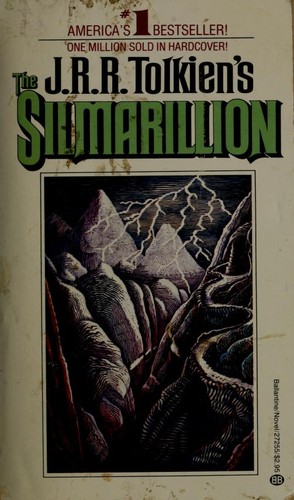
The difficulty is moderate to high, and it comes from density rather than technical vocabulary. The prose is deliberately elevated and archaic, with long genealogies, frequent shifts between similar-sounding names, and stretches of summary that cover centuries in a few paragraphs. The opening creation chapter is abstract and can feel remote. The pace picks up when the narrative slows into the individual tales, especially the stories of Beren and Lúthien and of Túrin. The book is not long, but readers often go slowly. Keeping the maps, the family trees, and the index of names nearby, as the book was originally published with them, is practical help. This is a 458-page mass-market paperback with small print, which some readers may find tiring, and a book of this kind often rewards being read in short sittings.
Helpful Background Knowledge
No prior study is required, but some familiarity with The Hobbit and The Lord of the Rings makes many names and references meaningful: the Rings, Sauron, Elrond, the Elves' departure west, and the Númenórean ancestry of Aragorn. A basic idea of how myth and legend differ from the novel helps, because the book often states events at a distance and with little interior psychology. Readers can also benefit from knowing that this is a posthumously edited book, assembled from drafts of different dates, so small inconsistencies or abrupt shifts of tone are part of its nature. Tolkien's interest in language is a useful guide: many names are built from his invented Elvish tongues, Quenya and Sindarin, and their meanings sometimes illuminate the stories.
Why Read This Book?
Reasons to choose this book are specific. It is the primary source for the mythology behind Middle-earth, and a reader who wants to know why the Elves are sorrowful, why the Rings matter, or why the Silmarils are mentioned in the songs of later ages will find the explanations here. It also contains some of Tolkien's most affecting writing, especially in the tragedies of the First Age, which are darker and more fatalistic than anything in the more famous novels. It is a rare chance to read an author's private mythology in a shape close to what he intended, while also seeing the editor's role in preparing it. For readers seeking books like The Lord of the Rings, it is the better choice if what they want is mythic depth rather than a repeat of the same adventure. Finally, it offers an alternative model for how epic fantasy can be written, as legend and chronicle rather than journey and character study.
Reader Takeaways
A careful reader may come away understanding how Tolkien's world is structured, from the divine order to the lines of Elven houses and Númenórean kings, and how each age shapes the next. They may reconsider the idea that fantasy is escapist, since the book dwells on loss, wrongdoing, and consequence. They can notice how repeated patterns, such as oaths, stolen treasures, and doomed rebellions, build a moral logic across the stories. They will also gain a fuller sense of what the later novels are echoing when they mention ancient events. Readers may also learn to read an unfinished, posthumously edited text with an eye to who shaped it, and to treat the book as one stage in a long creative process rather than a final statement.
Strengths
The book has remarkable range, moving from a metaphysical creation story to intimate tragedy while keeping a recognizable vision. Its best episodes combine a legendary scale with emotional force, and the use of echoing motifs gives the history coherence. It offers a very rich and consistent invented world, with names, languages, and geography that interlock. It is also historically important, because it shows the mythological ground behind one of the most influential fantasy works of the twentieth century. The structure, which places a creation myth first, then a legendary history, then a bridge to the better-known story, gives readers a clear route through very large material. Christopher Tolkien's editorial work made a complex body of drafts available as a single readable narrative.
Limitations and Cautions
The summary style that gives the book its mythic quality can also make it feel remote, with fewer scenes, less dialogue, and characters who are sometimes sketched rather than developed. The enormous cast and the similar names can be hard to track. Because it is a posthumously edited compilation, some readers and scholars question the editorial choices. Christopher Tolkien himself composed some material to fill gaps, notably in the chapter on the ruin of Doriath, and he later expressed reservations about the method. Later publications, including the History of Middle-earth, show that Tolkien's ideas continued to change, so this is one version of the mythology rather than a fixed final form. Reviewers at the time were often unenthusiastic, and the book remains more demanding than the novels. Finally, this profile describes a 1979 mass-market paperback printing, and readers wanting maps, illustrations, or a modern page layout may prefer a more recent edition.
Important Concepts, People, and Places
Eru Ilúvatar is the creator, whose theme the Ainur sing and who stands above the whole drama. The Ainur, divided into the Valar and the Maiar, are the powers who shape and govern the world; Melkor, later called Morgoth, is the rebel among them and the chief source of evil in the First Age. Sauron, a Maia in Morgoth's service, links this history to The Lord of the Rings. Arda is the world itself, and Valinor, the Blessed Realm in the West, is the home of the Valar and the origin of the Two Trees, Telperion and Laurelin, whose light is preserved in the Silmarils. Fëanor, the greatest Elven craftsman, makes the jewels and swears with his sons the Oath that drives the war. Beleriand is the western land where most of the First Age takes place, home to the Elven realms of Doriath, Nargothrond, and Gondolin. Thingol and Melian rule Doriath; their daughter Lúthien and the mortal Beren bring the story of the first recovered Silmaril. Túrin Turambar is the cursed hero of the longest tragedy. Eärendil is the mariner who carries a plea to the Valar and becomes a star. Númenor is the island realm of the Edain, whose downfall is told in the Akallabêth, and Elendil's escape from it leads to the later kingdoms of Gondor and Arnor. The Rings of Power, made by Elven smiths under Sauron's influence, close the book. Christopher Tolkien is the editor who shaped the work, and Guy Gavriel Kay was his assistant in preparing it.
Questions the Book Explores
Why does a world made in harmony contain discord, and is evil a distortion of good or something independent of it? How far do oaths, promises, and inherited loyalties bind a person's choices? What distinguishes the gift of mortality from the burden of endless life? Can art and craft be innocent when they inspire obsession and conflict? Can resistance to overwhelming power have meaning when victory is only partial? To what extent do individuals shape history, and to what extent does history shape them? Finally, in what ways can a myth be shaped by editors and later hands, and what does that mean for its authority?
Reading Group Guide
This is a book to read in stages rather than all at once. A group might read the Ainulindalë and Valaquenta for a first meeting and talk about the creation myth and the nature of the powers. It could then split the Quenta Silmarillion into three or four sessions, perhaps pausing at the flight of the Noldor, the tale of Beren and Lúthien, the tale of Túrin, and the fall of Gondolin. A final meeting can take on the Akallabêth and Of the Rings of Power. Members who have read The Lord of the Rings can point out echoes, while newcomers can say which names or scenes mattered to them without that background. A shared sheet with family trees and a map is useful. Groups may also want to compare this posthumous edition with the idea of a work that its author never completed.
Discussion Questions
1. How does the musical creation story shape your expectations for the rest of the book?
2. Is Fëanor a tragic hero, a villain, or both? What in the text supports your view?
3. Why do you think the tale of Beren and Lúthien is treated differently from the surrounding history?
4. What does the story of Túrin suggest about fate and responsibility?
5. How do Elves and Men understand death differently, and how does that affect their choices?
6. In what ways does the Akallabêth echo earlier episodes in the book?
7. Does the summary style of the narration make the events feel more distant, more solemn, or more fateful?
8. What difference does it make that the book was edited and partly composed by Christopher Tolkien after the author's death?
9. How does reading this book change your sense of The Lord of the Rings?
10. Does the book offer any real hope, or only consolation in loss?
Sources and Verification
The identity of the book and this edition was checked against a library catalogue record and an open bibliographic database, with bookseller listings used only to confirm the printing, the ISBN pair, and the page count. The history of the first publication, the editorial roles of Christopher Tolkien and Guy Gavriel Kay, and the book's reception draw on a general reference article and a specialist Tolkien reference site. Descriptions of the book's contents and themes are the editor's own synthesis based on general knowledge of the work, not a copy of any publisher or reviewer text. Sources disagree on the exact publication date of this paperback, so none is given here, and page counts differ among editions, so the figure shown applies to this printing only.