
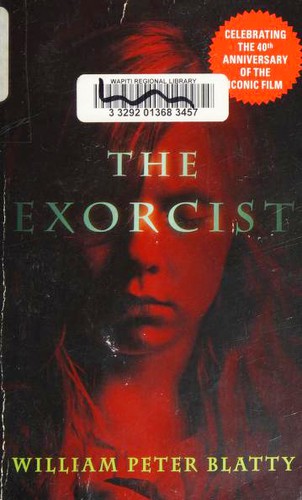
The Exorcist
William Peter Blatty's 1971 novel follows a movie actress living in a rented house in Georgetown, Washington, D.C. She watches her young daughter change from a bright child into someone terrifyingly unrecognizable. Doctors and psychiatrists run out of explanations, and the family eventually turns to the Catholic Church. The Church sends a Jesuit priest who is also a psychiatrist and is struggling with his own faith. Blatty draws on a reported 1949 exorcism case to ask what happens when medicine, skepticism and belief all fail to account for suffering. The book became a huge bestseller and one of the best-known books made into movies, yet it works as a serious, disturbing story about doubt, evil and love as well as a horror landmark.
Where to buy or borrow
Are you selling this book? Bookstores, publishers, authors and libraries can be listed here for free. Request a listing
About this book
Blatty borrows the methods of popular procedural fiction: case histories, test results, interviews and interrogations. He uses them to create a feeling of documented fact, so the supernatural events are measured against the ordinary, checkable world. The book is organized as a prologue, four numbered parts and a short epilogue. Each part narrows the focus, moving from the outside world into a single room. Meanwhile, the novel keeps returning to the spiritual lives of its adult characters, which separates it from horror that only wants to shock. Blatty wrote as a believing Catholic. However, he gives skepticism a strong voice and does not let faith win easily. That balance helps explain why theologians, critics and horror fans have all taken the book seriously.
A note on editions: Blatty revised the novel for a 40th-anniversary edition in 2011, and records for this ISBN differ on whether the printing dates from 1994 or 2013. To know whether you have the original or the revised text, check the copyright page.
Deep Overview
For much of its length the book is about diagnosis. Chris takes her daughter to physicians, neurologists and psychiatrists. Each treatment gives way to a more invasive test and a more tentative guess, and Blatty uses these scenes to show how far a secular, scientific vocabulary can go and where it stops. Chris is a skeptic who has little interest in religion, so she comes to the Church out of desperation, not conviction. Her turn to a priest for help is as much a story of reluctant concession as of belief.
The priest she meets is Damien Karras, a Jesuit who works as a psychiatrist at Georgetown and counsels fellow clergy. Karras is worn down by guilt over his declining mother and by doubts about his vocation. He is the book's moral center. He approaches Regan as a clinician and expects to find a psychological explanation, and his hesitation lets the reader share the same doubt. Alongside him is Lieutenant William Kinderman, a talkative, film-loving homicide detective who is looking into a death connected to the household. Kinderman supplies much of the novel's humor and also a quieter form of intelligence, and his investigation gives the plot a second, worldly track that sits next to the spiritual one.
Blatty's larger aim is not simply to frighten. Through Karras and Merrin he sets two kinds of faith side by side: one worn thin by experience, the other tested over many years. The possession itself is made as physically and verbally ugly as possible. The apparent purpose of the demon, as the book presents it, is to make people see themselves as vile and unlovable, and to push them toward despair. The question is how, against that, any human act of compassion can matter. The exorcism that closes the book is therefore less a spectacle than a test of the characters' capacity for sacrifice, and the novel suggests that goodness is shown through concrete acts rather than argument.
The book's real-world inspiration also shapes its tone. Blatty learned as a student of a reported 1949 exorcism involving a boy in the Washington area, and he moved the story to a girl in Georgetown. The result mixes documentary-style precision with horror, so the impossible events arrive in a setting that feels ordinary and checkable.
Key Themes
Science and the supernatural are set against each other, though not as simple opposites. Medical science is treated with respect, and its failures are shown in detail. The story wonders whether explanation and mystery can both be real.
Evil and suffering are treated as problems to be witnessed, not solved. The novel presents the possession as an attack aimed less at the body than at the dignity of the people watching it.
Parents and children, guilt and responsibility are central. Chris's anxiety as a divorced, working mother and Karras's guilt over his mother give the story an emotional base apart from the horror.
Self-sacrifice and love provide the novel's answer, in Blatty's telling, to the problem of evil. The author has said publicly that he saw the book as an affirmation of meaning, a reading that readers can weigh against their own.
Historical Context
Its immediate source is the 1949 case of a boy, known by the pseudonym Roland Doe, whose reported possession and exorcism involved Catholic priests in the Washington area and St. Louis. Blatty read about it as a Georgetown student. Researchers and skeptics have debated since then what actually happened and how the case should be interpreted, so the real events are contested and the novel should be read as fiction inspired by them, not as a record.
The book became a long-running bestseller, spending 57 weeks on the New York Times list, 17 of them at number one. Its 1973 film adaptation, with a screenplay by Blatty, widened its reach and strongly shaped how later horror treated possession.
Intended Audience
It is a poor fit for anyone who dislikes graphic, profane or sacrilegious material. The depiction of a child's possession contains disturbing sexual and violent imagery. Readers who want a fast, fright-per-page scare may also find the early chapters slow.
Reading Difficulty
Helpful Background Knowledge
Why Read This Book?
Reader Takeaways
Strengths
Limitations and Cautions
Important Concepts, People, and Places
Chris MacNeil: a famous actress and divorced mother whose rented house becomes the center of the crisis; her skepticism frames the first half of the book.
Regan MacNeil: Chris's young daughter, whose transformation drives the plot.
Father Damien Karras: a Jesuit priest and psychiatrist at Georgetown, troubled by guilt and doubt, who becomes the key figure in the final confrontation.
Father Lankester Merrin: an elderly Jesuit archaeologist whose Iraq excavation opens the book and who is later called back to face the evil he sensed.
Lieutenant William Kinderman: a homicide detective whose investigation links the supernatural events to the everyday world.
Pazuzu: an ancient Assyrian demon whose image Merrin finds in Iraq and who connects the opening scene with the possession.
Georgetown, Washington, D.C.: the setting, whose university and Jesuit presence ground the story in a real place.
Exorcism and possession: the Catholic ritual and the condition at the center of the plot.
The 1949 Roland Doe case: the reported exorcism that inspired the novel.
Jesuits: the Catholic order to which Karras and Merrin belong, whose intellectual tradition shapes the book's arguments about faith and reason.
Questions the Book Explores
Reading Group Guide
Discussion Questions
2. How does Chris MacNeil's lack of religious belief shape her choices, and did you find her reluctance convincing?
3. In what ways are Karras and Merrin different as men of faith, and what does the novel suggest about the way each is tested?
4. What role does Lieutenant Kinderman play, and why might Blatty have included a detective with such a distinctive personality?
5. The novel's source was a reported real case. Does knowing that change how you read the story?
6. What do you think the demon is trying to accomplish in the way it treats the people around Regan?
7. How does the book portray the relationship between parents and children, and how are guilt and love intertwined?
8. If you have seen the film, which scenes or ideas from the book do you think it left out, and what difference does that make?
Sources and Verification
Comments
No published comments yet.
Available editions
Paperback
First HarperPaperbacks printing (mass market paperback)
- Publisher
- HarperPaperbacks
- ISBN-13
- 9780061007224
- Pages
- 385