
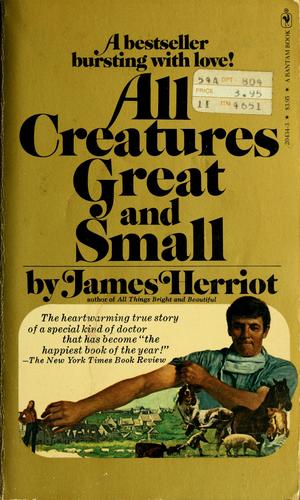
All Creatures Great and Small
All Creatures Great and Small is James Herriot's affectionate account of starting out as a country veterinarian in the Yorkshire Dales. Told in short, self-contained episodes, it follows a newly qualified young vet who finds that his training prepares him poorly for muddy farmyards, wary farmers, a mercurial senior partner and a household of eccentric companions. The edition profiled here is a Bantam paperback that gathers Herriot's first two UK books into one volume. It draws on the real career of Alf Wight, who wrote under a pen name, and it became one of the best-loved animal memoirs in English. It is also among the books turned into TV shows that keep finding new readers, and it makes a gentle, humane choice for a long read.
Where to buy or borrow
Are you selling this book? Bookstores, publishers, authors and libraries can be listed here for free. Request a listing
About this book
Herriot's method is unhurried. He builds chapters around a single animal, farm, or misadventure and lets character emerge through dialogue, comic timing, and close observation. Instead of a plot driven by suspense, the book offers a slowly deepening portrait of a place, a profession, and a young man's growing attachment to both. What distinguishes it is the combination of practical veterinary detail, much of it physically blunt, with a consistently kind view of people. The same stories later fed a film and several BBC and other television series, so anyone exploring books turned into TV shows will meet here the original material. It is also an easy fit for a reading group, since its chapters can be read and discussed separately.
Deep Overview
The structure is a loose chronology made of set pieces. In one chapter Herriot struggles through a difficult birth on a freezing night. In the next, a pampered dog and its devoted owner supply pure comedy. The book keeps moving between farm work and household life at Skeldale House, where Siegfried's younger brother Tristan, a vet in training with a talent for avoiding responsibility, and the housekeeper Mrs. Hall turn the practice into a family of sorts. A slowly developing courtship with a farmer's daughter, Helen Alderson, gives the second half a quiet emotional thread.
What Herriot is demonstrating, mostly by example, is that knowledge in this trade is earned in the field. The book contrasts scientific training with the hard-won instincts of older farmers and stockmen, and it treats both with respect. Humor depends on exaggerated personalities, but the tone shifts when an animal suffers, an owner cannot afford treatment, or a case ends badly. These darker notes keep the stories from becoming merely cozy. They show that the author's affection for animals includes accepting death and the limits of medicine.
The Yorkshire landscape is as important as any character. Dales weather, stone walls, hill farms and the seasonal rhythm of lambing and haymaking shape the work and the mood. Herriot writes about the countryside as a place he is still learning to understand, which gives even routine chapters a feeling of discovery.
The edition in this profile combines two originally separate UK books, so there is a mild change of pace partway through. By then the narrator has settled in, and the stories lean more on established relationships than on the shock of arrival. The overall effect is cumulative. A reader finishes with a sense of how one person's working life grew into a community, and of why such ordinary episodes have held readers for decades.
Key Themes
Human character through animals: owners reveal themselves in how they speak about their animals. Pride, thrift, loneliness, tenderness, and stubbornness all appear in a single consultation.
Compassion and its costs: the book values kindness to animals, but it also shows euthanasia, poverty and professional exhaustion.
The rhythms of rural life: seasons, markets, weather, and the long hours of the profession shape the stories and give them a settled sense of place.
A profession in transition: older knowledge and newer science sit side by side in the book, which captures a moment when veterinary work was changing.
Humor as affection: comedy rarely mocks for cruelty. It usually arises from eccentric people, awkward situations, and the narrator's own mistakes.
Historical Context
The author's own life gives the background. According to biographical sources, Alf Wight was born in Sunderland in 1916, raised in Glasgow, and qualified at Glasgow Veterinary College in 1939. He moved to Thirsk in 1940 to work for Donald Sinclair, the real-life model for Siegfried Farnon. The books compress and rearrange this experience, so the timeline of the narrative should not be treated as a strict biographical record.
Publishing history matters too. Herriot used a pen name partly because of professional rules at the time against vets advertising their services, according to Countryfile. His first book appeared in the UK in 1970, and the combined US volume was published in 1972 by St. Martin's Press. The books went on to inspire a 1975 film, a long-running BBC series from 1978 to 1990, and a new television series beginning in 2020, according to the franchise overview on Wikipedia.
Intended Audience
Readers who prefer fast plots, formal analysis of the veterinary profession, or contemporary perspectives on animal welfare may find it less suitable. Those who are sensitive to descriptions of animal illness and death should also be prepared, since the book does not look away from them.
Reading Difficulty
Some veterinary terms and Yorkshire expressions appear in dialogue, but context usually makes them clear. Descriptions of farm procedures, such as difficult births and surgery, can be graphic. No specialist knowledge is required.
Helpful Background Knowledge
It also helps to know that Herriot is a pen name and that the book blends lived experience with literary shaping. Readers who know the BBC television versions may find the book quieter, more digressive, and more concerned with the narrator's inner reactions.
Why Read This Book?
It is also the source of a much-adapted body of work. Readers curious about books turned into TV shows will find the stories that shaped later screen versions, along with a tone that screen adaptations can only partly reproduce. And because chapters stand on their own, the book is a flexible companion that can be picked up and put down over weeks.
Reader Takeaways
Readers may also notice how Herriot controls tone, alternating comedy with sorrow, and how much he reveals about the people around him by showing how they talk about their animals. It is also a useful example of how an author turns professional memory into storytelling.
Strengths
Limitations and Cautions
Mid-century attitudes and methods appear throughout, including treatment practices and approaches to animals that modern readers may find harsh or outdated. The pace is deliberately leisurely and episodic, which some readers may find repetitive over nearly 500 pages. Women and working-class characters are seen largely through the narrator's perspective. Finally, this mass market printing is small in format, which can be tiring for some readers.
Important Concepts, People, and Places
Siegfried Farnon: Herriot's employer and senior partner, an energetic and unpredictable figure who is generally understood to be based on Wight's real employer, Donald Sinclair.
Tristan Farnon: Siegfried's younger brother, a charming and disorganized student vet who supplies much of the book's comedy. Sources on his real-life model have not been checked for this profile.
Mrs. Hall: the housekeeper at Skeldale House, whose practical care holds the household together.
Helen Alderson: a farmer's daughter who becomes Herriot's romantic interest and later wife.
Skeldale House: the practice's home and office, the center of the book's domestic life and associated with the real house in Thirsk.
Darrowby: the fictional town based on Thirsk, where most of the action takes place.
Yorkshire Dales: the farming landscape that shapes the work, the weather, and the mood of the book.
Glasgow Veterinary College: the institution where Wight trained, representing the formal learning the narrator must supplement in the field.
BBC television series: the long-running adaptation, from 1978 to 1990, with a later series from 2020, that made the stories familiar to wider audiences.
The hymn behind the title: the title echoes a well-known Christian hymn, which fits the book's celebration of creatures of every size.
Questions the Book Explores
Reading Group Guide
Discussion Questions
2. Which episodes balance comedy and sadness most effectively, and how does the author achieve that balance?
3. In what ways do the farmers and pet owners in the book reveal themselves through their animals?
4. How does the setting of the Yorkshire Dales influence the pace and mood of the stories?
5. Siegfried and Tristan are very different men. What does each contribute to Herriot's education?
6. How should readers treat a book that blends memoir with literary shaping?
7. Which attitudes or practices in the book feel distant from modern ideas about animal care, and how does that affect your reading?
8. What does the book suggest about the relationship between formal knowledge and practical experience?
9. How does the romantic thread with Helen change the tone of the book?
10. If you have seen a screen adaptation, what did it keep or lose compared with the book?
Sources and Verification
Comments
No published comments yet.
Available editions
Paperback
Bantam mass market paperback combining the first two Herriot books (series volumes 1-2)
- Publisher
- Bantam
- ISBN-13
- 9780553204346
- Publication date
- Pages
- 499