
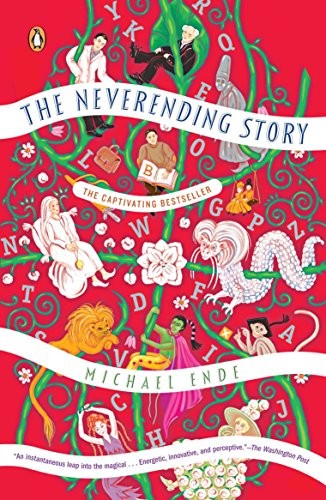
The Neverending Story
Michael Ende's 1979 novel, first published in German as Die unendliche Geschichte, follows Bastian Balthazar Bux, a bullied and bookish boy who steals an old volume and begins reading about Fantastica. Fantastica is a realm of imagination that is being eaten away by a spreading void called the Nothing. The story starts as a quest, then turns to a harder question: what becomes of a person who can have every wish granted? This Penguin paperback presents Ralph Manheim's English translation. It is one of the best-known fantasy books to come out of Germany. It is admired for its book-within-a-book design and for taking imagination, identity and desire seriously.
Where to buy or borrow
Are you selling this book? Bookstores, publishers, authors and libraries can be listed here for free. Request a listing
About this book
Deep Overview
The first half follows Atreyu, a boy from the Grassland, who is sent to find a cure for the Empress. He carries the amulet AURYN, which protects him, and he travels through a landscape of strange and often melancholy encounters. The giant turtle Morla, the oracle Uyulala, the dragon-like Falkor and the creature Gmork are among the figures who test his courage, his patience and his understanding of what the Nothing is. The answer he brings back is surprising. No ordinary hero can save Fantastica. It needs a human child to give the Empress a new name, because the world is sustained by the imaginative contact between the two realms.
The second half turns the book inside out. Bastian enters Fantastica, names the Empress, and takes up AURYN, whose inscription tells him to do what he wishes. Each wish remakes him: it makes him braver, stronger, handsomer and admired. It also costs him a memory of his human life. Ende is careful to show this as a slow process, not a sudden fall. Bastian grows arrogant, drifts from his loyal companions and falls under the sway of manipulative figures, until he risks forgetting who he was and why he came. The rest of the book is about recovery: how someone who has forgotten himself can find a true wish and bring something back to the world he left.
The novel is a story about stories. Fantastica is not a fixed fairy-tale kingdom. It changes according to what imagination and belief supply, and the Nothing is the result when people stop imagining or retreat into cynicism and lies. Ende is making an argument through plot: fantasy is neither a shelter from reality nor a toy. It is a way of testing what a person wants, and wanting without self-knowledge is dangerous. The ending returns Bastian to his father, so the whole fantastic journey is measured by what it does for his life in the ordinary world.
Key Themes
Desire and its price is the central ethical question of the second half. Wishes are granted, but each one removes something of the wisher, so the book asks what wanting consists of and how a person can know what they truly want.
Identity and memory are closely linked. Bastian's sense of self rests on what he remembers, so losing memories becomes a form of dissolving.
Loneliness and belonging shape the human frame. Bastian is isolated, and his story is partly about whether fantasy can connect a person to others or merely replace them.
Reading as participation is another theme. The book repeatedly shows a reader who is changed by a story and who changes it in turn, blurring the line between audience and author.
Historical Context
The book was a notable commercial success in Germany. It spent a long run at number one on the Der Spiegel bestseller list. The first English translation by Ralph Manheim appeared in 1983, and Penguin's paperback followed in 1984.
The story also became one of the best-known books made into movies. Wolfgang Petersen directed a 1984 film, and Ende, who first took part as a script advisor, became publicly critical of how the adaptation developed. The film covers only part of the story, so the novel holds much more than many viewers expect.
Intended Audience
It may suit less well readers who want fast, plot-driven action throughout, since the second half slows to examine Bastian's inner change. Younger children may need help with the more abstract passages and the darker episodes of loss, despair and manipulation.
Reading Difficulty
The second half asks readers to follow a subtler idea: that each granted wish diminishes the wisher. The book also contains episodes of loneliness, fear and despair that younger readers may find heavy. As translated fiction, it keeps some German storytelling habits, such as a confident narrator and a taste for allegorical names and episodes. Retailer listings suggest a reading age in the range of roughly eight to thirteen, though these ranges vary and a patient adult reader will meet no real barrier. No special prior knowledge is required.
Helpful Background Knowledge
It helps to read slowly through the shifts between the attic and Fantastica and to notice what Bastian gives up each time he makes a wish. If a reader is interested in Ende more broadly, Momo is another of his books, often discussed alongside this one for its concern with time and modern life.
Why Read This Book?
The book is also an unusually direct treatment of what it means to be absorbed by fiction. It makes the reader aware of reading, and it treats imagination as something that can be fed, wasted or misused. This Penguin edition gives an accessible English route into a major work of German-language fantasy, and its length gives the ideas room to develop.
Reader Takeaways
Another takeaway concerns return. The book's emphasis falls on what Bastian brings back to his ordinary life, which invites readers to ask what any imaginative experience is for.
Strengths
Limitations and Cautions
Important Concepts, People, and Places
Ralph Manheim: the translator whose English version this edition presents.
Roswitha Quadflieg: the illustrator of the original German edition, whose chapter-opening letters and pictures helped define its look.
Bastian Balthazar Bux: the boy whose reading and later wishes form the human story at the book's centre.
Atreyu: the young hunter from the Grassland whose quest drives the first half.
Fantastica: the realm of imagination inside the book, which changes with what it receives from human minds.
The Nothing: the spreading void that erases Fantastica and stands for the loss of imagination and hope.
The Childlike Empress: the ruler at Fantastica's centre, whose illness signals the world's danger and who needs a new name from a human child.
AURYN: the amulet that protects its bearer; it passes from Atreyu to Bastian and sets his wishes in motion.
Coreander: the bookseller whose shop Bastian enters, and who turns out to know the book's secret.
Wolfgang Petersen: the director of the 1984 film adaptation, which Ende publicly criticised.
Questions the Book Explores
Reading Group Guide
Discussion Questions
2. What makes the Nothing a more unsettling threat than a conventional villain?
3. Why must a human child give the Childlike Empress her new name, and what does that suggest about the relationship between the two worlds?
4. How does Atreyu's quest differ in tone and purpose from Bastian's journey?
5. Which of Bastian's wishes seem most understandable to you, and at what point does wishing become a problem?
6. What does the book suggest about the link between memory and identity?
7. How does the novel treat loneliness, and does fantasy help or hinder Bastian's connection with others?
8. What does Bastian bring back at the end, and is it enough?
9. How does your experience of the book compare with any film or stage version you know?
10. What does the book suggest about the responsibilities of readers, and do you agree?
Sources and Verification
Comments
No published comments yet.
Available editions
Paperback
- Publisher
- Penguin Books
- ISBN-13
- 9780140074314
- Pages
- 377