
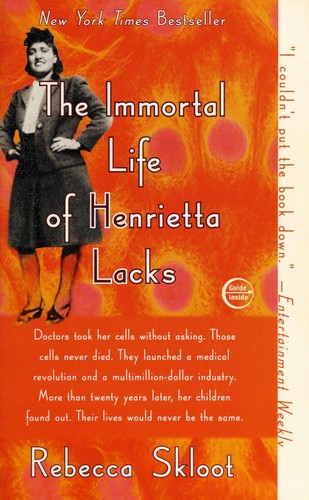
The Immortal Life of Henrietta Lacks
Rebecca Skloot combines biography, family history, science writing, medical history, and investigative reporting to reconstruct the life and legacy of Henrietta Lacks. In 1951, while Lacks was being treated for cervical cancer at Johns Hopkins Hospital, cells obtained from her tumor without her knowledge or consent became the source of HeLa, the first human cell line that could be continuously propagated in culture. The book explains why this development mattered to laboratory science, but its central purpose is to restore a person and family to a story that had often been told chiefly as scientific progress. The narrative moves among three interconnected histories: Henrietta's life and treatment; the development and expanding use of HeLa cells; and the later experiences of her children, particularly Deborah Lacks, as they tried to understand what had happened. Skloot also includes the process of her own reporting, showing that access to a family's history depends on trust, patience,…
Where to buy or borrow
Are you selling this book? Bookstores, publishers, authors and libraries can be listed here for free. Request a listing
About this book
The narrative moves among three interconnected histories: Henrietta's life and treatment; the development and expanding use of HeLa cells; and the later experiences of her children, particularly Deborah Lacks, as they tried to understand what had happened. Skloot also includes the process of her own reporting, showing that access to a family's history depends on trust, patience, and decisions about who has authority to tell painful stories.
Rather than treating the controversy as a simple conflict between heroic science and exploited patients, the book examines overlapping questions of consent, race, poverty, institutional power, tissue ownership, commercialization, privacy, and public benefit. Its three-part structure—Life, Death, and Immortality—allows personal and scientific timelines to converge gradually rather than proceeding in strict chronological order.
Deep Overview
The narrative moves among three interconnected histories: Henrietta's life and treatment; the development and expanding use of HeLa cells; and the later experiences of her children, particularly Deborah Lacks, as they tried to understand what had happened. Skloot also includes the process of her own reporting, showing that access to a family's history depends on trust, patience, and decisions about who has authority to tell painful stories.
Rather than treating the controversy as a simple conflict between heroic science and exploited patients, the book examines overlapping questions of consent, race, poverty, institutional power, tissue ownership, commercialization, privacy, and public benefit. Its three-part structure—Life, Death, and Immortality—allows personal and scientific timelines to converge gradually rather than proceeding in strict chronological order.
Key Themes
A second major theme is the recovery of identity. Henrietta was frequently reduced to a specimen name or an incorrect identity in scientific accounts. Skloot attempts to place her within a particular family, community, era, and system of segregated medicine. Memory and inheritance therefore operate on several levels: biological material persists in laboratories, family stories preserve a person, and trauma can pass through generations.
Trust is another recurring concern. The family's suspicions cannot be understood apart from what happened to Henrietta, later interactions with researchers, and the broader history of medical mistreatment of African Americans. The book asks readers to consider how scientific institutions can earn trust rather than merely expect it.
Historical and Medical Context
HeLa emerged when researchers were struggling to maintain human cells outside the body for extended periods. The cell line's capacity for continued growth made it unusually useful for repeatable laboratory work and large-scale distribution. Skloot follows its role across postwar biomedical research while also tracing problems associated with cell-line contamination and the growing commercial market for biological materials.
The book belongs to a wider history of research ethics that includes debates over experimentation on vulnerable populations, informed consent, patient privacy, genetic information, and ownership of removed tissue. An important post-publication development occurred in 2013, when the National Institutes of Health and members of the Lacks family established a controlled-access arrangement for HeLa whole-genome sequence data. That agreement is not part of the book's original historical endpoint and should be consulted separately when discussing Henrietta Lacks's continuing legacy.
Intended Audience
Readers seeking a technical account of cell biology or a comprehensive legal treatise may find the scientific and legal explanations introductory. Readers should also be prepared for descriptions of cancer, death, institutionalization, abuse, family trauma, racism, and serious breaches of trust.
Reading Difficulty
The pacing is often closer to narrative journalism than to a textbook, but the large cast and interwoven timelines reward attentive reading. The endnotes and index are valuable for readers who want to distinguish reconstructed scenes, interviews, archival evidence, and broader historical claims.
Helpful Background Knowledge
It is also helpful to remember that ethical expectations, professional guidelines, and legal requirements are related but not identical. An action may have been common or legally permissible in a particular period without being ethically defensible by contemporary standards—or even by all standards of its own time.
Why Read This Book?
It is also a strong case study in how abstract ethical questions become personal. Consent, tissue ownership, privacy, commercial value, and public benefit are not presented merely as classroom dilemmas; they shape a family's understanding of its history and its relationship with medicine. The book can therefore support conversations among readers who might not otherwise approach the same issue from a shared starting point.
Reader Takeaways
The narrative also shows that public benefit does not automatically erase private harm. Scientific advances and ethical failures can coexist within the same history. Readers may become more attentive to the language of medical consent, the privacy implications of biological samples, the relationship between race and institutional trust, and the responsibilities of journalists or researchers working with vulnerable families.
Editorial Strengths
Another strength is the sustained attention given to Deborah Lacks and to the emotional burden of trying to understand a mother's biological afterlife. The reporting process remains visible, allowing readers to examine Skloot's access, choices, and relationship with the family rather than presenting the narrative as if it came from an impersonal or all-knowing source.
The scientific explanations are designed for nonspecialists, making the book useful for interdisciplinary discussion. Notes, references, and an index also provide routes for further investigation.
Limitations and Cautions
Because the book was published in 2010, it cannot cover later developments in HeLa genomic-data governance, subsequent litigation, settlements, or continuing changes in research policy. Readers using it to study current law or policy should pair it with updated primary sources.
The book introduces complex scientific, legal, and bioethical subjects but does not provide exhaustive technical treatment. Its narrative power can also encourage readers to interpret one extraordinary case as representative of every form of biospecimen research. Comparisons with current consent practices and other tissue-research cases are needed before drawing broad conclusions.
Important Concepts and Terms
People and institutions central to the narrative include Henrietta Lacks; her daughter Deborah and other members of the Lacks family; cell-culture researcher George Gey; physician Richard Wesley TeLinde; Johns Hopkins Hospital; and the researchers, journalists, and companies involved in HeLa's expanding scientific use.
Readers should also note the importance of Jim Crow segregation and the historical mistreatment of African Americans in medicine. These are not incidental background details: they help explain both the original power imbalance and the family's later distrust.
Questions the Book Explores
How should society weigh discoveries that benefit millions against harms experienced by individuals and families? Why do race, poverty, education, and institutional status affect who can obtain information and whose objections receive attention? What obligations do scientists, physicians, companies, and journalists have after the law's minimum requirements have been met?
The book also asks what immortality means. Is it cellular survival, public remembrance, scientific influence, family memory, or some combination of these?
Reading Group Guide
Before discussion, distinguish facts established in the narrative from ethical judgments made by readers. Assigning participants to examine the perspectives of patients, family members, clinicians, laboratory researchers, institutions, and commercial organizations can reveal where responsibilities overlap or conflict.
For a contemporary extension, compare the book's historical events with the NIH-Lacks Family Agreement governing controlled access to certain HeLa genome data. Groups should avoid treating any individual family member as the sole spokesperson for the entire Lacks family and should distinguish Henrietta's documented wishes from assumptions about what she might have chosen.
Discussion Questions
2. What is gained—and what ethical complications arise—when Skloot includes herself in the narrative?
3. How does the book distinguish scientific benefit from ethical justification?
4. Which failures in the story result from individual choices, and which arise from institutions or accepted professional practices?
5. What would meaningful informed consent have required in Henrietta's situation?
6. How do race, class, education, and medical vocabulary shape the Lacks family's encounters with researchers?
7. Does the commercial value of a cell line create obligations to the tissue source or that person's family? Why or why not?
8. How should privacy be handled when one person's biological data can reveal information about relatives?
9. In what ways does the book restore Henrietta's identity, and where does the available evidence still leave gaps?
10. How should readers evaluate conflicts among public benefit, private harm, recognition, compensation, and scientific access?
11. What responsibilities does a writer assume when gaining access to medical records and painful family histories?
12. How might the book be written differently from the perspective of a scientist, a bioethicist, or a member of the Lacks family?
Sources and Verification
The publisher's teacher and reader guides were used to confirm the book's three interwoven narratives, structure, cross-disciplinary relevance, and documented discussion topics. Current context concerning controlled access to HeLa whole-genome data was checked against the National Institutes of Health. Editorial assessments of audience, difficulty, strengths, limitations, and takeaways are WebToTell guidance rather than claims attributed to those sources.
Comments
No published comments yet.
Available editions
Hardcover
First U.S. edition, hardcover
- Publisher
- Crown Publishers
- ISBN-13
- 9781400052172
- Publication date