
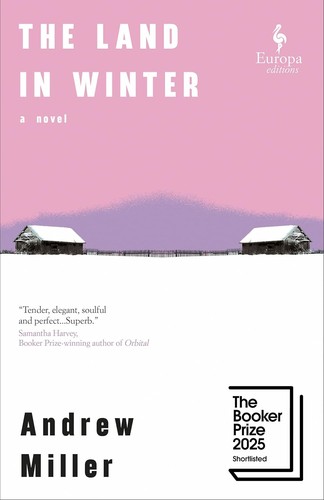
The Land in Winter
The Land in Winter is a novel about two marriages tested by one unforgiving season. In the winter of 1962–63, a young country doctor, Eric Parry, his wife Irene, and their farming neighbours Bill and Rita Simmons find their West Country lives closed in by snow until there is little left to hide behind. Andrew Miller cares less about what the weather destroys than about what it exposes: the compromises each partner has made, the social distances that marriage was meant to close, and the legacy of a war that ended less than two decades earlier. The book matters because of its sense of proportion. It gives an ordinary domestic crisis the seriousness usually reserved for public upheaval. The novel was shortlisted for the 2025 Booker Prize and won the Walter Scott Prize. It stands out among book club books because it offers four flawed but sympathetic points of view and no easy verdicts.
Where to buy or borrow
Are you selling this book? Bookstores, publishers, authors and libraries can be listed here for free. Request a listing
About this book
The book was first published in Britain in 2024 by Sceptre, an imprint of Hodder & Stoughton, and is Andrew Miller's tenth novel. His career began with Ingenious Pain in 1997, set in the eighteenth century, and he has moved between distant historical periods and the present day ever since. Here he chooses a middle distance: the generation that grew up under the shadow of the Second World War and came of age just before the social changes of the later 1960s. The novel reads partly as a study of that in-between moment, when old rules about class, respectability and women's roles still held but were starting to feel less secure.
Miller works through close third-person narration, following each character's thoughts closely while keeping the narrator's own judgements in the background. He rarely tells the reader what to conclude about anyone. Meaning comes from how private thought sits against public behaviour and how one character's account of an event differs from another's. As a result, the book's moral seriousness is built up quietly, through sympathy and accumulated detail, rather than delivered in big statements.
The novel's restraint is what sets it apart. Many novels set during dramatic historical weather treat the event as spectacle. Miller treats the severe winter as a condition of life that slows everything down and lets ordinary tensions build. His recognition shows how much a novel can do with a small cast and a narrow setting. The book was shortlisted for the Booker Prize and won major British awards for historical fiction, which signals its standing as both literary fiction and historical fiction without placing it firmly in either camp.
Deep Overview
The opening chapter, set in a psychiatric hospital where a young patient has taken his own life in the night, is deliberately disorienting. The two men in that basement will reappear only in passing, but their presence establishes a tone of quiet dread that underpins everything that follows and introduces the theme of institutional confinement—both literal and social—that runs through the book.
The central engine of the plot is the Boxing Day party, which Miller handles with the care of a playwright staging a confrontation. Alcohol, music, and the presence of Eric's mistress and her husband create a pressure that cracks open each character's self-presentation. Rita dances in front of an audience she cannot quite join; Bill feels cornered by his father's social world; Irene weeps with a loneliness she has not named; and Eric, for the first time, is seen by the people he most wants to impress in a way he did not intend. The party is the hinge on which the novel's second half turns.
The snow is not merely backdrop. The Big Freeze of 1962–63, with snowdrifts that isolated entire communities for months, functions as a kind of third force in each relationship. It removes escape routes, compresses time, and turns the ordinary act of crossing the field between two cottages into an event. Miller's prose in the winter scenes is notably sensory: the quality of light through a frosted window, the sound of a stove ticking, the taste of cold metal on a doorknob.
Beneath the domestic surface, the novel carries the weight of the Second World War and the Holocaust without ever staging them directly. Bill's father, a wealthy London landlord, keeps his naturalisation certificate in his wallet and has erased his Eastern European past. Rita's father, a British army photographer who documented the liberation of Bergen-Belsen, is a patient at the same asylum that opens the book. Eric's GP partner, Gabby Miklos, is a Mitteleuropean émigré who speaks of the mechanised documentation of genocide with a calm more disturbing than any outburst. These references are brief, oblique, and therefore more resonant. They remind the reader that the social order in which these four young people are trying to settle their lives was built on recent, unresolved catastrophe.
The novel's resolution is neither triumph nor tragedy. Miller has described his guiding intention as letting his four characters see out their parts in whatever way was right for them, and the ending honours that principle. The book closes with the snow beginning to melt, but the emotional landscape it has mapped is far from settled.
Key Themes
Class and social positioning: Eric's humble Birmingham upbringing versus his wife's literary London circle; Bill's upper-middle-class birth versus his self-imposed life as a smallholding farmer; Rita's working-class origins in a Bristol nightclub. Class is not an abstract backdrop but a constant, low-grade pressure on every interaction.
The persistence of the past: The Second World War and the Holocaust are never depicted as events but are present in the characters' bodies, habits, and silences. Rita's father's trauma, Bill's father's erased identity, and Gabby Miklos's emigration all show how a national catastrophe lives on in private, domestic life.
Isolation and confinement: The physical isolation imposed by the Big Freeze mirrors and amplifies the emotional isolation of each character. Snow turns the village into a series of locked rooms, and the characters' inner lives become the only available landscape.
Gender and expectation in the early 1960s: Both women are pregnant, both feel constrained by the roles assigned to them, and both find in their unlikely friendship a space where their individual desires can be briefly named.
Appearance versus interior truth: The novel repeatedly contrasts what is said or performed at a dinner table with what is felt in a quiet kitchen at midnight. Miller's prose privileges the second.
Historical Context
The war's aftermath is still raw. Eric is old enough to have completed RAF training but was relieved the conflict ended before he was called up. Rita's father served in the British army and photographed the liberation of Bergen-Belsen; the trauma of that experience has left him institutionalised. Bill Simmons Sr., a successful London landlord, is an immigrant from Eastern Europe who has changed his name and carries his naturalisation papers in his wallet. Gabby Miklos, Eric's medical partner, is a Mitteleuropean émigré whose reflections on the Holocaust's documentation carry a quiet, devastating authority. In 1962, these were not historical footnotes. They were living wounds, and Miller treats them as such—present, unresolved, and inseparable from the small decisions these four characters make about where to live, who to marry, and what to say at a dinner party.
The novel also captures a specific social texture: the way a village GP is expected to know every patient's business, the informality of smoking in a car while pregnant, the social ritual of a Boxing Day drinks party with its own codes of who is invited and who is expected to perform.
Intended Audience
Readers who prefer fast-paced narratives, tightly plotted mysteries, or genre fiction with clear escalation may find the pacing slow, particularly in the first third, where the alternating chapters can feel like they are cutting across one another before a central conflict has fully formed. The opening chapter, set in a psychiatric hospital, is deliberately oblique and may initially puzzle readers looking for a straightforward entry into the main story. The novel also assumes a degree of familiarity with British class dynamics and the social conventions of the early 1960s; readers from other cultural backgrounds will still find the emotional core universal, but some of the specific social friction may be less immediately legible.
Reading Difficulty
Conceptually, the novel is not demanding in the way a philosophical or highly allusive text might be. The themes—marriage, class, the past's grip on the present—are recognisable and do not require prior theoretical knowledge. The historical context (the Big Freeze, post-war British social life, the aftermath of the Holocaust) is conveyed through the narrative itself rather than through asides or footnotes, so no external research is necessary, though a general familiarity with 1960s Britain will deepen the reading.
The pace is slow and cumulative through the first two-thirds, then accelerates noticeably in the final third, where consequences of the Boxing Day party and the winter's isolation come to a head. The book is best read in sittings of an hour or two rather than in marathon sessions; the prose rewards unhurried attention, and several readers have remarked on the pleasure of re-reading particular sentences.
Helpful Background Knowledge
Familiarity with the British class system as it operated in the early 1960s will sharpen the reading. The novel's tensions are partly about the gap between birth and occupation (Bill is upper-middle-class by family, working-class by trade), between regional identity and metropolitan culture (Irene's London versus the West Country), and between social expectation and personal desire. Understanding these dynamics does not require an academic background; a few hours with a well-drawn novel of the period, or even a general history of post-war Britain, will suffice.
Knowledge of the Holocaust and its aftermath is not a prerequisite, but it does add weight to the references to Rita's father, Bill's father, and Gabby Miklos. Miller handles these references obliquely, and a reader who is unfamiliar with the historical events will still feel their emotional force, though the specific significance of, say, the Bergen-Belsen photographs or the experience of Mitteleuropean emigration will be more fully realised by a reader with some background.
No prior reading of Miller's earlier novels is necessary, though readers who have enjoyed Pure, The Crossing, or Now We Shall Be Entirely Free will recognise the author's distinctive mode: a precise, humane attention to individual interiority set against a sharply drawn historical landscape.
Why Read This Book?
The character work is the novel's greatest strength. Four people, each given equal narrative weight, each flawed and each sympathetic. Miller does not sort them into heroes and villains; he lets you inhabit each one and understand the logic of their choices, even when those choices hurt the people they love. The friendship between Irene and Rita, two women from different worlds who find in each other a mirror and a refuge, is among the most tenderly drawn relationships in contemporary British fiction.
The handling of the past is another reason to reach for this book. The Holocaust, the war, the experience of emigration—these are present without being staged. Miller trusts the reader to feel the weight of what is not said, and the effect is more unsettling than any direct depiction could achieve. For readers looking for a Booker Prize book that is quiet, humane, and deeply felt rather than loud or confrontational, this is a strong candidate.
Finally, the prose itself is a reason. Miller writes sentences that reward a second reading, that compress an entire emotional state into a single domestic image. If you enjoy a book you can hold up to the light and notice new things on a second pass, this will be one of those books.
Reader Takeaways
There is also a practical understanding of how the past operates in the present. The characters do not discuss the war or the Holocaust as topics; they carry them in their silences, their habits, their physical reactions. A reader will notice, in the weeks after finishing the book, how much of their own life is shaped by events they did not live through but inherited.
The novel invites a reassessment of how one reads a marriage. Miller does not present the Parrys or the Simmons as a case to be solved. Instead, he shows how two people can be genuinely kind to each other and still be unable to stay. The reader may reconsider their own assumptions about what loyalty requires and what a relationship owes to the individual within it.
Finally, the book trains the eye for the significance of small objects and gestures. A glass of water left on a kitchen table, a box of cigarettes in a coat pocket, a book chosen for the wrong reason—these are not decorative details but evidence. A reader who picks up this habit of attention will find it useful well beyond the page.
Strengths
Character balance: All four principal characters are given full interior access. None is reduced to a function for the others. This is difficult to sustain across a full novel, and Miller achieves it without sacrificing the distinct voice and logic of each person.
Period authenticity without nostalgia: The early 1960s are rendered through concrete, everyday details—the music on the radio, the food on the table, the particular social rituals—rather than through a romanticised or critical reconstruction. The period feels lived-in, not performed.
Structural control: The alternating chapters, the disorienting opening, the party as fulcrum, the snow as a pacing device—all of these elements serve the novel's thematic concerns rather than creating mere variety. The structure is in service of the argument that no single perspective can contain the truth of these relationships.
Emotional restraint: The novel deals with infidelity, class resentment, wartime trauma, and mental illness, yet it never tips into melodrama. The tension is maintained through understatement, which makes the moments of eruption all the more affecting.
Limitations and Cautions
The opening chapter: The psychiatric hospital scene is deliberately disorienting and does not foreshadow the main plot in any obvious way. Readers who expect the first chapter to establish the novel's central conflict may find it puzzling or even off-putting before the narrative settles into its main characters.
Limited action: The novel is, by design, a quiet book. There is no chase, no catastrophe, no physical violence. The drama is entirely interior and relational. Readers who need external plot momentum to stay engaged may find the middle section tests their patience.
The ending: The resolution is neither fully satisfying nor fully unresolved. It honours Miller's stated intention of letting his characters find their own way out, but some readers may want a more definitive answer to the central conflicts, particularly around Eric and Irene. The ending is open enough to generate discussion, which is a strength for a book club, but a personal frustration for a solo reader seeking closure.
Cultural specificity: The novel's social dynamics are deeply rooted in British class culture of the early 1960s. While the emotional core is universal, some of the specific friction—the way a village GP is expected to know everything, the particular snobbery of a Boxing Day guest list—may be less immediately legible to readers outside the British context.
Important Concepts, People, and Places
West Country / Somerset: The village where the story is set. Miller renders the landscape with the specificity of a local author, and the terrain—the field between the two cottages, the distant farm, the village road—is as important to the novel's dynamics as any character.
Eric Parry: A young general practitioner, Birmingham-born, raised in modest circumstances. His position as village doctor gives him social standing but also a sense of being perpetally one step removed. His affair with a married patient is the novel's most explicit breach of trust.
Irene Parry: Eric's wife, originally from literary London. Her sense of displacement in the countryside and her growing awareness of her husband's infidelity drive the novel's emotional core.
Bill Simmons: A would-be farmer who bought a small dairy holding after leaving Oxford without a degree. He is the son of a wealthy London landlord and is trying to escape his family's social world while being dependent on it. His inexperience and ambition create a constant undercurrent of anxiety.
Rita Simmons: Bill's wife, formerly a dancer in a Bristol nightclub. Her working-class background, her restless inner life, and her friendship with Irene make her one of the novel's most vividly drawn characters.
Bill Simmons Sr.: An Eastern European immigrant who became a successful London landlord. He has erased his past, carries his naturalisation certificate at all times, and represents the complicated intersection of wealth, immigration, and national identity in post-war Britain.
Rita's father: A British army photographer who documented the liberation of Bergen-Belsen. His institutionalisation in the psychiatric hospital that opens the novel is a direct, unflinching consequence of wartime trauma.
Gabby Miklos: Eric's GP partner and a Mitteleuropean émigré. His reflections on the Holocaust's documentation and the question of how such events are explained carry a quiet, devastating weight in the novel's social scenes.
The Boxing Day party: The central social event of the novel and the turning point around which the plot pivots. It brings all four characters, plus Eric's mistress and her family, into a single room under the pressure of alcohol, music, and the approaching blizzard.
Walter Scott Prize for Historical Fiction: Awarded to the novel in 2025. The judges described its prose as 'as softly dazzling as the snow' and praised its ability to paint big themes on a subtle canvas.
2025 Booker Prize shortlist: The novel was shortlisted, with the judges describing it as a 'dazzling chronicle of the human heart.'
Questions the Book Explores
How does a national trauma persist in the private, domestic lives of those who lived through it? The Holocaust and the war are never depicted as events but are present in silences, in a naturalisation certificate in a wallet, in a father's institutionalisation, in an émigré's calm account of bureaucratic genocide. The novel asks whether such a past can be left behind or whether it is inherited, carried in the body, and passed to the next generation.
Can a person genuinely escape their class position, or does it always resurface in the choices they make and the people they attract? Bill's attempt to become a farmer, Irene's discomfort in the countryside, Rita's negotiation between her nightclub past and her farm-wife present—all raise this question without resolving it.
What is the cost of performing a role one was never meant for? Each of the four characters is managing an image, and the novel traces the slow, painful work of that performance breaking down.
Does isolation reveal truth or deepen confusion? The snow cuts the village off from the outside world and forces the characters into a closer, more uncomfortable proximity with each other. The novel suggests that isolation does one and the other at the same time.
What does it mean to be a good person when your actions cause harm to those closest to you? Eric's affair, Bill's financial recklessness, Irene's self-doubt, Rita's withdrawal—each is a small, human failure that the novel treats with sympathy rather than judgement.
Reading Group Guide
The novel is well suited to book clubs because its four distinct perspectives, its class dynamics, and its open-ended resolution generate sustained, productive conversation. It is not a book that rewards a single 'right' reading, and members will inevitably disagree about which character they sympathise with most and why.
A useful structure for the discussion: begin with the structure (the alternating chapters, the disorienting opening, the party as hinge), then move to the characters (who is most fully realised, whose story feels incomplete), then to the themes (class, the past, gender, isolation), and finally to the ending (what is resolved, what is not, and whether the openness feels earned or evasive).
Encourage the group to pay attention to objects and small gestures throughout the novel—the box of eggs, the science-fiction paperback, the naturalisation certificate, the glass of water left on the kitchen table. These are not decorative; they are the novel's evidence, and discussing them will deepen the reading.
The book benefits from being read in a warm room and at a comfortable pace. The prose is best savoured, not rushed, and the winter setting will make the reader physically aware of the cold even when the characters are indoors by a fire. A pot of tea and a blanketed chair are practical recommendations.
Discussion Questions
Miller gives each of the four principal characters equal narrative weight. Does this create a sense of fairness, or does it dilute the emotional stakes by refusing to choose a single point of view? Compare your experience of following one character's chapter to another's. Is there a moment where the shift between characters feels like a betrayal of the reader's investment?
The Boxing Day party is the novel's central set piece. Trace what each character does, says, and conceals in that scene. What does the party reveal about each of them that they might never have discovered alone? And what does the party's aftermath—its hangovers, its awkward silences, its small cruelties—add to what the scene itself showed?
Bill's father carries his naturalisation certificate in his wallet at all times. Rita, before marriage, worked in a Bristol nightclub. Irene came from literary London. Each of these biographies carries a specific social risk in 1962. Which of the four characters do you think is most vulnerable to the judgement of the village, and why?
Rita reads science fiction and horror novels from the library van while her husband expects her to prefer Virginia Woolf. What does this small disagreement about reading taste reveal about the marriage, about Rita's identity, and about the novel's broader treatment of class?
The snow is described with a physicality that makes it feel like a character. In which scenes does the weather feel most like an agent of change, and in which does it feel like a mirror for the characters' emotional state? Is there a difference between those two functions, and does it matter?
The novel is set eighteen years after the war ended, yet the past is everywhere. Is the past in this book a weight the characters are carrying, or a door they are slowly, painfully closing? Can both be true at the same time?
Where does the novel end, and what does it leave unresolved? Does the ending feel earned given the way the story has been building, or does it leave too much to the reader's own completion? Defend your position with a specific scene from the final third.
Sources and Verification
Comments
No published comments yet.
Available editions
Hardcover
- Publisher
- Sceptre (imprint of Hodder & Stoughton)
- ISBN-13
- 9798889661573