
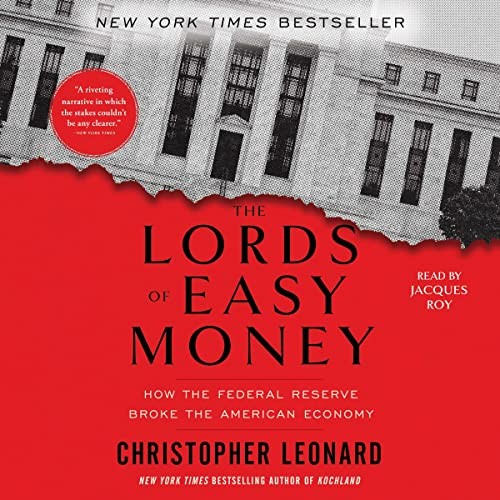
The Lords of Easy Money
How the Federal Reserve Broke the American Economy
Christopher Leonard examines the Federal Reserve’s transformation after the 2008 financial crisis, concentrating on years of near-zero interest rates and large-scale asset purchases known as quantitative easing. He argues that policies designed to stabilize markets and stimulate recovery also encouraged debt, elevated financial-asset prices, strengthened the position of major investors, and made the economy increasingly dependent on continued monetary support. The narrative is anchored by Thomas Hoenig, president of the Federal Reserve Bank of Kansas City, whose repeated dissents in 2010 expressed concern about financial instability and the long-term consequences of exceptionally easy money. Leonard also follows Jerome Powell from private equity into central banking, using corporate finance and industrial employment to connect monetary policy with activity outside Washington and Wall Street. The result is investigative economic journalism that presents central banking as a consequenti…
Where to buy or borrow
Are you selling this book? Bookstores, publishers, authors and libraries can be listed here for free. Request a listing
About this book
Deep Overview
Leonard builds his account around Thomas Hoenig, who led the Federal Reserve Bank of Kansas City from 1991 to 2011. Hoenig had spent much of his career supervising banks and had witnessed the consequences of earlier credit booms. In 2010, he cast the sole dissenting vote at all eight meetings of the Federal Open Market Committee. His concern was broader than an immediate prediction of consumer-price inflation. He feared that exceptionally low rates maintained for an extended period would distort incentives, encourage leverage, inflate asset values, and create imbalances that would become painful to reverse.
The crucial policy episode is the Federal Reserve’s November 3, 2010 announcement that it would purchase an additional $600 billion in longer-term Treasury securities. Leonard interprets this second round of quantitative easing as a turning point at which emergency measures began to resemble a continuing model of economic management. In his account, investors learned that the central bank would intervene when financial markets weakened. This expectation encouraged greater risk-taking while making later efforts to tighten policy politically and financially difficult.
Jerome Powell provides a second major narrative line. Leonard examines Powell’s work in private equity, including his involvement with the industrial company Rexnord, before following his movement into public service and eventually Federal Reserve leadership. This material allows the book to connect inexpensive debt with leveraged corporate ownership, restructuring, investor returns, and pressure on industrial workers. The point is not merely biographical. Powell’s path embodies Leonard’s larger argument that financial techniques and central-bank decisions became increasingly central to the organization of the American economy.
The book proceeds through the uneven post-crisis recovery, the Fed’s attempts to normalize policy, market turbulence, and the extraordinary interventions made during the COVID-19 shock. Leonard argues that each intervention reinforced dependence on low rates and abundant liquidity. Asset owners gained rapidly when stocks, bonds, and real estate appreciated, while many workers remained exposed to insecure employment, weak bargaining power, and rising living costs.
This causal interpretation is deliberately forceful and remains open to debate. Supporters of the Fed’s actions emphasize mass unemployment, deflationary danger, damaged credit markets, and the risk of a deeper depression. Leonard gives greater weight to the policies’ distributional consequences and cumulative financial hazards. His central question is therefore institutional as well as economic: what happens when an unelected body uses emergency powers repeatedly, shapes the distribution of wealth, and becomes unable to withdraw support without destabilizing the markets it helped elevate?
Key Themes
• **Asset inflation and inequality:** Leonard argues that policies raising the value of stocks, bonds, and real estate disproportionately benefit people who already own substantial assets.
• **Leverage and fragility:** Cheap borrowing can produce growth and investment, but it can also reward financial engineering, encourage speculative risk, and leave firms vulnerable when conditions change.
• **Moral hazard and the expectation of rescue:** Repeated intervention may teach investors that major losses will be limited by public institutions, weakening ordinary market discipline.
• **Technocratic authority:** The book examines how decisions presented as technical can determine employment conditions, household costs, corporate behavior, and the distribution of economic power.
• **Dissent within institutions:** Thomas Hoenig’s experience illustrates both the value and the limitations of principled disagreement inside organizations that place a premium on consensus.
Historical Context
These choices reflected lessons central bankers drew from the Great Depression and from Japan’s struggle with deflation: acting too timidly after a financial collapse could allow unemployment and falling prices to reinforce one another. Critics, including Hoenig, drew attention to a different history—the savings-and-loan crisis, recurrent asset bubbles, and the buildup to the 2008 collapse—in which extended periods of inexpensive credit contributed to excessive risk.
The book also sits within a broader post-1980 transformation marked by financial deregulation, the expansion of private equity, declining union power, greater corporate use of debt, and widening wealth inequality. Its argument should be read as one interpretation within an active debate over how much responsibility belongs to monetary policy, fiscal policy, globalization, technological change, taxation, regulation, and corporate governance.
Intended Audience
Readers seeking a formal economics textbook, a mathematical assessment of quantitative easing, or a balanced collection of competing scholarly models will need supplementary material. Those who already strongly agree or disagree with criticism of the Federal Reserve may benefit most by treating the book as a developed prosecutorial argument whose evidence and causal claims should be tested rather than accepted automatically.
Reading Difficulty
The book’s shifting attention among Federal Reserve meetings, personal histories, corporate transactions, and national economic developments demands moderate concentration. Readers may occasionally need to distinguish between consumer-price inflation, asset-price appreciation, changes in the money supply, and changes in bank reserves. No advanced mathematics is required, although a simple reference guide to monetary-policy terminology may improve comprehension.
Helpful Background Knowledge
Readers should also understand the basic distinction between fiscal policy and monetary policy. Congress and the executive branch make decisions about taxation and public spending; the Federal Reserve influences financial conditions through interest-rate policy, lending facilities, and its balance sheet. Familiarity with the housing bubble, the collapse of Lehman Brothers, the Great Recession, and the COVID-19 market crisis will make the chronology easier to follow. A basic understanding of bonds is useful because bond prices, yields, and borrowing costs are central to how quantitative easing is intended to work.
Why Read This Book?
The book is also valuable as a study of institutional dissent. Thomas Hoenig’s objections show that arguments within the Federal Reserve were not simply disputes between people who favored recovery and people who opposed it. They involved competing assessments of time: whether immediate support justified risks that might emerge years later. Finally, the book offers a framework for questioning who receives the earliest and greatest benefits when public policy operates through financial markets.
Reader Takeaways
It also demonstrates why monetary policy cannot be judged solely by whether markets rise or a recession ends. Evaluation requires asking what kinds of investment are encouraged, who assumes the risks, who owns the appreciating assets, and what happens when support is withdrawn. Even readers unconvinced by Leonard’s full argument may come away more attentive to the political and social consequences of central banking.
Strengths
The long time horizon is another advantage. Rather than treating each intervention as an isolated response, the book asks how policies and market expectations accumulated from the aftermath of 2008 through the COVID-19 crisis. Its attention to leverage, bank regulation, private equity, and industrial employment broadens the discussion beyond inflation statistics. The narrative also restores conflict to an institution often depicted as operating through impersonal expertise and consensus.
Limitations and Cautions
The emphasis on Thomas Hoenig gives dissent a memorable representative, but it can also organize complex policy disagreements around a hero-versus-establishment structure. Readers should compare Leonard’s argument with research defending asset purchases as necessary responses to unemployment, deflationary risk, and disrupted credit markets.
Because the book appeared in January 2022, it could not assess the complete cycle of subsequent inflation, rapid interest-rate increases, balance-sheet reduction, banking stress, and later monetary-policy decisions. Its account is therefore historically bounded even where its questions remain relevant.
Important Concepts, People, and Institutions
• **Thomas M. Hoenig:** President of the Federal Reserve Bank of Kansas City from 1991 to 2011 and the book’s central figure. His eight FOMC dissents in 2010 provide the narrative’s principal warning about prolonged easy money and financial imbalance.
• **Jerome H. Powell:** A former private-equity executive who joined the Federal Reserve Board in 2012 and later became chair. Leonard uses his career to connect leveraged finance with the evolution of Federal Reserve policy.
• **Ben S. Bernanke:** Federal Reserve chair during the 2008 crisis and the early rounds of large-scale asset purchases. His approach reflected a determination to prevent financial collapse and deflation.
• **Federal Reserve System:** The United States’ central-bank system and the institution at the center of the book’s questions about expertise, independence, democratic accountability, and economic distribution.
• **Federal Open Market Committee:** The Federal Reserve body responsible for major monetary-policy decisions. Hoenig’s dissents occurred in this committee.
• **Federal Reserve Bank of Kansas City:** The regional Reserve Bank Hoenig led. His experience in bank supervision shaped his concern about leverage and institutional risk.
• **Federal Reserve Bank of New York:** The institution whose trading desk implements FOMC asset-purchase directives in financial markets.
• **Quantitative easing:** Large-scale central-bank purchases of longer-term securities intended to lower borrowing costs and support economic activity when short-term rates are already near zero.
• **QE2:** The second major post-crisis asset-purchase program, including the November 2010 authorization to purchase an additional $600 billion in longer-term Treasury securities.
• **Zero-interest-rate policy:** The maintenance of a policy rate near zero to encourage borrowing and economic activity. Leonard concentrates on the distortions he believes can develop when such conditions persist.
• **Leverage:** The use of borrowed money to increase the scale of an investment. It can magnify returns while also amplifying losses and financial fragility.
• **Private equity:** An ownership model that frequently combines investor capital with substantial borrowing to acquire and restructure companies. It is important to Leonard’s account of how cheap credit affects corporations and workers.
• **Rexnord:** The industrial company used as a case study connecting leveraged ownership, corporate restructuring, manufacturing, and Jerome Powell’s earlier financial career.
• **Carlyle Group:** The private-equity firm where Powell worked. It forms part of the book’s bridge between Wall Street-style finance and central-bank leadership.
• **Asset-price inflation:** Rising prices for investments such as stocks, bonds, and real estate. The book treats this as an important channel through which easy money can widen wealth differences.
• **Moral hazard:** The danger that protection from losses encourages greater risk-taking. Leonard applies the concept to investors who come to expect central-bank intervention during market declines.
• **Too big to fail:** The problem presented by financial institutions whose collapse could threaten the wider economy, creating pressure for public rescue and weakening normal consequences for excessive risk.
Questions the Book Explores
• Does quantitative easing mainly stimulate productive recovery, or does it disproportionately increase financial-asset values?
• How do low interest rates change the behavior of banks, private-equity firms, corporations, and investors?
• Can a central bank withdraw market support after investors have reorganized their expectations around it?
• How should policymakers weigh immediate unemployment against financial dangers that may take years to appear?
• What democratic accountability is appropriate when an independent central bank makes decisions with major distributional consequences?
• Why is dissent difficult inside institutions that depend on public confidence and a unified message?
• Who gains first from money introduced through financial markets, and who bears the eventual risks?
Reading Group Guide
Track Thomas Hoenig and Jerome Powell as contrasting institutional figures. Consider how biography shapes the book’s interpretation of policy and whether either person is made to represent forces larger than one career can contain. Pay particular attention to the Rexnord case: discuss what it demonstrates directly and what Leonard asks it to symbolize about debt-driven corporate ownership.
It may be useful to assign participants different perspectives—central banker, unemployed worker in 2010, homeowner, renter, pension manager, industrial employee, bank regulator, and leveraged investor. Ask how each would judge the same policy. Finally, compare the moral language of rescue, discipline, prudence, and risk. Who is expected to exercise restraint, and who is protected when restraint fails?
Discussion Questions
2. Does Thomas Hoenig function primarily as a source, a protagonist, a symbol of dissent, or all three?
3. How does the book distinguish between rescuing the economy and rescuing financial markets? Is that distinction convincing?
4. What does the Rexnord case contribute that a purely macroeconomic explanation could not?
5. How should policymakers compare an immediate, measurable danger such as unemployment with a possible future danger such as an asset bubble?
6. Did Federal Reserve intervention weaken market discipline, or was intervention necessary because ordinary market discipline would have caused intolerable damage?
7. To what extent can monetary policy be held responsible for inequality compared with tax policy, labor policy, trade, technology, and housing constraints?
8. Does central-bank independence protect sound decision-making, reduce democratic accountability, or do both at once?
9. How does Leonard’s narrative structure affect the reader’s view of Ben Bernanke, Jerome Powell, and Thomas Hoenig?
10. What evidence would cause you to revise your judgment of quantitative easing after reading the book?
11. Can a policy be successful during a crisis but harmful when continued afterward? Where should that boundary be drawn?
12. How might the book have been different if told from the perspective of a worker who found employment during the recovery or a household that refinanced a mortgage at a lower rate?
Sources and Verification
Comments
No published comments yet.
Available editions
Ebook
ebook
- Publisher
- Simon & Schuster
- ISBN-13
- 9781982166687
- Publication date
- Pages
- 384