Category

Economic Policy

Economic policy is how governments and central banks try to steer growth, prices and jobs, and it affects everyone's savings, rent and wages. Christopher Leonard's The Lords of Easy Money examines the Federal Reserve's decade of low interest rates and quantitative easing after 2008, and who gained from it. Sebastian Mallaby's The Man Who Knew is a biography of Alan Greenspan and the choices made during his long years at the Fed. Clear, story-driven books for readers who want to understand the forces behind interest rates and financial crises.

2 published books 0 published articles

Books in this category

Primary category

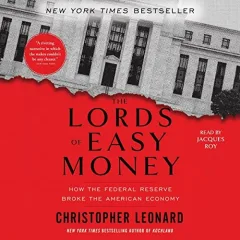
The Lords of Easy Money

How the Federal Reserve Broke the American Economy

By Christopher Leonard

Christopher Leonard examines the Federal Reserve’s transformation after the 2008 financial crisis, concentrating on years of near-zero interest rates and large-scale asset purchases known as quantitative easing. He argues that policies designed to stabilize markets and stimulate recovery also encouraged debt, elevated financial-asset prices, strengthened the position of major investors, and made the economy increasingly dependent on continued monetary support. The narrative is anchored by Thomas Hoenig, president of the Federal Reserve Bank of Kansas City, whose repeated dissents in 2010 expressed concern about financial instability and the long-term consequences of exceptionally easy money. Leonard also follows Jerome Powell from private equity into central banking, using corporate finance and industrial employment to connect monetary policy with activity outside Washington and Wall Street. The result is investigative economic journalism that presents central banking as a consequenti…
View book

Related category

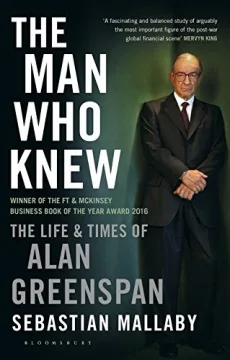
The Man Who Knew

The Life and Times of Alan Greenspan

By Sebastian Mallaby

Sebastian Mallaby’s biography follows Alan Greenspan from a statistics-obsessed childhood and early career as a jazz musician through economic consulting, Republican politics, and more than eighteen years as chair of the Federal Reserve. Its central concern is not simply whether Greenspan was a brilliant policymaker or a principal architect of financial disaster. Mallaby instead examines the contradiction between Greenspan’s ability to recognize economic danger and his reluctance to use public power against leverage, speculation, and asset bubbles. The result is simultaneously a life story, an institutional history of the Federal Reserve, and an account of the transformation of American finance after World War II. By tracing Greenspan’s encounters with Ayn Rand, Richard Nixon, Gerald Ford, Ronald Reagan, and successive presidential administrations, the book shows monetary policy as a product of political calculation, incomplete evidence, personal influence, and ideas about markets. Gr…

View book

Articles in this category

No published articles are currently connected to this category in this language.