
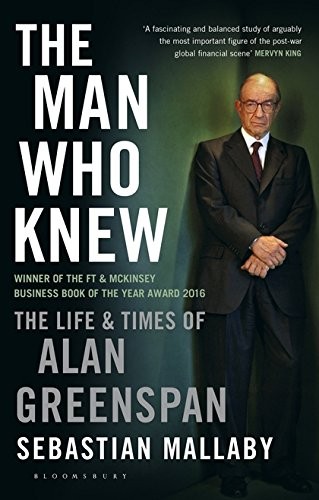
The Man Who Knew
The Life and Times of Alan Greenspan
Sebastian Mallaby’s biography follows Alan Greenspan from a statistics-obsessed childhood and early career as a jazz musician through economic consulting, Republican politics, and more than eighteen years as chair of the Federal Reserve. Its central concern is not simply whether Greenspan was a brilliant policymaker or a principal architect of financial disaster. Mallaby instead examines the contradiction between Greenspan’s ability to recognize economic danger and his reluctance to use public power against leverage, speculation, and asset bubbles. The result is simultaneously a life story, an institutional history of the Federal Reserve, and an account of the transformation of American finance after World War II. By tracing Greenspan’s encounters with Ayn Rand, Richard Nixon, Gerald Ford, Ronald Reagan, and successive presidential administrations, the book shows monetary policy as a product of political calculation, incomplete evidence, personal influence, and ideas about markets. Gr…
Where to buy or borrow
Are you selling this book? Bookstores, publishers, authors and libraries can be listed here for free. Request a listing
About this book
Deep Overview
His relationship with novelist and philosopher Ayn Rand supplied a different element: a moral vocabulary of individualism, capitalism, and suspicion of government intervention. Mallaby does not treat this association as a permanent key that mechanically explains every later decision. Instead, he traces how Greenspan modified ideological commitments as he entered Republican politics and encountered the practical demands of governing. Work connected to Richard Nixon introduced him to campaign strategy and executive power. As chair of the Council of Economic Advisers under Gerald Ford, he confronted inflation, recession, energy pressures, and the compromises required within a presidential administration. Under Ronald Reagan, he was not merely an apostle of tax cuts; he could oppose policies he considered fiscally reckless.
The Federal Reserve years form the book’s institutional center. Appointed chair in 1987, Greenspan soon faced the October stock-market crash. Later challenges included banking and credit strains, the Asian financial crisis, Russia’s 1998 default, the collapse of Long-Term Capital Management, the technology-stock boom and bust, and the rise of housing finance. Mallaby explains why Greenspan’s flexible, data-driven judgment appeared so successful. He resisted rigid formulas, cultivated agreement within the Federal Open Market Committee, communicated strategically, and recognized productivity improvements that helped permit strong growth without an immediate inflationary response.
Success also created danger. Markets increasingly treated Greenspan as a uniquely capable guardian, while policymakers gained confidence that crises could be managed after speculative excesses collapsed. Mallaby’s decisive argument concerns the difference between knowing and acting. Greenspan was not wholly blind to bubbles, leverage, or unsafe lending. He understood that prolonged stability could encourage financial risk. Nevertheless, he generally prioritized price stability and was reluctant to employ monetary or regulatory tools aggressively against asset-market excesses. Political resistance, uncertainty about identifying bubbles, faith in private adaptation, and the perceived costs of intervention all narrowed his response.
The biography therefore ends with an unresolved but consequential judgment. Greenspan’s achievements in controlling inflation and managing emergencies were real, yet those achievements cannot be separated from a financial order that became increasingly leveraged and fragile. His life illustrates how expertise can diagnose a threat without producing timely action—and how a celebrated record of crisis management may help create confidence that makes a future crisis more destructive.
Key Themes
**Pragmatism and ideology:** Greenspan’s youthful association with Ayn Rand shaped his language and instincts, but government service pushed him toward selective compromise. Mallaby examines the persistence of free-market preferences without reducing the later Greenspan to a fixed doctrine.
**Price stability and financial stability:** Low consumer-price inflation can coexist with dangerous borrowing, leverage, and asset inflation. The book asks whether central banks defined stability too narrowly.
**The politics of expertise:** Greenspan’s authority rested on analytical ability, but also on coalition building, strategic ambiguity, relationships, and an acute sense of what political institutions would tolerate.
**Reputation and institutional dependence:** The public image of the “maestro” concentrated confidence in one official. Mallaby shows how personal prestige can strengthen an institution while discouraging scrutiny of its assumptions.
**Success as a source of risk:** Repeatedly containing market disruptions encouraged confidence that later disruptions could also be repaired. Stability could therefore promote the risk-taking that undermined it.
Historical Context
By the 1980s and 1990s, deregulation, globalization, securitization, derivatives, and cross-border capital flows had made finance more complex and influential. The Federal Reserve’s defeat of high inflation under Paul Volcker strengthened central-bank credibility, while Greenspan inherited expectations that monetary policy could stabilize both prices and economic activity. His chairmanship coincided with the “Great Moderation,” a period associated with relatively stable growth and low inflation, but also with expanding credit markets and increasingly sophisticated financial risk-taking.
The book’s retrospective perspective is crucial. Greenspan retired in January 2006, before the housing collapse and the 2007–2008 financial crisis transformed assessments of his tenure. Mallaby writes after that reversal, when earlier praise of Greenspan’s crisis management had given way to arguments about deregulation, mortgage lending, interest rates, leverage, and the Federal Reserve’s responsibility for systemic risk.
Intended Audience
Readers do not need professional economic training, although patience with discussions of inflation, interest rates, asset prices, regulation, and financial leverage will help. Those seeking a short introduction to Greenspan may find the scale excessive. Readers wanting either a celebration or a simple indictment may also resist Mallaby’s sustained effort to preserve contradictions and distinguish among different kinds of responsibility.
Reading Difficulty
The most challenging portions involve the interaction of monetary policy, regulation, market expectations, and asset bubbles. Readers may need to pause over distinctions such as consumer-price inflation versus asset-price inflation, interest-rate policy versus supervisory action, and liquidity support versus long-term financial stability. The narrative’s personal and political scenes provide relief from the denser institutional material, but this is best approached as a sustained history rather than a quick survey.
Helpful Background Knowledge
Readers may benefit from knowing the broad presidential sequence from Richard Nixon through George W. Bush, since Greenspan’s influence crossed several administrations. It also helps to distinguish the 1970s inflation crisis, the 1987 stock-market crash, the technology boom of the 1990s, and the housing and credit boom preceding 2007. No specialized preparation is essential; the book itself supplies much of the necessary context.
Why Read This Book?
It is also valuable because it complicates retrospective blame. The book takes Greenspan’s failures seriously without pretending that he lacked insight or that every later consequence was obvious in advance. That tension makes the work useful beyond its subject: it offers a framework for thinking about any powerful expert whose intelligence, adaptability, and record of success may coexist with consequential hesitation. Finally, the biography links one unusual life to the rise of modern finance, giving personal form to changes that can otherwise appear abstract.
Reader Takeaways
Greenspan’s career encourages reconsideration of the word “ideologue.” His early beliefs mattered, but so did ambition, empirical habits, political adaptation, and the desire to remain influential. Readers may also become more alert to the social production of expert authority: reputations are built not only through correct forecasts but through communication, access, consensus management, and the successful containment of earlier emergencies.
The broader lesson is cautionary. An institution that becomes skilled at repairing crises after they occur may unintentionally reassure markets and encourage greater risk. Policy success should therefore be judged not only by visible short-term outcomes but by vulnerabilities accumulating outside the chosen measures of stability.
Strengths
The book’s evidentiary breadth is another strength. Extensive interviews and documentary research permit detailed reconstructions of policy disputes and political relationships. Its interpretive balance is equally important: Mallaby recognizes Greenspan’s analytical successes and crisis-management abilities while maintaining a firm critique of his response to leverage and bubbles.
The chronological sweep allows readers to see gradual change. Greenspan’s movement from Randian circles to the center of federal power is presented as adaptation rather than a single conversion. The work is also strong at showing that central-bank independence is never complete isolation from politics; it depends on persuasion, reputation, alliances, and institutional legitimacy.
Limitations and Cautions
Access to Greenspan creates exceptional detail but also poses an interpretive challenge: readers should continue distinguishing Greenspan’s retrospective explanations from independently established motives. Mallaby does not simply accept his subject’s account, yet the biography necessarily devotes substantial attention to Greenspan’s own framing.
The allocation of responsibility for the global financial crisis remains contested. Ben Bernanke, while praising the biography’s balance, disputed aspects of Mallaby’s assessment of Greenspan’s psychology and the policy lessons drawn from it. Readers should therefore treat the book as a powerful, evidence-based interpretation rather than the final settlement of debates over monetary policy, regulation, housing finance, and systemic risk.
Important Concepts, People, and Institutions
**Sebastian Mallaby:** The biographer who uses Greenspan’s life to investigate modern finance, central banking, and the gap between recognizing risk and acting against it.
**Federal Reserve System:** The U.S. central bank and the principal institutional setting of Greenspan’s mature career. Its mandates, independence, regulatory powers, and crisis role shape the book’s policy questions.
**Federal Open Market Committee:** The Federal Reserve body responsible for key monetary-policy decisions. Greenspan’s ability to guide its deliberations was an important source of his authority.
**Ayn Rand:** The novelist and advocate of radical individualism whose circle influenced Greenspan as a young man. Her significance lies in the tension between his early anti-government ideas and his later exercise of government power.
**Richard Nixon and Gerald Ford:** Presidents central to Greenspan’s entry into national politics and executive-branch policymaking. His work in their orbit reveals his development as a political strategist as well as an economist.
**Ronald Reagan:** The president who appointed Greenspan to chair the Federal Reserve in 1987. Greenspan’s Reagan-era role also shows that his fiscal judgments could diverge from movement conservatism.
**Paul Volcker:** Greenspan’s predecessor at the Federal Reserve, associated with breaking the high inflation of the late 1970s and early 1980s. Greenspan inherited the stronger anti-inflation credibility created during Volcker’s tenure.
**Monetary policy:** The management of interest rates and financial conditions to influence inflation and economic activity. Mallaby examines what monetary policy can accomplish and what it may neglect.
**Asset bubbles:** Sustained increases in asset prices that become detached from underlying economic value. Whether and how central banks should resist such booms is one of the book’s defining problems.
**Leverage:** The use of borrowed money to increase financial exposure. It can magnify gains during a boom and losses during a downturn, turning falling prices into systemic instability.
**Great Moderation:** The period of comparatively stable output and inflation associated with much of Greenspan’s chairmanship. In the book, it is both an achievement and a possible source of complacency.
**1987 stock-market crash, Asian financial crisis, Russian default, and Long-Term Capital Management:** Major disruptions that tested Greenspan’s crisis management and helped establish his reputation as a protector of financial stability.
**Housing and mortgage-credit boom:** The expansion that preceded the 2007–2008 crisis. It supplies the decisive test of whether Greenspan’s policy framework adequately addressed financial fragility.
Questions the Book Explores
Can a central bank preserve price stability while allowing financial instability to grow?
How did Greenspan’s early free-market convictions survive, weaken, or change as he acquired governmental power?
Why did political leaders, investors, journalists, and fellow policymakers invest so much confidence in one central banker?
Should monetary policy attempt to restrain asset bubbles before they burst, or should central banks focus on repairing the damage afterward?
How much of Greenspan’s record resulted from individual judgment, and how much reflected broader political and institutional limits?
Did repeated success in containing crises create moral hazard, complacency, or excessive faith in the Federal Reserve?
What should accountability mean when a policymaker acts under real uncertainty but also possesses unusual authority and information?
Reading Group Guide
Compare the young Greenspan influenced by Ayn Rand with the later central banker. Identify moments of genuine intellectual revision, pragmatic compromise, and strategic presentation. A useful discussion can distinguish changing one’s mind from temporarily setting beliefs aside.
Divide the Federal Reserve years into crisis management and crisis prevention. Consider why Greenspan was often effective at the first and less successful at the second. Groups may also compare the reputational effects of visible rescue operations with the less visible work of restraining a boom.
Pay attention to relationships—with presidents, advisers, colleagues, market participants, and romantic partners—not as biographical ornament but as evidence about how Greenspan acquired trust and influence. Finally, discuss the book alongside later criticism, including Ben Bernanke’s disagreement with parts of Mallaby’s assessment. This helps separate the biography’s factual reconstruction from its debatable causal and moral conclusions.
Discussion Questions
2. Does Mallaby portray Greenspan as abandoning Ayn Rand’s ideas, adapting them, or applying them selectively?
3. Which mattered more to Greenspan’s rise: analytical ability, political skill, personal relationships, or historical circumstance?
4. How should readers weigh Greenspan’s success in limiting inflation against the financial fragility that accumulated during his tenure?
5. When evidence about a bubble is uncertain, what level of risk justifies government intervention?
6. Did Greenspan’s reputation improve the Federal Reserve’s effectiveness, or did it create dangerous dependence on personal authority?
7. How does the book complicate the familiar contrast between independent technocrats and elected politicians?
8. Were Greenspan’s crisis responses prudent containment, or did they encourage markets to expect future rescue?
9. Which parts of the financial crisis can fairly be connected to Greenspan, and which require a broader institutional explanation?
10. Does Mallaby hold Greenspan to a reasonable standard for decisions made under uncertainty?
11. How might the story look different if told primarily from the perspective of workers, borrowers, or homeowners?
12. What lessons from Greenspan’s career should present and future central bankers resist applying too mechanically?
Sources and Verification
Comments
No published comments yet.
Available editions
Hardcover
hardcover
- Publisher
- Penguin Press
- ISBN-13
- 9781594204845
- Publication date