
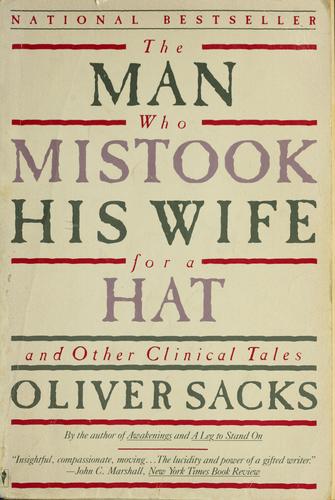
The Man Who Mistook His Wife for a Hat
And Other Clinical Tales
In this collection of twenty-four clinical narratives, neurologist Oliver Sacks examines people whose injuries, illnesses, and atypical neurological conditions have profoundly altered perception, memory, bodily awareness, language, impulse, or identity. The title case concerns Dr. P., a musician who can describe individual visual features yet cannot reliably recognize the objects and people before him. Other chapters consider severe amnesia, Tourette syndrome, loss of proprioception, phantom limbs, involuntary reminiscence, unusual artistic abilities, and distinctive forms of calculation and attention. Sacks is interested not only in locating an impairment but also in understanding the life constructed around it. Music, routine, imagination, faith, art, and personal relationships may become essential means of orientation. The result is an influential example of literary medical writing that presents neurology as a study of whole lives, while also raising enduring questions about patie…
Where to buy or borrow
Are you selling this book? Bookstores, publishers, authors and libraries can be listed here for free. Request a listing
About this book
Deep Overview
“The Lost Mariner” develops the relationship between memory and identity through Jimmie G., whose severe amnesia leaves him psychologically anchored in an earlier period of his life. Sacks asks whether a person without continuous recent memory can preserve a coherent self. He finds that sustained attention, emotion, worship, and meaningful activity may briefly create forms of continuity that factual recall cannot provide. In “The Disembodied Lady,” Christina loses proprioception—the internal sense of the body’s position—and must consciously use vision to direct movements that most people perform automatically. Her experience reveals how deeply ordinary agency depends on neurological processes that remain invisible until they fail.
The second part, “Excesses,” turns toward conditions expressed through too much activity rather than too little. “Witty Ticcy Ray” portrays a man with Tourette syndrome negotiating the relationship among medication, involuntary behavior, spontaneity, and personality. Treatment can reduce disabling symptoms, but it can also change the speed and style through which someone has learned to live. The clinical question therefore becomes inseparable from the patient’s judgment about what kind of life is tolerable or desirable.
“Transports” considers overpowering memory, sensory transformation, visions, and states associated with seizure or disease. Sacks treats these experiences as neurologically significant without assuming that their personal or cultural meaning is exhausted by diagnosis. His discussion of Hildegard of Bingen, for example, connects reported visionary imagery with migraine phenomena while leaving room to consider the religious and artistic use made of those experiences.
The final part examines people then described through categories of intellectual disability or autism. Chapters such as “Rebecca,” “The Twins,” and “The Autist Artist” emphasize narrative understanding, numerical fascination, drawing, memory, and concrete imagination. Some terminology and assumptions reflect the period and now demand caution. Nevertheless, the governing argument is consistent: a list of deficits cannot adequately describe a person. Sacks seeks a neurology attentive to individual worlds, compensations, values, and forms of meaning—even as the literary shaping of those worlds creates ethical questions of its own.
Key Themes
A second theme is compensation. Patients use music, vision, ritual, art, humor, habit, or social structure to perform tasks that damaged systems can no longer manage automatically. Adaptation is presented as active and individual rather than as a simple return to normality.
The book also questions deficit-based medicine. Sacks repeatedly asks what remains possible after a capacity is lost and whether unusual abilities can coexist with profound difficulties. Treatment consequently involves values as well as symptoms.
Finally, the collection explores the tension between explanation and meaning. A neurological account may clarify the mechanism behind an experience, but it does not necessarily settle what that experience means within a person’s life, faith, relationships, or sense of self.
Historical and Intellectual Context
Its language also belongs to 1985. Some diagnostic labels and descriptions of disability are now considered reductive or outdated, while contemporary standards place greater emphasis on informed consent, patient authorship, confidentiality, neurodiversity, and the social conditions surrounding disability. Reading the book historically therefore means recognizing both its role in making neurological experience accessible and the ethical limitations of physician-controlled case narration.
Intended Audience
Those seeking a current diagnostic manual, systematic neuroscience textbook, treatment guide, or representative account of each condition will need more recent sources. Readers uncomfortable with intimate medical narratives or older disability terminology may prefer to approach the collection alongside contemporary patient-written work.
Reading Difficulty
The greater difficulty is interpretive rather than technical. Sacks moves among clinical evidence, literary analogy, philosophical speculation, and emotional response without always marking firm boundaries between them. Readers should distinguish observed symptoms from interpretation and avoid treating one striking case as a universal model.
Helpful Background Knowledge
Familiarity with the concepts of neuroplasticity and compensation can clarify why patients develop alternative strategies. Modern perspectives on disability and neurodiversity provide an important counterpoint by encouraging readers to ask who defines normal function, whose voice controls the narrative, and how environmental support affects a person’s opportunities.
Why Read This Book?
The book is additionally worth reading as a foundational—and debatable—work of popular medical storytelling. Its achievements and ethical tensions provide a productive basis for discussing how clinicians write about people whose experiences they interpret for a wider audience.
Reader Takeaways
Readers may reconsider the meaning of treatment when symptoms are intertwined with identity and adaptation. They may also become more alert to the power imbalance within clinical storytelling. Compassionate intention does not remove questions about consent, accuracy, anonymity, interpretation, or the possibility that a vivid narrative can overshadow the person represented.
Strengths
Another strength is the insistence that diagnosis does not exhaust personhood. Even where the language now feels dated, Sacks looks for preserved abilities, individual preferences, and practical forms of accommodation. The book's memorable cases can motivate readers to investigate neuroscience and medical ethics more deeply.
Limitations and Cautions
Some terminology and descriptions of intellectual disability and autism reflect assumptions common in the period but unacceptable or contested today. The patients rarely control the published narrative, and social barriers receive less attention than neurological difference. Readers should balance the book with recent medical research and first-person accounts by disabled and neurodivergent writers.
Important Concepts, People, and Conditions
Alexander Romanovich Luria is a major intellectual influence. His detailed neuropsychological case histories offered Sacks a model for studying how a neurological disturbance reorganizes a whole person’s world.
Dr. P. is the pseudonymous musician in the title case. His visual agnosia interferes with recognizing faces and objects even though elementary vision remains available, illustrating the difference between seeing features and understanding what they form.
Jimmie G., the “lost mariner,” experiences severe amnesia associated with Korsakoff syndrome. His case anchors the book’s examination of memory, time, and personal continuity.
Christina, the “disembodied lady,” loses proprioception, the internal sense of bodily position. Her deliberate reliance on vision reveals a normally automatic foundation of movement.
Ray, presented in “Witty Ticcy Ray,” has Tourette syndrome. His response to haloperidol raises questions about symptom control, spontaneity, work, leisure, and informed treatment choices.
Hildegard of Bingen, a medieval abbess, composer, and visionary writer, appears in Sacks’s discussion of imagery that he associates with migraine aura. Her inclusion demonstrates his effort to connect neurological phenomena with cultural creation.
Agnosia is an inability to recognize or interpret sensory information despite relatively preserved basic sensation. Proprioception is the sense of the body’s position and movement. Hemispatial neglect disrupts attention to one side of space. Phantom phenomena involve sensations attributed to an absent or neurologically disconnected limb. These concepts collectively challenge the assumption that perception is a single, unified faculty.
Questions the Book Explores
What remains of the self when access to personal history or familiar perception is profoundly altered?
Can a neurological symptom be both disabling and connected to valued aspects of personality or creativity?
How do people construct alternative ways of functioning when an automatic capacity is lost?
Does identifying a neurological mechanism fully explain the meaning of a vision, memory, talent, or unusual behavior?
What responsibilities arise when a clinician transforms a patient’s life into a public story?
Reading Group Guide
Track moments when Sacks shifts from observation to interpretation. Groups can ask which conclusions are medically supported, which are philosophical, and which depend on narrative framing. The title chapter, “The Lost Mariner,” “The Disembodied Lady,” “Witty Ticcy Ray,” and “Rebecca” offer especially useful contrasts among perception, memory, embodiment, treatment, and storytelling.
Consider pairing the book with a recent first-person disability narrative or contemporary account of medical consent. This creates space to examine what changes when the subject, rather than the clinician, controls the description of a neurological life.
Discussion Questions
2. How does music function as a neurological aid, personal practice, or source of identity in the title case?
3. What does Jimmie G.’s story suggest about the relationship between memory and moral or spiritual continuity?
4. How does Christina’s loss of proprioception change the meaning of apparently simple bodily actions?
5. In “Witty Ticcy Ray,” who should determine whether the benefits of medication outweigh changes in spontaneity and personality?
6. Does the division into “losses” and “excesses” adequately describe neurological difference?
7. How do Sacks’s literary references deepen the cases, and when might they romanticize them?
8. What ethical obligations should govern the publication of a patient’s intimate history, even when names are changed?
9. Which ideas in the book remain valuable, and which require revision in light of contemporary disability perspectives?
10. How would the collection differ if each patient had written a response to Sacks’s account?
Sources and Verification
Comments
No published comments yet.
Available editions
Hardcover
hardcover
- Publisher
- Summit Books
- ISBN-10
- 0671554719