
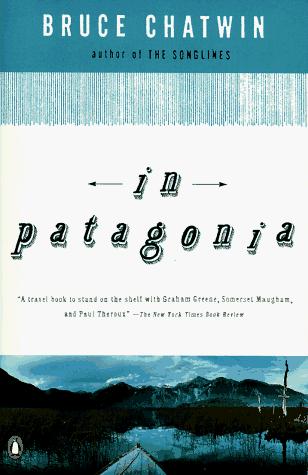
In Patagonia
Bruce Chatwin’s In Patagonia follows a journey through the southern regions of Argentina and Chile, but it is neither a practical guide nor a continuous record of an itinerary. Chatwin assembles the book from brief encounters, historical digressions, family legends, archival traces, and sharply observed landscapes. A childhood memory of a mysterious scrap of animal skin—said to come from a prehistoric creature—provides the journey with its initial quest. Along the way, Chatwin investigates Welsh settlement, Indigenous displacement, European migration, labor unrest, vanished outlaws, eccentric colonists, and stories attached to remote houses and settlements. The result is a mosaic in which Patagonia becomes both a geographical region and a repository of exile, longing, violence, and reinvention. First published in 1977, the book became influential for its compressed, episodic approach to travel writing and its deliberate movement between reportage, oral history, literary reconstruction…
About this book
Deep Overview
The journey runs through Argentine and Chilean Patagonia, including settlements shaped by Welsh migration, sheep ranching, maritime travel, border life, and European colonization. Chatwin meets people whose families arrived from Wales, Germany, Russia, Italy, and elsewhere. Their accounts reveal Patagonia as a region repeatedly imagined as an escape: from poverty, political repression, industrial society, family history, or the limitations of Europe. Yet the promised refuge seldom remains innocent. Settlement depends on contested land; fortunes collapse; utopian communities fragment; and the violence of conquest remains present beneath tales of adventure.
Chatwin moves continually between immediate observation and recovered history. Charles Darwin and Robert FitzRoy appear through the history of HMS Beagle and nineteenth-century European encounters with the region. Indigenous peoples, including the Selk’nam and other communities of southern South America, enter a record shaped largely by outsiders and marked by dispossession, forced assimilation, disease, and killing. The book also follows the traces of North American outlaws Butch Cassidy and the Sundance Kid, whose Patagonian episode demonstrates how historical figures can be transformed into mobile legends.
The landscape is not treated simply as scenery. Its distances, winds, sparse settlements, fossils, caves, and exposed plains influence the book’s form. Short sections mimic travel through a territory where one inhabited place may be separated from another by long intervals. Instead of supplying smooth transitions, Chatwin lets gaps remain visible. A conversation, grave, photograph, ruin, or family document may become the center of an episode before the narrative abruptly moves elsewhere.
This method produces a layered Patagonia made from physical travel, inherited memory, oral testimony, archival reading, and literary imagination. Chatwin is especially drawn to people who have left one world without fully belonging to another. Exiles, wanderers, failed settlers, collectors, sailors, revolutionaries, and fugitives collectively turn the region into a study of restlessness. The book suggests that travel is never only movement across a map: it is also a way of pursuing stories that recede, change, or multiply as the traveler approaches them.
Key Themes
A second theme is the unstable relationship between history and legend. Family anecdotes, outlaw stories, scientific accounts, and local memories coexist without always resolving into a single authoritative version. Chatwin is interested in what people preserve and embellish as much as in what can be proved.
Human restlessness provides another connective thread. Sailors, settlers, fugitives, explorers, and the author himself are driven by a persistent urge to move. Their mobility can be liberating, but it can also conceal dissatisfaction or reproduce older forms of conquest.
Extinction and disappearance recur through prehistoric remains, damaged cultures, abandoned settlements, and fading memories. These losses give the journey an elegiac undertone. Finally, the book explores the power of objects—a scrap of skin, a photograph, a letter, or a ruined building—to release stories far larger than themselves.
Historical Context
The region’s modern history includes Argentine and Chilean territorial expansion, the seizure of Indigenous lands, large-scale sheep ranching, immigration, and the growth of port and railway settlements. Welsh colonists established communities in Argentine Patagonia beginning in the nineteenth century, preserving elements of their language and culture while negotiating difficult relationships with the state, the land, and neighboring peoples. By the time Chatwin traveled there in the mid-1970s, these histories survived in institutions, family memories, buildings, and contested local narratives.
The book also emerged during a renewed period of British interest in literary travel writing. Its publication in 1977 preceded the genre’s strong revival in the 1980s and helped demonstrate that a travel book could combine field observation with biography, archival history, anecdote, and novelistic compression.
Intended Audience
Readers seeking a practical guide, a comprehensive regional history, a straightforward chronological journey, or a consistently transparent distinction between documented fact and reconstructed story may find it less satisfying. It rewards curiosity about digression and ambiguity more than a desire for systematic coverage.
Reading Difficulty
The episodic organization makes the book easy to read in short intervals, but its cumulative design requires attention. Historical references to exploration, colonization, European migration, Indigenous peoples, and political movements are not always fully explained. The book is therefore moderate in difficulty: stylistically clear, structurally unconventional, and historically dense.
Helpful Background Knowledge
Readers may also benefit from knowing that Patagonia is not a single political unit or culturally uniform landscape. It crosses an international border and encompasses multiple environments and communities. Awareness that many older accounts of the region were written through colonial, scientific, or frontier perspectives will make it easier to assess both Chatwin’s sources and his own point of view.
Why Read This Book?
Reader Takeaways
It may also sharpen a reader’s awareness of form. Omissions, abrupt transitions, and juxtaposition are not merely stylistic decoration; they determine how Chatwin creates meaning. At the same time, the book invites readers to question what responsibilities accompany the transformation of real people and contested histories into memorable literature.
Strengths
His descriptive economy is another strength. Physical details often establish social atmosphere as well as setting, while carefully chosen objects connect remote events to personal histories. The breadth of material is also notable: natural history, exploration, migration, labor conflict, outlaw mythology, and family memory appear within a relatively compact book. Above all, the work demonstrates how travel writing can become an inquiry into the stories through which people understand place.
Limitations and Cautions
The boundary between observed fact, retold anecdote, reconstruction, and literary shaping is not always explicit. Critics have consequently debated the book’s documentary reliability and its use of techniques associated with fiction. Its representation of Indigenous peoples and supposedly remote or “primitive” life also warrants scrutiny. Later scholarship has argued that Chatwin’s fascination with authenticity and disappearance can reproduce assumptions inherited from colonial travel traditions. These concerns do not erase the book’s literary importance, but they make critical reading essential.
Important Concepts, People, and Places
Tierra del Fuego and the Strait of Magellan connect the narrative to maritime exploration, imperial travel, and the histories of Indigenous communities in the far south.
Charles Amherst Milward, a relative of Chatwin’s grandmother, links the author’s childhood relic to Patagonian travel and the remains of a giant ground sloth. His story supplies the book’s initial quest.
The giant ground sloth, often associated in the narrative with the childhood “brontosaurus” story, represents extinction, scientific curiosity, family mythology, and the power of an object to generate travel.
Charles Darwin and Robert FitzRoy matter because the voyages of HMS Beagle helped shape influential European descriptions of Patagonia and Tierra del Fuego. Their presence also connects exploration to science and colonial encounter.
The Welsh settlement in Patagonia represents one of the book’s major migration histories. Its descendants embody cultural persistence, adaptation, and the complicated pursuit of a new homeland.
Butch Cassidy and the Sundance Kid appear through their South American afterlives. Their Patagonian story shows how criminal history can merge with frontier legend.
The Selk’nam and other Indigenous peoples of the far south are essential to understanding the cost of colonization. Their dispossession and destruction challenge romantic images of an open frontier.
Nomadism and restlessness are recurring concepts rather than narrowly defined theories in this book. Chatwin uses travelers, migrants, sailors, and fugitives to consider why movement exerts such power over human imagination.
Oral history is central to the method: conversations and inherited accounts give the book much of its material. Their use also raises questions about ownership, accuracy, memory, and narrative transformation.
Questions the Book Explores
How does a landscape become crowded with stories from different historical periods?
What remains of a person or community after documents, buildings, and direct memories begin to disappear?
Where does history end and legend begin, particularly when testimony has passed through several tellers?
What connects scientific collecting, imperial exploration, settlement, and the desire for adventure?
Can a traveler represent other people fairly while selecting and reshaping their lives for literary purposes?
Is restlessness a response to particular circumstances, or a more persistent feature of human life?
Reading Group Guide
Compare episodes about migrants, outlaws, explorers, and Indigenous communities. Discuss who is allowed to speak, whose history is reconstructed indirectly, and how differences in narrative treatment influence the reader’s sympathy.
Notice the transitions between sections. A productive discussion can examine what Chatwin gains by omitting routine travel logistics and what context disappears with them. Groups may also select several objects—letters, photographs, fossils, houses, graves—and trace how each serves as a bridge between present observation and absent lives.
Finally, discuss the book simultaneously as literature and evidence. Rather than deciding only whether it is “true” or “fictional,” consider the different standards readers apply to description, dialogue, oral testimony, historical synthesis, and narrative reconstruction.
Discussion Questions
2. What image of Patagonia emerges from the accumulation of short episodes rather than from a continuous description?
3. Which characters seem to embody freedom, and which reveal the costs of attempting to escape an earlier life?
4. How does Chatwin use physical objects to recover or invent connections with the past?
5. What are the effects of keeping the author’s emotions and daily difficulties largely outside the foreground?
6. How do stories of Welsh settlement complicate the idea of Patagonia as an isolated region?
7. In what ways do the outlaw narratives resemble the family and settlement legends elsewhere in the book?
8. How should readers respond when a work’s literary effectiveness depends partly on compression, reconstruction, or uncertain testimony?
9. Where does the book challenge colonial ideas about exploration, and where might it repeat them?
10. Does the fragmentary form acknowledge the impossibility of fully knowing a place, or does it give the traveler excessive control over other people’s stories?
11. Which section most strongly changes the meaning of an earlier episode, and how is that connection created?
12. What responsibilities do contemporary readers have when approaching the book’s accounts of Indigenous peoples and cultural destruction?
Sources and Verification
Comments
No published comments yet.
Available editions
Paperback
Penguin Classics paperback edition, with an introduction by Nicholas Shakespeare
- ISBN-13
- 9780142437193
- Publication date