
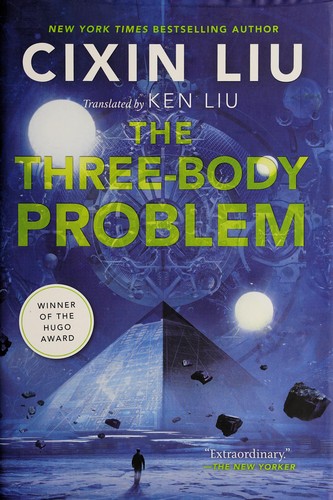
The Three-Body Problem
During China’s Cultural Revolution, the persecution of scientists shapes astrophysicist Ye Wenjie’s judgment of humanity and eventually connects her to a secret installation searching for extraterrestrial intelligence. Decades later, nanotechnology researcher Wang Miao encounters inexplicable experimental results, a disturbing countdown, and a virtual world governed by wildly unstable celestial cycles. His investigation—with the blunt, observant police officer Shi Qiang—reveals that these mysteries belong to a conflict extending far beyond Earth. The Three-Body Problem combines historical trauma, scientific investigation, conspiracy, and first-contact fiction. Its central threat is not simply the arrival of another civilization, but humanity’s divided response to that possibility. Some see extraterrestrial intervention as extinction; others welcome it as judgment or rescue. Through this division, Cixin Liu asks whether technological intelligence produces wisdom, whether despair can be…
Where to buy or borrow
Are you selling this book? Bookstores, publishers, authors and libraries can be listed here for free. Request a listing
About this book
Deep Overview
In the later timeline, Wang Miao, a researcher working with nanomaterials, is drawn into an investigation after prominent scientists begin dying by suicide and experimental physics produces apparently inconsistent results. He begins seeing a countdown that has no obvious physical source. His search leads him to a sophisticated virtual-reality experience called Three Body, where players attempt to understand a civilization trapped on a planet with unpredictable eras of stability and catastrophe. The game’s cycles of destruction are not merely puzzles. They model life in a star system whose three suns make long-term planetary conditions exceptionally difficult to predict.
Wang’s investigation is assisted by Shi Qiang, commonly called Da Shi, a police officer whose crude manner conceals practical intelligence and a strong understanding of human behavior. Together, they uncover the Earth-Trisolaris Organization, a movement formed around knowledge of the extraterrestrial civilization represented in the game. Its participants are not united by one motive. Some regard the Trisolarans as reformers capable of correcting human corruption; others accept humanity’s destruction; still others pursue narrower political or personal objectives. First contact therefore creates factions rather than planetary solidarity.
The threat acquires another dimension through the sophons: engineered particles used to interfere with experimental physics and monitor human activity. This strategy attacks civilization at the level of scientific progress. Humanity can see the approaching danger, but its ability to develop the knowledge needed to resist is deliberately constrained. The resulting conflict unfolds across two radically different timescales—the immediate fear and political disorder of the present, and an invasion journey measured in centuries.
The novel ultimately connects private despair to consequences on a planetary scale. Ye Wenjie’s choices cannot be separated from the violence she endured, yet the story does not reduce them to simple revenge. They emerge from a judgment about the human species. Against that judgment, Wang, Shi Qiang, and others must decide whether survival remains worth pursuing when victory is uncertain. The book’s scientific wonders thus support an ethical confrontation: whether intelligence deserves confidence, whether suffering justifies surrender, and whether fragile civilizations can learn to defend a future they may never personally see.
Key Themes
The novel also examines science as both a method and a social institution. When experiments cease producing dependable results, the crisis is psychological as well as technical: scientists begin to doubt whether the universe is intelligible. Political power can persecute researchers, but an adversary capable of corrupting experimental evidence can undermine the foundations of research itself.
Another recurring concern is the difference between knowledge and wisdom. Both human and Trisolaran societies possess impressive intelligence, yet technological achievement does not eliminate fear, hierarchy, or ruthless strategic behavior. The story also emphasizes deep time. Decisions made by one generation can expose remote descendants to dangers they did not choose, raising questions about responsibility across centuries.
Historical and Intellectual Context
The book also belongs to the modern development of Chinese science fiction. Its combination of Chinese history, planetary-scale speculation, and technically oriented problem-solving helped bring wider international attention to the field. For English-language publication, translator Ken Liu worked with Cixin Liu on presenting the story to a new readership, including placing the Cultural Revolution material at the beginning rather than revealing it later.
The title refers to the three-body problem in classical mechanics: predicting the motion of three gravitationally interacting bodies. Although particular configurations can be calculated or simulated, there is no single general closed-form solution comparable to the familiar solution for two bodies. In the novel, this mathematical difficulty becomes the basis for a civilization’s unstable environment.
Intended Audience
Readers who prefer intimate character studies, consistently naturalistic dialogue, or fast action from the opening chapter may find parts of the book comparatively formal or exposition-heavy. It is also a poor match for anyone seeking a fully self-contained resolution: the immediate investigation reaches a meaningful stage, but the larger struggle continues through the remaining volumes of the trilogy.
Reading Difficulty
The Three Body game introduces historical figures and compressed cycles of civilizational collapse, requiring readers to distinguish simulation, metaphor, and external reality. Some sections pause the investigation for scientific explanation or large-scale speculation. The book therefore rewards patient reading more than rapid plot consumption. No advanced scientific training is required, but comfort with abstract ideas will help.
Helpful Background Knowledge
Readers do not need to study these subjects in advance. The novel provides narrative explanations, and unfamiliar names or scientific terms can be understood from context. It may, however, help to remember that Chinese personal names conventionally place the family name first: in Ye Wenjie, for example, Ye is the family name.
Why Read This Book?
The book is also notable for the scale of its expansion. What begins as an investigation into scientists, experimental anomalies, and a mysterious game gradually becomes a conflict involving planetary engineering and centuries-long strategy. Readers interested in how speculative fiction can connect a particular national history to a cosmic problem will find a distinctive example here.
Reader Takeaways
It complicates the assumption that humanity would respond collectively to evidence of extraterrestrial life. Political beliefs, resentment, hope, and opportunism would continue to shape interpretation. Finally, the book asks readers to consider long-term duty: whether people should sacrifice in the present to protect descendants who cannot repay them and may never understand what was done on their behalf.
Strengths
The historical opening gives the later cosmic conflict a human cause rather than presenting it as an arbitrary disaster. The book also handles scale effectively, moving from one family’s suffering to the fate of civilizations without abandoning the connection between them. Shi Qiang provides a useful counterweight to the abstract science through observation, improvisation, and practical resilience.
Limitations and Considerations
Because this is the first volume of a trilogy, its largest conflict is established rather than resolved. The depiction of the Cultural Revolution is crucial but focused primarily on the experiences that shape Ye Wenjie; it should not be treated as a comprehensive history of the period. Readers should also distinguish the novel’s speculative technologies from established physics, even when they are introduced through real scientific concepts.
Important Concepts, People, and Organizations
Wang Miao is a nanotechnology researcher who investigates the countdown, the collapse of confidence among scientists, and the Three Body game. His viewpoint guides readers from apparent scientific impossibility toward the extraterrestrial conflict.
Shi Qiang, or Da Shi, is a police officer whose practical intelligence challenges the despair of more academically accomplished characters. He represents resilience grounded in human behavior rather than theoretical knowledge.
Yang Weining is an engineer at Red Coast Base and Ye Wenjie’s husband. His relationship to Ye and the classified project places him near the decisive events surrounding first contact.
Red Coast Base is the secret installation from which attempts are made to communicate beyond Earth. It joins Cold War-style military secrecy with radio astronomy and the search for extraterrestrial intelligence.
Trisolaris is a planet shaped by the chaotic motion of three suns. Repeated environmental destruction has made survival, prediction, and escape central to Trisolaran civilization.
The Earth-Trisolaris Organization is a human movement built around knowledge of Trisolaris. Its internal divisions show that collaboration with an outside power can arise from radically different motives.
Sophons are altered subatomic particles deployed to observe Earth and obstruct advances in fundamental physics. They turn scientific uncertainty into a form of strategic containment.
The three-body problem is the orbital-mechanics problem underlying Trisolaris’s unpredictable climate. It gives the novel both its title and its principal scientific metaphor.
The Cultural Revolution is the historical movement that forms the background to Ye Wenjie’s persecution and loss of faith in human institutions.
Questions the Book Explores
Would confirmed extraterrestrial contact unite human beings, or intensify ideological and political divisions?
What happens to scientific culture when observation no longer appears reliable?
Does superior technology imply superior ethics or political judgment?
What duties does the present owe to generations facing a danger centuries away?
Is pessimism about humanity a form of realism, or can it become an excuse for surrender and destruction?
How do civilizations balance openness, concealment, cooperation, and survival when they cannot know another civilization’s intentions?
Reading Group Guide
Compare Wang Miao and Shi Qiang as investigators. Wang relies on scientific expectations, while Shi reads institutions and people. Consider which form of knowledge proves more useful at different stages.
Pay attention to the Three Body game as more than a delivery system for background information. Examine how repeated destruction shapes the imagined political culture of Trisolaris. Groups may also compare the human factions supporting contact: their shared goal conceals major disagreements about humanity’s future.
Finally, discuss the ending as the conclusion of an investigation rather than the resolution of a war. What kinds of commitment can the characters make when the decisive confrontation lies beyond their lifetimes?
Discussion Questions
2. At what point does Ye Wenjie’s understandable disillusionment become an unjustifiable judgment about humanity?
3. Why are some human beings prepared to welcome Trisolaris despite the threat it presents?
4. What does Shi Qiang understand about survival that the novel’s scientists and political organizers sometimes overlook?
5. How does the Three Body game influence players emotionally as well as intellectually?
6. Is the interference with experimental physics more damaging as a technological barrier or as a psychological weapon?
7. Does the novel portray scientific progress as humanity’s best defense, or does it suggest that social cohesion matters just as much?
8. How does the long timescale of the invasion change ordinary ideas about courage, sacrifice, and responsibility?
9. Which elements of Trisolaran behavior arise from environmental instability, and which appear to reflect choices that could have been made differently?
10. After the final comparison involving insects, does the book seem fundamentally hopeful, pessimistic, or deliberately undecided?
Sources and Verification
Comments
No published comments yet.
Available editions
Hardcover
First U.S. edition
- Publisher
- Tor Books
- ISBN-13
- 9780765377067
- Publication date