
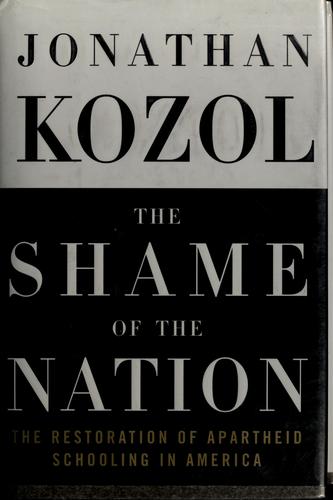
The Shame of the Nation
The Restoration of Apartheid Schooling in America
Jonathan Kozol examines the renewed racial segregation of American public schools and the unequal educational conditions accompanying it. Drawing on visits to nearly sixty schools, especially in large urban systems, he combines classroom observation, conversations with children and educators, historical reflection, and policy criticism. His argument extends beyond disparities in buildings or budgets: racially isolated schools are often subjected to rigid discipline, scripted instruction, relentless test preparation, reduced arts and humanities offerings, and assumptions about children’s future economic roles that affluent communities would resist. The book places these conditions against the unfulfilled promise of Brown v. Board of Education and challenges claims that standards and accountability can compensate for unequal opportunities. Its central concern is moral as well as institutional: what does a democracy reveal about itself when it accepts profoundly different forms of school…
Where to buy or borrow
Are you selling this book? Bookstores, publishers, authors and libraries can be listed here for free. Request a listing
About this book
Deep Overview
The book then follows the consequences of separation into children’s daily educational experience. Kozol contrasts the early advantages available to affluent families—including enriched preschool preparation—with the overcrowding, deteriorated facilities, limited materials, and reduced recreational or artistic opportunities he observes in many urban schools. This is not simply an argument that one group receives fewer resources. He argues that children are offered different conceptions of education itself. Privileged schools commonly assume that students deserve intellectual exploration, beauty, play, arts, literature, and preparation for higher education. Schools under pressure to raise test scores may instead impose scripted language, tightly controlled behavior, public performance labels, and extended test preparation.
Several chapters examine what Kozol regards as an “ordering regime.” Classroom practices modeled on managerial efficiency organize learning through prescribed objectives, slogans, commands, and quantifiable outcomes. He connects this regime to vocational rhetoric that treats young students as future units in a labor market rather than as developing citizens and imaginative human beings. The criticism is not directed at individual teachers struggling within these systems. On the contrary, Kozol repeatedly distinguishes institutional mandates from educators who protect curiosity, kindness, and intellectual life under difficult conditions.
The analysis expands from classrooms to housing patterns, district boundaries, school admissions, funding, and the courts. Kozol challenges reform narratives that promise excellence without confronting racial isolation or unequal resources. Isolated success stories, charismatic leaders, transfer programs, and tougher standards may improve particular situations, but he argues that they cannot substitute for structural change. He also disputes rhetoric suggesting that demands for resources excuse low expectations; in his view, children deserve both high expectations and the conditions that make fulfilling them possible.
The later chapters turn toward resistance and responsibility. Kozol considers desegregation initiatives, courageous educators, community advocacy, litigation, and the possibility of renewed civil-rights mobilization. “Treasured places”—schools where adults preserve humane relationships and rich learning—show what education can be, but they do not absolve the wider system. The book ultimately asks readers to stop treating segregated inequality as an unfortunate background condition. Kozol presents it as a political choice maintained through boundaries, spending decisions, policy priorities, and public acquiescence.
Key Themes
**Separate schooling and unequal opportunity:** Racial concentration matters partly because it overlaps with unequal facilities, staffing, curriculum, class size, counseling, enrichment, and political influence. The book rejects the idea that separation can be assessed independently of the opportunities attached to it.
**Two competing visions of education:** One model encourages inquiry, creativity, aesthetic experience, and broad intellectual development. The other emphasizes compliance, test performance, market preparation, and behavioral control. Kozol asks why the second is disproportionately imposed on poor children of color.
**Childhood under institutional pressure:** Students’ observations are central evidence. Their comments reveal that children notice neglected bathrooms, missing arts programs, inadequate playgrounds, overcrowding, and the difference between their schools and those serving affluent communities.
**Accountability without equality:** Standards can expose poor outcomes, but Kozol contends that measurement becomes punitive when governments demand equivalent results from radically unequal circumstances while declining to remedy those circumstances.
**Memory, moral language, and public action:** The nation celebrates civil-rights heroes while tolerating conditions opposed to their work. Kozol uses that gap between commemoration and practice to call for collective resistance rather than private sympathy.
Historical Context
Kozol also writes within the policy climate created by the No Child Left Behind Act of 2001. That law intensified standardized testing, performance targets, and sanctions for schools failing to demonstrate prescribed progress. The book does not reject educational expectations; it questions an accountability system that measures schools against common benchmarks while leaving profound differences in funding and opportunity intact.
A further legal backdrop is San Antonio Independent School District v. Rodriguez, the 1973 Supreme Court decision that declined to recognize education as a fundamental right under the federal Constitution and upheld the challenged Texas financing structure. Together, these developments help explain the book’s urgency: formal equality had been declared, but neither integrated enrollment nor materially comparable schooling was guaranteed nationwide.
Intended Audience
Readers who value field reporting and individual voices alongside policy argument are likely to find the approach compelling. Those seeking a neutral survey of competing reform models, a technical evaluation based primarily on causal statistical methods, or a detailed implementation blueprint may find it less suited to their purpose. Its emotional intensity and explicit advocacy are integral to the work rather than incidental features.
Reading Difficulty
Its rhetoric is also intense. Readers must distinguish the documented observations and statistics from the author’s moral judgments and broader interpretations. Chapter notes and the spending appendix support closer study, while the thematic chapter titles help organize a book that alternates between reportage, historical argument, and advocacy.
Helpful Background Knowledge
It is also useful to know that American public schools are governed and financed through overlapping local, state, and federal systems. Because communities differ greatly in wealth, political influence, and tax capacity, equal treatment on paper does not automatically produce equal educational conditions. Basic knowledge of standardized testing and the No Child Left Behind era will further illuminate Kozol’s criticism of test-centered accountability.
Why Read This Book
The work also provides a strong framework for evaluating reform claims. It presses readers to ask whether a proposal redistributes opportunity, merely measures unequal outcomes, or celebrates exceptional schools while leaving the surrounding system unchanged. Above all, it restores a civil-rights and democratic dimension to debates often reduced to test scores, administrative efficiency, and individual effort.
Reader Takeaways
The book also encourages attention to educational language. Terms such as accountability, standards, choice, efficiency, and preparation may appear neutral while concealing disagreements about power, resources, and the purpose of schooling. Readers may become more skeptical of reforms that require disadvantaged children to adapt to inequity rather than requiring institutions to remove it.
Finally, Kozol’s portraits of children and educators make policy consequences tangible. Segregation is not only a distributional pattern; it shapes relationships, imagination, dignity, and the range of futures students are invited to consider.
Strengths
His historical framing exposes the distance between public celebration of Brown and the conditions found in many schools decades later. He is particularly effective at contrasting the rich, exploratory education expected in affluent communities with the scripted and utilitarian programs imposed elsewhere.
The work also resists blaming teachers as a group. It recognizes educators and principals who preserve humane schooling within restrictive systems, giving the indictment moral complexity and identifying institutional courage as well as failure.
Limitations and Cautions
Its evidence is strongest as an account of conditions Kozol investigated during the early 2000s. Enrollment patterns, policies, funding figures, legal disputes, and testing systems have changed since publication, so the book should be paired with current data when used to describe present conditions.
Kozol offers principles for action and examples of resistance, but less operational detail than readers seeking a comprehensive policy design may want. Critics have also argued that his emphasis on integration and resources gives insufficient attention to competing reform arguments. Those disagreements make the book productive for debate but should not be mistaken for settled consensus.
Important Concepts, People, Institutions, and Places
**Brown v. Board of Education:** The 1954 Supreme Court ruling serves as the book’s central democratic promise. Kozol measures contemporary segregation against its declaration that state-sponsored separate schooling is unconstitutional.
**No Child Left Behind Act:** The federal accountability framework behind much of the book’s discussion of testing, sanctions, scripted instruction, and pressure on low-performing schools.
**San Antonio Independent School District v. Rodriguez:** The 1973 Supreme Court case is important to the difficulty of challenging unequal school finance through the federal Constitution.
**Martin Luther King Jr., Rosa Parks, and Thurgood Marshall:** Civil-rights figures whose names appear on highly segregated schools, creating one of the book’s most pointed examples of commemoration detached from practice.
**Gary Orfield:** A scholar of school segregation whose research helps situate Kozol’s observations within national resegregation patterns.
**New York City, the Bronx, Chicago, Los Angeles, Seattle, and metropolitan Boston:** These places are among the settings through which the book examines racial isolation, unequal opportunity, district boundaries, and desegregation efforts.
**METCO:** The Metropolitan Council for Educational Opportunity program in Massachusetts represents an enduring, though limited, effort to expand access across urban-suburban school boundaries.
**High-stakes testing:** Testing linked to significant consequences for students, teachers, or schools. Kozol argues that it can narrow instruction and intensify pressure where resources are already weakest.
**Scripted curriculum:** Highly prescribed lessons and classroom routines intended to standardize instruction. In the book, these exemplify the restricted professional and intellectual environment often imposed on urban schools.
**Resegregation:** The renewed increase of racial isolation after earlier desegregation gains. It is the book’s defining historical process rather than a claim that the old legal system returned in exactly the same form.
**Educational apartheid:** Kozol’s deliberately provocative term for the combined racial separation and inequality he documents. Its force and its limits are central subjects for critical discussion.
Questions the Book Explores
What remains of Brown v. Board of Education when legal segregation is prohibited but racial isolation persists?
Why are creativity, beauty, play, and broad intellectual study treated as necessities in affluent schools but as dispensable luxuries elsewhere?
Do standardized testing and sanctions remedy inequality, reveal it, or deepen its effects?
How do district boundaries, housing patterns, school funding, and admissions systems transform private advantage into institutional advantage?
Can exceptional educators and individual schools overcome structural inequality without wider political change?
What obligations do citizens outside segregated districts bear toward children educated within them?
Reading Group Guide
Compare “The Ordering Regime,” “Preparing Minds for Markets,” and “Excluding Beauty.” Track how discipline, economic expectations, and curriculum form a single account of unequal education. Consider whether the problem is excessive standardization, unequal standardization, or a deeper disagreement about what schools are for.
Pay close attention to “False Promises” and “Treasured Places.” Ask whether the successful programs and humane schools support hope, demonstrate what policy could accomplish, or risk becoming exceptions used to excuse systemic failure.
Conclude by separating diagnosis from remedy. Make one list of conditions Kozol condemns and another of actions he endorses or implies. This reveals where the book is most specific and where readers must develop the policy argument further.
Discussion Questions
2. Which school scenes most effectively connect institutional policy to a child’s daily experience?
3. Is integration valuable principally because it redistributes resources and influence, or does it have an independent democratic value?
4. How does the book distinguish high expectations from punitive accountability?
5. What assumptions about children’s future roles are embedded in the curricula Kozol describes?
6. When does standardized instruction protect students from inconsistent teaching, and when does it suppress meaningful learning?
7. Why does Kozol emphasize art, music, recess, attractive surroundings, and personal relationships alongside funding and test scores?
8. Can school inequality be substantially reduced without addressing housing segregation and district boundaries?
9. What responsibilities belong to federal, state, and local governments respectively?
10. Where does Kozol provide the strongest practical direction, and where does his call for action remain general?
11. How should readers test the book’s early-2000s claims against current conditions?
12. What would a genuinely equal education require beyond equal spending?
Sources and Verification
Comments
No published comments yet.
Available editions
Paperback
paperback
- Publisher
- Crown
- ISBN-13
- 9781400052455
- Publication date