
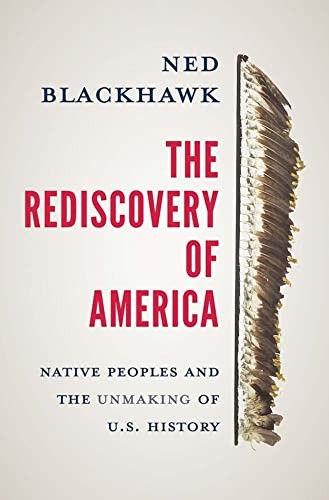
The Rediscovery of America
Native Peoples and the Unmaking of U.S. History
The Rediscovery of America is a large-scale reinterpretation of United States history that places Native nations within—not beside—the histories of colonization, revolution, constitutional government, territorial expansion, the Civil War, federal administration, and twentieth-century reform. Spanning roughly five centuries, the book draws together scholarship on numerous regions and communities to show that Native peoples remained political actors whose diplomacy, resistance, adaptation, labor, territorial power, and legal claims influenced the developing United States. Blackhawk’s method is synthetic rather than encyclopedic: he does not attempt to provide a complete chronological history of every Indigenous nation. Instead, he revisits major turning points commonly found in national histories and asks how they look when Native-newcomer relations become part of the central explanation. European colonization emerges as uncertain and contested rather than inevitable. Britain’s imperial…
Where to buy or borrow
Are you selling this book? Bookstores, publishers, authors and libraries can be listed here for free. Request a listing
About this book
Blackhawk’s method is synthetic rather than encyclopedic: he does not attempt to provide a complete chronological history of every Indigenous nation. Instead, he revisits major turning points commonly found in national histories and asks how they look when Native-newcomer relations become part of the central explanation. European colonization emerges as uncertain and contested rather than inevitable. Britain’s imperial problems and the American Revolution become connected to disputes over western settlement and Indian affairs. Nineteenth-century state-building appears inseparable from warfare, dispossession, treaty relations, and federal authority over Native peoples. The later chapters follow the damaging effects of allotment and assimilation while also emphasizing the activism that contributed to policy reform, legal recognition, and modern self-determination.
The word “unmaking” in the subtitle signals a challenge to inherited historical categories rather than a rejection of historical inquiry. Blackhawk argues that conventional national narratives have too often treated Indigenous peoples as preliminary figures who disappear once an ostensibly modern United States takes shape. His alternative presents Native and non-Native histories as mutually shaping, though profoundly unequal, relationships. ([yalebooks.yale.edu](https://yalebooks.yale.edu/book/9780300244052/the-rediscovery-of-america/?utm_source=openai))
Deep Overview
Blackhawk’s method is synthetic rather than encyclopedic: he does not attempt to provide a complete chronological history of every Indigenous nation. Instead, he revisits major turning points commonly found in national histories and asks how they look when Native-newcomer relations become part of the central explanation. European colonization emerges as uncertain and contested rather than inevitable. Britain’s imperial problems and the American Revolution become connected to disputes over western settlement and Indian affairs. Nineteenth-century state-building appears inseparable from warfare, dispossession, treaty relations, and federal authority over Native peoples. The later chapters follow the damaging effects of allotment and assimilation while also emphasizing the activism that contributed to policy reform, legal recognition, and modern self-determination.
The word “unmaking” in the subtitle signals a challenge to inherited historical categories rather than a rejection of historical inquiry. Blackhawk argues that conventional national narratives have too often treated Indigenous peoples as preliminary figures who disappear once an ostensibly modern United States takes shape. His alternative presents Native and non-Native histories as mutually shaping, though profoundly unequal, relationships. ([yalebooks.yale.edu](https://yalebooks.yale.edu/book/9780300244052/the-rediscovery-of-america/?utm_source=openai))
Key Themes
• **Sovereignty and political status:** Treaties, diplomacy, jurisdiction, and nation-to-nation relations demonstrate that Native peoples cannot adequately be understood only as racial or cultural minorities.
• **Violence and state formation:** Conquest, warfare, forced removal, militia campaigns, land seizure, and coercive federal policies were connected to the growth of American governmental power.
• **Contingency rather than inevitability:** European and later American dominance was produced through prolonged conflict and changing alliances; it was not a predetermined result of first contact.
• **Survival and adaptation:** The narrative attends to catastrophic loss without reducing Native history to victimhood. Communities reorganized, negotiated, litigated, resisted, and preserved political identities.
• **Historical erasure:** Blackhawk examines how mainstream accounts made Native peoples peripheral even when Indian affairs substantially influenced familiar events.
• **Democracy and dispossession:** The expansion of political institutions for some Americans occurred alongside the restriction of Native sovereignty and the transfer of Indigenous lands.
• **Self-determination and resurgence:** Twentieth-century activists and tribal leaders helped reshape federal Indian law and policy, laying foundations for greater governmental autonomy. ([yalebooks.yale.edu](https://yalebooks.yale.edu/book/9780300244052/the-rediscovery-of-america/?utm_source=openai))
Historical and Intellectual Context
Blackhawk synthesizes several decades of this work for readers interested in the full span of U.S. history. His continental framework moves beyond an account centered exclusively on the thirteen British colonies. Spanish colonialism, western Native powers, French and British competition, Mexico, Canada, California, and the trans-Mississippi West all become relevant to explaining the country that eventually emerged.
The book also intervenes in public arguments about how American history should be taught. Its governing proposition is that adding isolated Native episodes to an otherwise unchanged national chronology is insufficient. The causal explanations themselves must be reconsidered: territorial ambition, imperial administration, constitutional authority, military expansion, citizenship, and reform all developed through relationships with Native nations. Professional historical reviews have characterized the book as an ambitious synthesis of recent scholarship and a critique of persistent erasures in American historiography. ([online.ucpress.edu](https://online.ucpress.edu/ch/article-abstract/101/2/99/200545/Review-The-Rediscovery-of-America-Native-Peoples?redirectedFrom=fulltext&utm_source=openai))
Intended Audience
Readers already familiar with standard U.S. history will be well positioned to recognize how Blackhawk changes the emphasis and causal structure of familiar events. Those approaching the subject for the first time can still follow the chronological narrative, but may need to pause over the many nations, jurisdictions, conflicts, and policy changes.
It is less suitable for someone seeking a brief introductory survey, a community-by-community history of all Native North America, or a memoir centered on personal Indigenous experience. This is a long scholarly synthesis concerned chiefly with historical interpretation and political relationships.
Reading Difficulty
The structure is broadly chronological and divided into two parts of six chapters each, which helps orient the reader. Nevertheless, individual chapters often connect events occurring in several regions. The main challenge is therefore cumulative rather than stylistic: readers must keep track of changing political relationships and understand that terms such as sovereignty, treaty, removal, allotment, termination, and self-determination refer to distinct historical and legal arrangements.
Maps, illustrations, notes, and the index support closer study. A library catalog records bibliographical references extending from pages 449–550, indicating the substantial scholarly apparatus behind the narrative. ([academic.oup.com](https://academic.oup.com/ahr/article-abstract/130/1/488/8069669?utm_source=openai))
Helpful Background Knowledge
Readers should also distinguish tribal sovereignty from the sovereignty of foreign states and from the civil rights of individual citizens. Native nations entered treaties, exercised governmental authority, and maintained collective political identities, even as federal and state power constrained them. Recognizing this political dimension prevents the book from being reduced to a general account of race relations.
Keeping a map and a simple timeline nearby may be useful. The terms “Indian,” “American Indian,” “Native American,” and “Indigenous” appear in different historical, legal, and analytical contexts; readers should attend to how each is being used rather than assuming they are always interchangeable.
Why Read This Book?
The book offers a bridge between specialized Indigenous-history scholarship and a broad national narrative. It enables readers to see connections among episodes often taught separately: imperial border policy and revolutionary unrest; treaty relations and federal authority; western conquest and the Civil War; assimilation policy and modern legal activism.
It is also a useful model of historiographical revision. Blackhawk shows how a national story changes when historians reconsider where it begins, which actors possess political agency, and which institutions count as part of constitutional history. Its recognition by the National Book Foundation as the 2023 Nonfiction winner confirms its public and literary significance, although that award should not substitute for critical evaluation of its arguments. ([nationalbook.org](https://www.nationalbook.org/awards-prizes/national-book-awards-2023/?utm_source=openai))
Reader Takeaways
The book encourages skepticism toward narratives of inevitable conquest. Outcomes that appear predetermined in retrospect resulted from unstable alliances, demographic catastrophes, contested borders, government decisions, and repeated Native resistance.
Readers may also gain a more precise understanding of agency. Recognizing Native agency does not minimize colonial violence or dispossession; it means examining how Indigenous people made consequential choices under unequal and often coercive conditions.
Finally, the later chapters demonstrate that Native political history did not end with nineteenth-century conquest. Tribal leaders, attorneys, organizers, and reservation communities continued to influence law and policy, making survival, governance, and self-determination essential parts of modern American history.
Strengths
Its geographic scope challenges an Atlantic-coast narrative in which American history moves steadily westward from the thirteen colonies. Multiple empires, borderlands, Native powers, western territories, and regional forms of colonial violence enter the national frame.
Another strength is the balance between structural power and Indigenous action. The book addresses epidemics, warfare, dispossession, removal, assimilation, and federal domination while refusing to make disappearance the organizing endpoint. Diplomacy, adaptation, legal argument, political organization, and institutional survival remain visible.
Professional reviewers have particularly recognized the work as a broad and ambitious synthesis that exposes erasures in conventional histories and reframes major political developments through Native-newcomer relations. ([online.ucpress.edu](https://online.ucpress.edu/ch/article-abstract/101/2/99/200545/Review-The-Rediscovery-of-America-Native-Peoples?redirectedFrom=fulltext&utm_source=openai))
Limitations and Cautions
The emphasis is primarily political and historical. Law, diplomacy, war, federal administration, and collective sovereignty often provide the narrative framework. Cultural, environmental, gender, economic, and community histories are present where they serve the broader argument but are not always developed to the same depth.
The book generally ends its sustained narrative in the late twentieth century. Readers seeking a comprehensive treatment of twenty-first-century Native governance, environmental struggles, cultural revitalization, contemporary court decisions, or present-day tribal economies will need supplementary reading.
Its density may also limit its usefulness as a first or only introduction. Because the book revises familiar narratives, readers with little knowledge of the conventional chronology may not always recognize the full significance of the reinterpretation. These limitations arise largely from the demands of synthesis rather than from a lack of scholarly scope.
Important Concepts
• **Native-newcomer relations:** Blackhawk’s relational framework for understanding how Indigenous peoples and arriving populations shaped one another and produced new political orders.
• **Settler colonialism:** A form of colonial expansion oriented toward acquiring territory and replacing or subordinating existing Indigenous political orders.
• **Treaty relations:** Agreements that recognized Native nations as political parties while also becoming instruments through which the United States obtained land and asserted authority.
• **Indian affairs:** The governmental field through which imperial and later federal authorities managed diplomacy, trade, war, removal, reservations, and tribal relations.
• **Removal:** The coercive displacement of Native nations from their homelands, especially associated with nineteenth-century U.S. expansion.
• **Reservations:** Territories associated with tribal communities and federal policy; they became sites of confinement and control but also enduring bases of community and government.
• **Allotment and assimilation:** Policies designed to divide collectively held lands and absorb Native individuals into dominant American society, frequently producing additional land loss.
• **Termination:** A mid-twentieth-century federal policy intended to end selected federal-tribal relationships and recognition.
• **Self-determination:** The policy and political movement supporting greater tribal authority over government, programs, lands, and community affairs.
• **Historical erasure:** The removal or marginalization of Native peoples from accounts of events in which they were consequential participants.
Questions the Book Explores
• How does U.S. history change when Native nations are treated as political powers rather than as obstacles to settlement?
• Why did European colonization succeed, and what is obscured when that success is portrayed as inevitable?
• How did disputes over Indigenous lands and diplomacy contribute to Britain’s imperial crisis and the American Revolution?
• What relationships connect democratic expansion, territorial growth, warfare, and Native dispossession?
• How did the Civil War and Union victory alter Native communities and federal authority in the West?
• How did treaties function both as recognitions of political status and as mechanisms of land transfer?
• Why did Native peoples remain marginal in national histories despite their influence on American institutions?
• How did twentieth-century Native activists use law, political organization, and federal policy to defend or rebuild collective authority?
Reading Group Guide
At each meeting, identify one familiar event whose meaning changes when Native affairs are included. Track three recurring subjects separately: land, sovereignty, and federal power. This prevents the many regional examples from becoming an undifferentiated sequence of conflicts.
Groups may also assign members to follow particular regions or political entities across the narrative. A map-based exercise can clarify how events in the Northeast, Southeast, Great Lakes, Southwest, California, and Great Plains belong to one continental history without being identical.
The publisher provides an instructor’s guide and discussion questions as supplementary material. Groups should consult those materials directly rather than assuming this independent guide reproduces them. ([yalebooks.yale.edu](https://yalebooks.yale.edu/book/9780300244052/the-rediscovery-of-america/?utm_source=openai))
Discussion Questions
2. Which event in the book most substantially altered your previous understanding of U.S. history? What changed: the facts, the actors, or the explanation?
3. How does the book distinguish Indigenous agency from either triumphalist history or a narrative focused solely on victimization?
4. What is gained by treating Native nations as political entities? What becomes difficult to explain when they are viewed only as racial minorities?
5. How does the book complicate the relationship between American democracy and territorial expansion?
6. In what ways did Native affairs shape the American Revolution and the powers of the federal government?
7. How does the continental scale strengthen the argument? Where does that breadth require too much compression?
8. What roles do treaties play in the narrative—as diplomatic recognition, legal obligation, instrument of dispossession, or all three?
9. Does the concept of mutual shaping adequately convey relationships marked by major inequalities of military and institutional power?
10. Why have Native peoples been so frequently removed from mainstream national histories even when they influenced major events?
11. How does the twentieth-century history of activism and self-determination change a story that might otherwise end with conquest?
12. What would schools, museums, monuments, or public commemorations look like if they adopted the book’s central historical framework?
Sources and Verification
Comments
No published comments yet.
Available editions
Hardcover
First hardcover edition
- Publisher
- Yale University Press
- ISBN-13
- 9780300244052
- Publication date
- Pages
- 616