
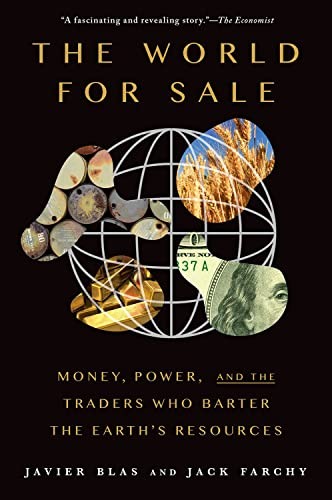
The World for Sale
Money, Power and the Traders Who Barter the Earth’s Resources
The World for Sale investigates the private commodity-trading firms that move oil, metals, grain, and other raw materials between producers and buyers. Javier Blas and Jack Farchy show how these firms became essential intermediaries in the global economy while remaining far less visible than banks, oil majors, or governments. Their account follows traders into markets transformed by decolonization, resource nationalization, the rise of OPEC, the Soviet Union’s collapse, China’s economic expansion, sanctions, and civil war. Companies such as Glencore, Vitol, Trafigura, and Cargill emerge not merely as brokers but as financiers, logisticians, intelligence gatherers, and sometimes politically consequential actors. The book’s central significance lies in connecting ordinary consumption to transactions conducted in distant ports, mines, ministries, and financial centers. It presents commodity trading as a form of capitalism built on information, credit, appetite for risk, and a willingness…
Where to buy or borrow
Are you selling this book? Bookstores, publishers, authors and libraries can be listed here for free. Request a listing
About this book
Deep Overview
Blas and Farchy explain the industry’s growth through changes in political control. In the mid-twentieth century, large Western oil companies managed much of the petroleum chain themselves. Nationalization and the growing power of resource-owning states disrupted those integrated networks. Producers gained formal control of their reserves but still needed buyers, shipping, credit, storage, and information. Independent traders entered that gap. The rise of OPEC and the petrostates therefore created opportunity for intermediaries able to connect newly assertive producers with worldwide demand.
The narrative gives particular weight to Marc Rich, whose aggressive, politically indifferent approach became a model for later trading houses. Rich’s career illustrates the book’s recurring tension: traders can keep essential goods moving across hostile borders, but the same flexibility can weaken sanctions, sustain repressive governments, and move money into systems with little transparency. Glencore, which grew from Rich’s business, becomes one of the clearest examples of how a trading operation can evolve into a major owner and producer of natural resources.
The collapse of the Soviet Union offered another decisive opening. State assets, metal production, and export channels entered a chaotic commercial environment. Traders possessing credit, foreign contacts, and knowledge of international prices could secure supplies that local producers urgently needed to monetize. Elsewhere, including resource-rich African states, firms exchanged advance financing and access to global markets for long-term commercial relationships. Such arrangements could provide governments with immediate liquidity while also operating beyond strong public scrutiny.
War and political crisis repeatedly appear as commercial environments rather than interruptions to commerce. The book examines deals connected to Saddam Hussein’s Iraq, sanctioned regimes, apartheid-era South Africa, and the Libyan uprising against Muammar Gaddafi. Its point is not that traders caused every crisis, but that their networks allowed them to convert instability, scarcity, and political isolation into opportunity.
Across these episodes, the authors identify a durable business model. Traders gather superior information, exploit price differences between locations and moments, arrange logistics, and use borrowed money to control large flows of goods. Over time, some firms expanded into mines, refineries, storage facilities, and other physical assets. The result is a history of globalization seen from its least public corridors—a system in which private intermediaries can become indispensable precisely because they are willing to cross the legal, political, and moral boundaries that constrain more visible institutions.
Key Themes
• **Opacity and accountability:** Private ownership, complex transactions, and operations across many jurisdictions can make major economic actors difficult for citizens and regulators to examine.
• **Risk and reward:** Traders profit by assuming price, credit, political, and logistical risks that other institutions avoid. The book asks who ultimately bears the losses when such risks go wrong.
• **Commerce beyond political loyalty:** Trading houses frequently treat ideology, alliances, and sanctions as obstacles to navigate rather than fixed moral commitments.
• **Information advantage:** Timely knowledge about production, shipping, inventories, government decisions, and local relationships can be as valuable as ownership of the commodity itself.
• **The blurred boundary between markets and states:** Resource transactions can finance governments, rebels, and politically connected networks, making private deals consequential for public affairs.
• **Globalization’s hidden infrastructure:** The apparent smoothness of world trade depends on credit, storage, transport, and dealmaking that consumers rarely see.
Historical Context
The oil shocks of the 1970s, the development of commodity futures markets, and financial deregulation widened the scope for firms capable of combining physical trade with market finance. The Soviet Union’s dissolution after 1991 then released vast mineral and energy assets into unstable commercial systems. At roughly the same time, China’s rapid industrialization drove extraordinary demand for energy and metals. Civil wars, sanctions, privatization, and weak state institutions produced further openings for firms comfortable with political uncertainty.
The book was published in 2021, after commodity markets had again demonstrated their vulnerability during the COVID-19 pandemic. Its concluding concerns also anticipate the strategic importance of metals required for electrification and the energy transition.
Intended Audience
Students of globalization, journalists, policy readers, and professionals working near trade finance or logistics will find an accessible narrative introduction to the sector. Readers looking for quantitative commodity analysis, trading instruction, or a systematic regulatory handbook should look elsewhere. Those uncomfortable with morally ambiguous protagonists may also find the book challenging, although that discomfort is integral to its subject.
Reading Difficulty
Terms involving physical trading, futures, arbitrage, sanctions, prepayment, and trade finance may require occasional attention, but the narrative usually supplies enough context to follow their purpose. The story-driven structure keeps the pace brisk, though readers may benefit from noting how companies change names, ownership, and roles over time. No specialist financial training is necessary.
Helpful Background Knowledge
It also helps to distinguish physical commodity trading from purely financial speculation. A physical trader may finance a producer, charter a vessel, arrange insurance and storage, manage currency or price exposure, and deliver material to a buyer. Familiarity with this wider chain makes the traders’ influence easier to recognize.
Why Read This Book?
The book is particularly valuable for showing how private transactions can acquire geopolitical consequences without taking place through formal diplomacy. It also offers an unusual perspective on globalization, emphasizing improvisation, personal networks, and political risk rather than abstract flows of capital. Readers following energy security, sanctions, critical minerals, or supply-chain resilience will gain a historical foundation for interpreting those issues.
Reader Takeaways
Readers may also reconsider opacity as both a commercial advantage and a democratic problem. Confidentiality can enable rapid decisions in volatile markets, yet it can conceal corruption, sanctions evasion, environmental harm, and unequal bargains. Finally, the book demonstrates that disruptions do not affect every market participant equally. Scarcity and disorder create suffering for many, but they can create exceptional opportunities for actors with capital, information, storage, and mobility.
Strengths
The authors also make clear why traders exist. They do not reduce the industry to speculation or scandal; they explain its roles in financing, logistics, storage, risk management, and market access. The narrative benefits from reporting experience and access to figures from an industry known for privacy. Its episode-based storytelling gives momentum to a subject that could otherwise become highly technical.
Limitations and Cautions
The narrative form can also complicate the book’s moral stance. The ingenuity and audacity of traders make compelling stories, and at times that narrative excitement may sit uneasily beside the political or social consequences of their deals. Because the book covers many countries and commodities, it cannot provide a complete institutional history of every firm or a comprehensive theory of commodity pricing. Finally, its main account ends around the time of its 2021 publication, before later developments in sanctions, energy security, and critical-mineral policy.
Important Concepts, People, and Organizations
• **Marc Rich:** A foundational figure in the modern trading model. His career demonstrates the industry’s appetite for politically difficult markets and the legal and ethical dangers that followed.
• **Glencore:** The company that developed from Marc Rich’s trading enterprise and expanded beyond intermediation into ownership of mines and other productive assets.
• **Vitol and Trafigura:** Major independent trading houses used to illustrate the reach of firms operating across oil, metals, logistics, finance, and politically sensitive markets.
• **Cargill:** A longstanding agricultural trading company that broadens the story beyond oil and metals and demonstrates the importance of private firms in global food flows.
• **OPEC:** The Organization of the Petroleum Exporting Countries helped shift control over oil away from Western majors, creating new opportunities for traders to connect producers with buyers.
• **The Seven Sisters:** The dominant Western oil companies whose integrated networks shaped the petroleum industry before nationalization and producer-state power altered the market.
• **Soviet dissolution:** The breakup of the Soviet Union created chaotic markets for metals and energy, enabling traders with capital and international contacts to become influential intermediaries.
• **Saddam Hussein and Iraq:** Iraq’s isolation and sanctions provide a case study in how commodities, political survival, and restrictions on trade became entangled.
• **Muammar Gaddafi and the Libyan Civil War:** The Libyan uprising illustrates how fuel supply and commodity finance can affect an armed struggle as well as a commercial market.
• **Vladimir Putin’s Russia:** Russian resource wealth and Western sanctions exemplify the political leverage attached to commodity revenues and the controversial role of trading intermediaries.
• **Trade finance:** Credit supplied before or during a transaction allows producers to operate and traders to control shipments far larger than their immediately available cash.
• **Arbitrage:** The exploitation of price differences across places, qualities, or times. It is a basic source of trading profit and a mechanism through which separated markets become connected.
• **Resource nationalization:** The transfer of resource control from foreign companies to states. It changed ownership without automatically giving producer governments equivalent marketing and distribution capabilities.
Questions the Book Explores
• What services do traders provide beyond buying at one price and selling at another?
• Why do sanctions, wars, state collapse, and diplomatic isolation create unusual commercial opportunities?
• When does market intermediation become political power?
• Can a business claim neutrality when its transactions sustain governments, armed movements, or discriminatory systems?
• How did nationalization, OPEC, post-Soviet privatization, and China’s growth reshape commodity commerce?
• Why have regulators and the public often struggled to scrutinize private trading houses?
• Will the energy transition reduce traders’ influence, or shift it toward metals and other strategically important materials?
Reading Group Guide
Track how the source of power changes across the book. Early influence often comes from personal relationships and information; later chapters add access to bank credit, sophisticated markets, storage networks, and direct ownership of productive assets. Discuss whether this represents an evolution from middleman to multinational corporation.
Groups can also compare the book’s major historical turning points: resource nationalization, the Soviet collapse, China’s expansion, and the Arab Spring. In each case, ask what governments lacked and what traders supplied. Finally, notice how narrative excitement shapes moral response. Consider whether the presentation of audacious deals clarifies the industry’s culture or risks making damaging conduct appear glamorous.
Discussion Questions
2. Are commodity traders best understood as necessary market makers, opportunists, or both?
3. When a transaction is legal but strengthens a repressive government, what responsibility belongs to the trader?
4. How did resource nationalization unintentionally expand the role of independent trading houses?
5. Does commercial secrecy serve a legitimate purpose in this industry? Where should its limits lie?
6. How does the book complicate the idea that sanctions cleanly separate legitimate and illegitimate trade?
7. What does Marc Rich’s career reveal about the relationship between innovation and rule-breaking?
8. How did the collapse of the Soviet Union redistribute power among states, producers, traders, and financiers?
9. Does the book give sufficient attention to people living where commodities are extracted or transported?
10. How might decarbonization change the commodities traded without changing the underlying concentration of commercial power?
11. Did the authors’ thriller-like storytelling affect your judgment of the traders? If so, how?
12. What forms of public disclosure or regulation would improve accountability without preventing essential trade?
Sources and Verification
Comments
No published comments yet.
Available editions
Hardcover
hardcover
- Publisher
- Random House Business
- ISBN-13
- 9781847942654