
Parallel Text, Prose Translation, or Verse Translation: Which Edition of a Classic Poem Should You Choose?
A practical comparison of three formats for reading poetry across languages
Choose according to what you most want to access: the original language, the narrative and ideas, or the poem’s patterned movement. This guide compares the formats and the compromises each requires.
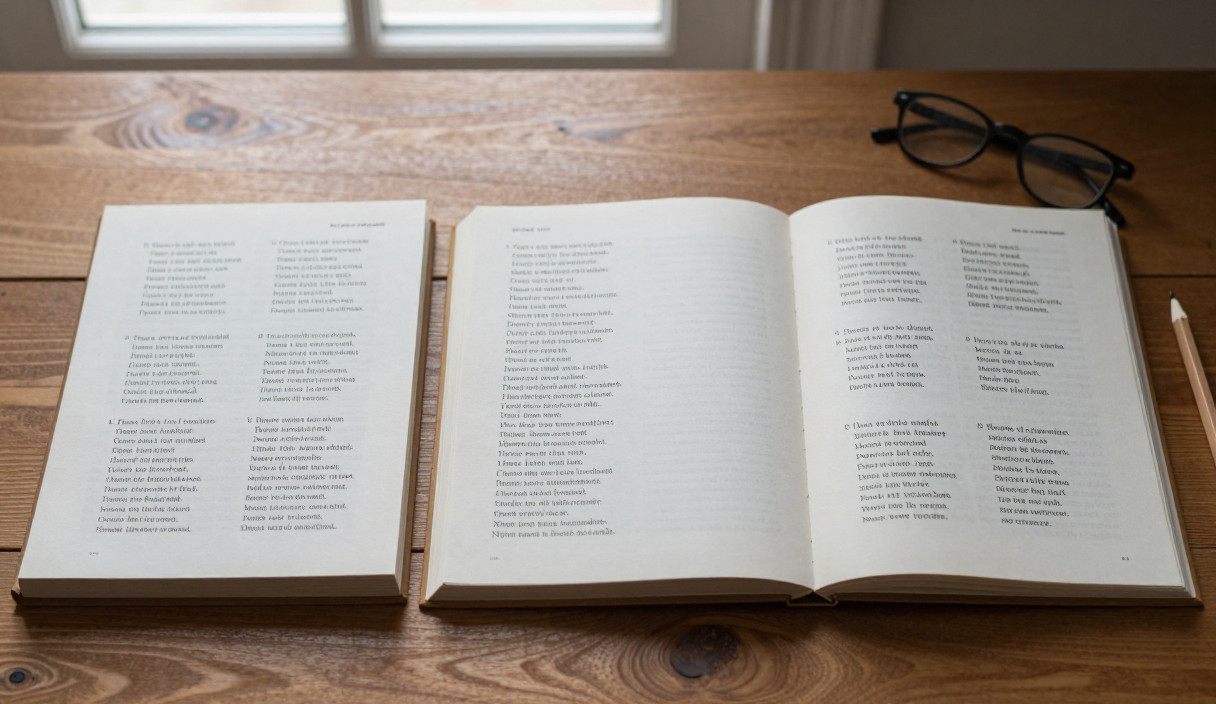
The shortest answer is simple. Choose a parallel-text edition when you want to examine the original language, a prose translation when your priority is following meaning or story, and a verse translation when you want the English to behave recognizably as poetry.
That rule is only a starting point. A parallel text can contain either prose or verse on its translated side, while verse translations range from line-by-line renderings to radical recreations. Prose can be precise without being neutral, and a metrical translation can preserve rhythm while altering syntax, emphasis, imagery, or register. No label tells you everything about a translator’s decisions.
The best choice therefore depends on the reading experience you want and the work in front of you. A long narrative poem may reward clarity differently from a sonnet sequence. A reader studying Latin will use facing pages differently from someone who cannot read the original script but wants to see stanza shapes. Cost, page design, notes, and portability may matter as much as abstract questions of fidelity.
Treat the format as an invitation to read in a particular way. Then inspect the translator’s note and a sample passage before deciding whether to accept that invitation.
What each format is designed to give you
A parallel-text or bilingual edition prints the source text alongside its translation, commonly on facing pages. Its defining feature is access to both texts rather than a particular translation method. The English side may reproduce verse form, use free verse, or present prose. Some editions also provide transliteration, pronunciation help, glosses, or extensive commentary.
This format is best when linguistic access matters. A reader with some knowledge of the source language can compare vocabulary, syntax, names, repeated formulas, and line divisions. A beginner can use the translation as support while testing recognition of the original. Even without knowing the language, a reader may observe line lengths, stanza patterns, repetitions, or changes in visual arrangement. Those observations have limits, however: typography alone cannot disclose sound, grammar, idiom, or cultural associations.
A prose translation releases the English from the obligation to maintain verse lines, meter, or rhyme. That freedom can allow the translator to prioritize sequence, argument, narrative continuity, and explicit relationships between clauses. It is often useful when a long poem has a complicated plot, when the reader needs to locate information quickly, or when the translation will serve as an aid beside the source text.
A verse translation retains lineation and seeks some kind of poetic movement in English. It may imitate a source meter, substitute a workable English meter, preserve rhyme or stanza form, or use free verse to create pace and emphasis. Its central claim is not necessarily that every word is closer to the source. Rather, it asks readers to encounter an English poem shaped by rhythm, compression, line breaks, sound, and repetition.
The trade between clarity and poetic form
Poetic form is not a decorative container that can always be removed without changing the work. Meter, rhyme, stanza structure, alliteration, and line breaks can establish expectations, join or divide ideas, accelerate a narrative, and make phrases memorable. A verse translation can therefore preserve important kinds of meaning that do not appear in a dictionary gloss.
Form also constrains the translator. English words rarely match source words in length, sound, range of meaning, and grammatical behavior. Reproducing a fixed rhyme scheme or meter may require reordering syntax, replacing an image, expanding a phrase, compressing an idea, or choosing a less exact word. Translator Lydia Davis has explained that maintaining rhyme and meter requires compromise and greater invention than translating prose. Dick Davis has similarly described how reproducing the monorhyme of a Persian ghazal can produce awkward English, even though abandoning it removes a central feature of the form.
Prose avoids some of those pressures. It can often follow an argument or chain of action with fewer distortions imposed by rhyme and meter. That does not make it literal by definition. The translator must still interpret ambiguous words, implied connections, figurative language, tone, and culturally specific expressions. Prose also changes the reading pace: a poem that originally demanded attention to recurring lines or stanzas may begin to move like a novel, speech, or summary.
Verse offers the stronger chance of conveying momentum and patterned sound. Prose generally offers the clearer path through who did what, what an image denotes, or how one statement relates to the next. Neither automatically wins. The question is which losses will interfere least with your purpose.
Readability, rhythm, and familiarity
For a first encounter with a long epic or intricate narrative poem, readable prose can lower the initial barrier. Paragraphs and conventional sentences help readers track action without simultaneously learning an unfamiliar verse system. Prose may be especially practical when the plot, mythology, or cast is already demanding.
Readers should not assume that every prose version is easy. A translator may remain close to the source syntax, retain repeated formulas, or choose elevated diction. Conversely, verse need not be obscure. Modern verse translations may use direct language and flexible lines while preserving poetic propulsion. David Raeburn’s Metamorphoses, for example, is presented in English hexameters designed to sustain narrative flow, while Richmond Lattimore described his aim in The Iliad as conveying a speed and rhythm analogous to those he found in the Greek.
The amount of familiarity required depends on more than the prose-or-verse distinction:
- A prose version with a substantial introduction, maps, summaries, and a name index may be highly welcoming to a newcomer.
- A free-verse translation with clear syntax may be easier than tightly literal prose.
- A formal verse translation may assume that readers will tolerate inversion, compression, repeated epithets, or unfamiliar poetic conventions.
- A parallel edition may assume some knowledge of the language, especially if its notes focus on textual variants rather than basic context.
- An edition made for language students may interrupt continuous reading with glosses and grammatical assistance.
If rhythm is central to your interest, read a sample aloud. A verse translation that appears stiff on the page may become intelligible in the voice; one that looks elegantly regular may sound padded or monotonous. If you repeatedly have to untangle the sentence before hearing the line, the edition may be better for study than for immersion.
Annotation can change the best choice
Translation format and editorial apparatus solve different problems. A fluent verse translation may carry you through the poem but leave myths, historical references, wordplay, or textual uncertainties unexplained. An extensively annotated prose edition may clarify those matters while offering little sense of the work’s sound. A parallel text may help you identify where a problem occurs without explaining why it matters.
Inspect where the notes are placed and what they do. Footnotes make consultation immediate but can fragment the page. Endnotes keep the poem visually clear but require page turning. A glossary or index is particularly useful in epics with large casts and variant names. Line numbers make comparison and classroom discussion easier. Introductions can supply cultural background, but readers who want an unmediated first encounter may prefer to read them afterward.
More annotation is not always better. Notes designed for specialists may discuss manuscripts, grammar, and scholarly disputes while leaving a newcomer’s elementary questions unanswered. Brief explanatory notes may be more useful for continuous reading. Conversely, a lightly annotated edition can conceal difficult translation choices by presenting one interpretation without alternatives.
Look for a translator’s note that identifies explicit priorities. Does the translator preserve line correspondence, stanza structure, rhyme, meter, repeated words, names, or syntactic order? Does the edition mark additions, omissions, damaged passages, or disputed readings? A candid account of compromise is more informative than a general promise of faithfulness.
Cost, size, and the practical reading experience
Parallel-text books commonly require more pages because they print two texts, and annotation adds further space. Howell D. Chickering’s Beowulf, for example, combines Old English and English on facing pages with commentary, glosses, and other supporting material. Some bilingual works also provide the source in both its original script and romanized form. Those features can make an edition larger and, in some cases, more expensive than a translation-only volume.
Price cannot be inferred from format alone. Publisher, binding, availability, rights, print run, and scholarly apparatus all affect it. Current prices also change. Compare the exact editions you can obtain rather than assuming that prose is cheap or that bilingual presentation is costly.
Page design deserves attention. Facing texts work best when corresponding passages remain aligned. Dense notes, narrow margins, small type, or sentences that repeatedly continue over the page can make comparison tiring. Ebooks may allow searching and adjustable type, but the source and translation may not remain visible together on a small screen. A compact translation-only edition may be preferable for commuting, while a larger annotated volume may be better at a desk.
Also check whether the edition is complete. A slim and inviting book may contain selected passages rather than the whole poem. That can be useful for sampling, but it is a different purchase from an unabridged translation.
A decision guide for different readers
Choose a parallel-text edition if:
- You know some of the source language or are learning it.
- You want to trace repeated words, names, line divisions, or stanza patterns.
- You need to cite or discuss particular passages in relation to the original.
- You accept slower reading and a potentially bulkier book.
Choose a prose translation if:
- Your first priority is understanding the plot, argument, imagery, or cultural material.
- You are approaching a long or structurally complicated poem for the first time.
- You want a reference aid while reading another translation or the source text.
- Formal resemblance matters less to you than syntactic clarity.
Choose a verse translation if:
- You want to feel patterned movement, compression, recurrence, and line-by-line emphasis.
- You plan to read aloud or want an English text that works as poetry in its own right.
- The original genre depends heavily on stanza form, meter, rhyme, or oral momentum.
- You are willing to consult notes when poetic compression makes a passage less immediately clear.
If your aims are mixed, two inexpensive or library editions may serve you better than one supposedly definitive volume. Read the verse translation continuously, then consult prose when the action or argument becomes unclear. Use a parallel text for passages whose wording, repetitions, or structure you want to examine. This layered approach makes the differences between translations productive rather than frustrating.
How to test an edition before committing
Start with the bibliographic description and contents page. Confirm whether the book includes the source text, whether the English is prose or verse, whether the work is complete, and what supporting material is present. Do not rely on a cover that merely calls a translation poetic, modern, accurate, or accessible.
Then compare a representative sample, preferably one containing speech, description, and action rather than only the famous opening. Ask:
- Can I follow the basic sense without repeatedly rereading?
- Does the English have a rhythm I want to spend many pages hearing?
- Are repetitions preserved or quietly varied?
- Do the line breaks clarify movement and emphasis?
- Can I locate the relevant note without losing my place?
- In a parallel edition, can I see which source passage corresponds to which translation?
- Is the type comfortable, and does the binding stay open enough for comparison?
Finally, decide what kind of difficulty you welcome. The best edition is not always the easiest. A reader may reasonably accept slower syntax in exchange for rhythmic force, or surrender formal resemblance to gain narrative confidence. What matters is that the edition’s difficulty belongs to the poem and the translator’s declared project, rather than to careless design or unexplained inconsistency.
No single format provides unfiltered access to a poem across languages. Parallel presentation exposes comparison but cannot perform it for you. Prose clarifies relationships but changes the poem’s visible and audible organization. Verse recreates poetic pressure but may need to depart from local wording. Choose the compromise that supports the reading you actually intend to do.