
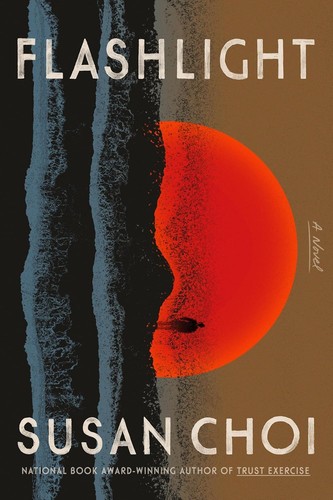
Flashlight
Flashlight is a 2025 literary fiction novel by Susan Choi that traces a Korean-American family across four generations, from a 1978 beach disappearance in Japan through decades of secrecy, displacement, and grief. When ten-year-old Louisa is found half-drowned on a Japanese shore after a nighttime walk, her father Serk is presumed dead, and the family fractures around the silence that follows. Choi follows the Kang family's tangled history—rooted in postwar Korea, wartime Japan, and Cold War politics—through the perspectives of Serk, his wife Anne, and their daughter, weaving personal trauma into a larger story of national identity and historical erasure. Shortlisted for the 2025 Booker Prize, the novel is a study in absence: what families cannot say, what histories refuse to surface, and how a single beam of light can only ever illuminate a fraction of the dark.
Where to buy or borrow
Are you selling this book? Bookstores, publishers, authors and libraries can be listed here for free. Request a listing
About this book
Deep Overview
The narrative then ripples outward and backward. Serk's own story is one of successive renamings: Seok in Korea, Hiroshi in occupied Japan, Serk in the United States. Each name marks a border crossing and a loss. His parents, lured by the promise of socialist paradise, relocate to the Democratic People's Republic of Korea in the early 1950s, a move that effectively erases them from his life. Serk, a teenager, takes a student visa to America instead, where he meets Anne, a stubborn, spiky woman whose adult life has been shaped by the absence of her son Tobias, whom she gave to her older lover and his wife when she was nineteen. Their marriage is built on mutual identification in alienation—two people the world did not quite fit—and on a shared refusal to fully narrate their pasts.
Anne carries her own secret: Tobias, whom she has been corresponding with annually since her youth. When she welcomes him back into the family without consulting Serk, the fragile equilibrium of the Kang household shifts. Serk, for his part, takes a year-long assignment in Japan without telling Anne that his primary purpose is to quietly map a path of return for his estranged parents. Both parents are, in different ways, building exits. Louisa, the only child of Serk and Anne, inherits their stubbornness and their silence. She becomes a keeper of her own secrets, a triangulator of the gaps her parents leave.
The novel's mid-section delivers a revelation that recontextualizes the family's entire history, shifting what reads as a quiet immigrant saga into a story entangled with North Korean state violence, re-education camps, and the geopolitics of the Korean peninsula. Reviewers describe this turn as a jolt that adds suspense and reorients the moral terrain. Choi's prose, which in the first half dwells in intimate, almost banal domestic detail, accelerates in the second half as personal stakes and under-discussed history braid together.
The flashlight, as title object, recurs throughout: in the psychologist's office, at a séance, in a darkened room in Paris, in the hands of a North Korean security agent walking car to car on an empty train. Each appearance is a brief illumination in a larger darkness. Choi's structural principle mirrors the metaphor: consciousness, as the psychologist Julian Jaynes described it, is a beam that sweeps a dark room and concludes, from the light wherever it points, that the room is all light. The novel insists on the opposite. The dark is vast. The light is narrow. And the family, four generations deep, is still walking through it.
Key Themes
The politics of naming and national belonging. Serk's successive names—Seok, Hiroshi, Serk—trace a life lived at the intersection of three states, each claiming him and none fully owning him. The novel situates this personal dislocation within the larger history of partitioned Korea, Japanese occupation, and Cold War rivalry for influence over the peninsula.
Memory's selectivity and unreliability. Louisa remembers the flashlight falling into sand with tactile precision but cannot recall the hours surrounding her father's disappearance. Choi treats memory as a flashlight in a dark room: it illuminates whatever it happens to point at, and the mind concludes the rest is equally lit. The novel interrogates whether consciousness can know what it has not been shown.
Family silence as inherited architecture. The Kang family does not communicate so much as orbit each other's unspoken truths. Their relationships are structured around what is withheld, and each generation builds its own locked room around the gaps it inherits.
The intersection of personal grief and state violence. The mid-novel revelation connects the family's private tragedy to North Korean re-education camps and the broader machinery of state control, suggesting that the personal and the political are not separate registers but the same event seen from different distances.
Historical Context
The postwar experience of ethnic Koreans in Japan adds another layer. Serk grows up as a Korean in a Japanese society where his ethnic identity marks him as both foreign and invisible, a condition that shapes his later immigration to the United States and his persistent sense of being claimed by no nation. The student visa that brings him to America is a product of Cold War educational exchange and the particular legal limbo of Korean residents in postwar Japan.
The novel also sits within a lineage of American literary fiction that reckons with immigration, hybridity, and the stories that official history leaves out. Choi's own background—born to a Korean father and an American Jewish mother, raised in South Bend, Indiana, and Houston, Texas—gives her a personal stake in the questions of belonging and cultural inheritance that drive the narrative. The work follows in the tradition of writers like Min Jin Lee, Lisa See, and the broader wave of Asian American and diaspora fiction that has expanded the canon of the American novel in the twenty-first century, while its specific focus on North Korean state history marks it as a contribution to a still-thin body of English-language fiction on that subject.
Intended Audience
Readers with an interest in Korean and East Asian history, in diaspora and immigration narratives, or in the ways family secrets compound across generations will find the novel's scope rewarding. It is also a strong pick for book club books that want a novel with enough narrative momentum to keep a group engaged but enough thematic complexity to sustain a full discussion. The Booker Prize shortlist and National Book Award longlist signal that it has been vetted by a broad critical readership.
It is less suitable for readers seeking straightforward plot-driven fiction, light reads, or a single sustained point of view. The characters are stubborn, often unlikeable, and the emotional register is sustained grief rather than catharsis. One reviewer noted that spending nearly 500 pages in the company of deeply unhappy people was exhausting. If that sounds like a dealbreaker, this may not be the right novel.
Reading Difficulty
The pacing is uneven by design. Early chapters that might read as slow—domestic scenes, a strawberry-picking trip rendered in extended detail—set up the emotional and historical stakes that accelerate in the second half. The mid-novel revelation shifts the genre in effect, moving from family drama toward something closer to a historical investigation, and the final third moves with considerably more urgency.
There are no prerequisite texts, but readers who have encountered Choi's earlier novels, especially Trust Exercise, will recognize her talent for the mid-book structural pivot and her willingness to let a character's voice carry the narrative. The New Yorker short story that became the prologue is available separately and can be read as a warm-up if the full novel feels daunting.
Helpful Background Knowledge
Familiarity with the experience of ethnic Koreans in postwar Japan is helpful but not essential. Choi conveys the social position of a Korean minority in a Japanese city well enough for the reader to understand Serk's sense of not belonging to either place.
If you have read Choi's previous novel, Trust Exercise, you will already know her capacity for the mid-book structural rupture and her interest in how narratives are shaped, who controls them, and what gets left out. Flashlight operates on a similar principle but applies it to a family history rather than a single event.
The 2020 New Yorker short story that became the novel's prologue is a standalone piece about a young girl's confrontation with a psychologist. Reading it before the full novel can sharpen your attention to the psychologist's office scene and to the flashlight as a narrative object from the very first page.
Why Read This Book?
The structural ambition is notable. A novel that begins as a domestic drama about a missing father becomes, by its midpoint, an entangled history of state violence and family survival, and it holds both registers without collapsing into either. The flashlight as a recurring motif—carried by a father on a beach, stolen from a psychologist's desk, used to stage a séance, swept by a security agent through an empty train—is a simple, almost childlike image that Choi sustains across 500 pages without it becoming reductive.
For readers building a list of fiction book recommendations for 2025, this is a novel that earns its Booker shortlist placement through craft and emotional specificity rather than trend. It is not the most accessible novel of the year, and it will not appeal to everyone, but it is a serious, well-made book about the things families carry that they cannot say aloud.
Reader Takeaways
The book also offers a working model for thinking about memory. Louisa's precise recollection of the flashlight falling into sand, set against her total amnesia for the surrounding events, is a small, concrete illustration of how the mind selects. You will notice this in your own life: the one detail that survives a traumatic event, the one that feels disproportionately vivid because it is the only one the mind could hold.
There is also a practical takeaway for readers of literary fiction. Choi demonstrates that a novel can be simultaneously a character study, a historical document, and a formal experiment without sacrificing emotional clarity. The first half's apparent slowness is not a flaw; it is the method by which the reader is given just enough light to feel the shape of the dark around it.
Strengths
The historical research is substantial without being didactic. The DPRK storyline, the re-education camp details, the Korean experience in wartime Japan—these are woven into the family narrative rather than presented as exposition. The New York Times reviewer noted that the historical details become prominent toward the end, and that the book shifts in tone from narrative to something closer to a historical report. Whether that shift lands as a strength or a limitation may depend on the reader, but the ambition to connect a single family's grief to a national history is executed with real care.
The characters resist easy sympathy. Anne is obstinate and cold; Serk is secretive and withdrawn; Louisa is fierce and ungenerous. Their unlikeability is not a flaw in the writing but a feature of it. Choi gives them, as the Guardian reviewer put it, the room they need to live, and that room includes the parts of them that are hard to sit with.
Limitations and Cautions
The pacing is deliberately uneven, and the first third in particular can feel slow. The strawberry-picking trip, the domestic scenes in Indiana, the early chapters of Anne and Serk's courtship—these are rendered in extended, sensory detail that some readers will find overwrought. A Cannonball Read reviewer admitted to skipping entire paragraphs of description. The payoff, for those who persist, is substantial, but the waiting period is real.
The mid-novel revelation, while effective, also introduces a political dimension that some readers may find overtakes the personal story. The New York Times reviewer observed that the extensive details about North Korean historical events, including re-education camps, begin to take over the narrative, making the book feel less like a novel and more like a historical report. This is a fair characterization of the second half, and it may not suit readers who want the family drama to remain the sole focus.
The shifting timelines, while a deliberate formal choice, can disorient. Characters remember events out of order, and the third-person narration does not always signal clearly where in the timeline the reader is. Keeping a small note of which perspective you are in can help.
Important Concepts, People, and Places
Anne: Louisa's mother, a stubborn, spiky woman whose adult life is shaped by the absence of her son Tobias. She becomes ill after Serk's disappearance, and her condition deepens the family's sense of loss.
Louisa: The ten-year-old found on the beach, the daughter who inherits her parents' silence and builds her own. Her perspective is the novel's primary lens in the present tense.
Tobias: Anne's son from a previous relationship, raised by his father. His reunion with the Kang family is a source of tension and a thread connecting the novel's generations.
The Democratic People's Republic of Korea (DPRK / North Korea): The political context that shapes Serk's family history and the novel's second-half revelation. The DPRK's re-education camps and state control are central to the book's engagement with historical injustice.
Japan: The setting of the novel's opening and of Serk's childhood. The beach where Serk disappears, the psychologist's office, and the family's postwar displacement all take place here.
The New Yorker: The magazine where Choi's short story version of the prologue was published in August 2020, winning the Sunday Times Short Story Award in 2021. The publication history matters because it shows how the novel's opening scene was tested as a standalone before being expanded.
Farrar, Straus and Giroux: The American publisher of the 2025 hardcover edition. Jonathan Cape is the UK publisher.
The 2025 Booker Prize: Flashlight was shortlisted, confirming the novel's standing in contemporary international fiction.
The National Book Award: The novel was longlisted for the 2025 Fiction longlist, and Choi's previous novel Trust Exercise (2019) won the award, making Flashlight a follow-up to a major prize winner.
Julian Jaynes: The psychologist whose 1976 metaphor of consciousness as a flashlight searching a dark room is echoed in the novel's title and structure, though Choi does not explicitly cite him in the text.
Questions the Book Explores
How much of a person's identity is determined by the state that claims them? Serk's three names and his inability to settle into any single national narrative raise the question of whether identity can exist outside political borders, or whether every identity is, in the end, a compromise with the state that holds your passport.
Can a family survive the silence of its own history? The Kang family's inability to talk about the past—Serk's parents in the DPRK, Anne's son Tobias, the night on the beach—creates a structural absence that shapes every relationship in the novel. The book asks whether silence is a form of protection or a form of violence, and whether the next generation can inherit a story that was never told.
What does consciousness actually give us? The flashlight metaphor, drawn from the idea that we can only be aware of whatever our attention happens to illuminate, raises a philosophical question about the limits of self-knowledge. If the mind is a beam in a dark room, how much of the room is there? And can we ever know?
Where does a personal tragedy end and a political history begin? The mid-novel revelation blurs this boundary, suggesting that the family's private grief is entangled with the state's public violence in ways the characters did not choose. The novel asks whether it is possible to grieve a personal loss without also confronting the larger system that made the loss possible.
Reading Group Guide
Start the discussion with the structure. Ask the group where they found the timeline most disorienting and where it clicked. The novel's first third is the most demanding, and a group that names the pacing difficulty together will be more patient with the middle section.
The mid-novel revelation is the pivot. If your group has not yet finished when you meet, you can discuss the first half's questions of family silence and identity without spoilers. If you have all finished, the revelation becomes the fulcrum: how does it change your reading of Serk's earlier secrecy? Does it make his silence more or less forgivable?
The flashlight as a motif is a good entry point for a more formal discussion. It appears in at least five distinct scenes, each with a different emotional valence. Ask the group which appearance mattered most to them and why. The psychologist's office, the séance, the North Korean train—each one reframes the object.
Finally, talk about what the novel does not tell you. The title is about a beam of light, and the novel is equally about the dark it does not reach. A group that spends time on the gaps—what Serk's parents experienced in the DPRK, what Louisa truly remembers, what Anne knows about Tobias's present life—will find the richest conversation. The book rewards the reader who sits with the unanswered questions rather than trying to close them.
Discussion Questions
Serk is known by three names over his lifetime: Seok, Hiroshi, Serk. Which name, if any, does he feel he is, and what does the act of renaming cost him?
Anne and Serk are both described as secret-keepers. Is their silence a form of love, a form of self-protection, or something closer to a refusal to let the other person in? Can a marriage survive on mutual non-disclosure?
Louisa remembers the flashlight falling into sand with vivid precision but cannot recall the hours around her father's disappearance. What does this selective memory suggest about how the mind processes trauma? Have you ever had a memory that was vivid in one small detail and blank everywhere else?
The novel connects the Kang family's private grief to North Korean state violence. At what point, if any, does a personal story become a political one? Is there a version of this story that does not require the DPRK backstory?
Choi's earlier novel Trust Exercise also features a mid-book structural rupture that recontextualizes everything before it. What does the parallel suggest about how Choi thinks narrative truth works? Is a story that changes its own frame more honest or less honest than a linear one?
The Guardian reviewer noted that Choi gives her characters the room to be more than vessels for political wrangling. Do you agree? Are Serk, Anne, and Louisa fully realized individuals, or do they sometimes serve the historical argument? Where is the line?
The novel is set across Japan, the United States, and the DPRK, and touches on Paris and Indiana. How does geography shape each character's sense of belonging? Is there a place in the novel that feels like home to any of them?
If you read the 2020 New Yorker short story that became the prologue, how does knowing the full novel change your reading of that scene? Does the longer context make the psychologist's office feel more or less contained?
The title is Flashlight. The novel is about absence. What is the relationship between the object and the theme? Is the light the story, or is the dark?
Sources and Verification
Comments
No published comments yet.
Available editions
Hardcover
- Publisher
- Farrar, Straus and Giroux
- ISBN-13
- 9780374616373
- Publication date