
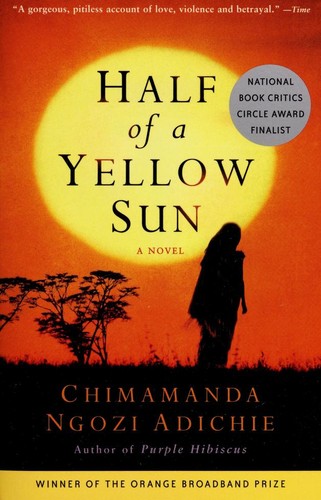
Half of a Yellow Sun
Half of a Yellow Sun is Chimamanda Ngozi Adichie's 2006 novel about Nigeria's 1960s: the hopeful years after independence, the ethnic violence that followed, and the Biafran secession and war of 1967 to 1970. Instead of a general's-eye account, it follows five people: a village boy turned houseboy, a radical university lecturer, his educated partner, her formidable twin sister, and a shy English writer. As politics reshape their love affairs, loyalties and class assumptions, famine and displacement strip away comfort. As historical fiction it gives a human scale to a conflict many readers know only through photographs of starving children, and it remains one of the most widely recognised novels about the war.
Where to buy or borrow
Are you selling this book? Bookstores, publishers, authors and libraries can be listed here for free. Request a listing
About this book
Deep Overview
The structure is the first thing a reader must understand. The four parts do not run in a straight line: two are set in the early sixties and two in the late sixties, and they alternate. The early sections show a young country full of parties, seminars, flirtation and family politics, with ethnic and class tensions already visible. The later sections show the same people after the 1966 killings of Igbo people in the north, after the east's declaration of independence as Biafra, and after the blockade has turned hunger into the defining condition of daily life. Because the reader knows how the story is moving even when the characters do not, scenes of ordinary pleasure carry a shadow, and the later suffering is felt as loss rather than as spectacle.
Adichie's central method is to let public events arrive through private decisions. A massacre is encountered through a relative's fate and a journey by train; a military air raid interrupts an ordinary afternoon; shortages show up as arguments over what to feed a child. Romantic betrayal and political betrayal are set side by side so that each illuminates the other. The household also keeps testing its own ideals. Odenigbo's talk of pan-African solidarity, Olanna's sense of duty, Richard's wish to belong and Kainene's detachment all meet situations that their theories did not anticipate.
A second thread concerns authorship. Richard is trying to write about Nigeria, and excerpts from a book called The World Was Silent When We Died are interspersed through the narrative. The device invites a question about whose voice has the right to narrate Biafra, and the novel's own stance, as a work by a writer born after the war, is part of that conversation. Ugwu's development, from wide-eyed servant to someone who bears witness, gives that question a concrete shape.
What Adichie is demonstrating, in short, is that a catastrophe usually remembered through statistics and humanitarian images was lived by individuals with tastes, vanities, loyalties and flaws. She does not present Biafra as a simple morality tale; characters make selfish and cruel choices, and the Biafran cause is shown with both its idealism and its propaganda, privilege and corruption alongside courage. Readers who know little about the war will find enough orientation within the story itself, but the novel rewards a willingness to look up events as they come.
Key Themes
Class and power at close range: the relationship between Ugwu and his employers, the comforts of the Lagos elite, and the way wartime shortages redistribute privilege all show hierarchy operating inside a movement that speaks of liberation.
Identity, tribe and nation: Igbo, Hausa, Yoruba and British characters, and the question of whether Nigeria or Biafra deserves allegiance, show how identities that colonialism helped harden can become matters of life and death.
Colonial legacy and outsider perspective: Richard's position as an English admirer of Igbo art raises questions about authenticity, belonging and the limits of solidarity.
Hunger, propaganda and international indifference: the book shows starvation and the way both sides managed information, and it dwells on the gap between global attention and local suffering.
Memory and storytelling: the book-within-a-book and Ugwu's development raise the problem of who tells the story of a war, and whether fiction can restore dignity to people who have been reduced to numbers.
Historical Context
The novel also belongs to a literary tradition. Nigerian writers such as Chinua Achebe and the poet Christopher Okigbo, who died in the war, had already written about the period, and Biafran memoirs and poems exist, but Adichie wrote as a member of a post-war generation for whom the conflict was described as both present and unspoken in family life. Her novel sits within contemporary historical fiction about postcolonial Africa and reached a large international readership at a time when many readers outside Nigeria had little context for the war. The work is a novel, not a history, and readers should consult historians for contested points such as responsibility, casualty figures and the role of foreign powers.
Intended Audience
It may be less suitable for readers who want a fast, plot-driven war story or a rigorous account of military and diplomatic detail. The material includes sexual violence, starvation, bombing, and the deaths of children, so readers sensitive to such content should approach it with care. Younger teenagers may find the content heavy, and the book is generally read as adult fiction.
Reading Difficulty
Emotional intensity is the main burden. Later chapters are harrowing, so the pace may be best managed with breaks. No specialist knowledge of Nigerian politics is required. An audiobook edition exists, read by Zainab Jah, which may suit readers who find the names and Igbo phrases easier to follow by ear.
Helpful Background Knowledge
Readers do not need to resolve every historical detail beforehand. A map of southeastern Nigeria, with Nsukka, Enugu, Port Harcourt, Umuahia and Kano marked, is probably more useful than a detailed chronology. It is also worth knowing the book's structure in advance: the non-linear arrangement is deliberate and not a sign that the reader has missed something. Those who prefer to avoid plot spoilers should be cautious with some encyclopaedic and study-guide summaries.
Why Read This Book?
It also gives a useful answer to a common problem with books about atrocity: how to be honest about suffering without turning people into symbols. Among award winning books, it carries unusually strong credentials, having been recognised by the Orange Prize in 2007 and later chosen by public vote as the best winner of the first 25 years of the Women's Prize. For readers following Adichie's career, it is the place where her gifts for dialogue, social comedy and moral complexity first operate on a large historical canvas, and it shows a range quite different from Purple Hibiscus, the more intimate novel that preceded it.
Reader Takeaways
Readers may also reconsider what they take to be reliable testimony. The book prompts attention to who narrates, who is silent, and how outside observers and local people can describe the same events in very different registers. Finally, it may encourage readers to look for further reading, from Nigerian histories of the war to other Biafran fiction, memoir and poetry, and to notice how a novel can create understanding without replacing historical study.
Strengths
The book is also fair-minded about Biafra itself: it records the movement's hope and its propaganda, its idealism and its inequities. The range of social positions among the main characters, from servant to professor to businesswoman to foreign writer, gives a broader view than a single protagonist would. It is also a reasonable entry point into Nigerian history for general readers, and it has been recognised through major prizes and a public vote.
Limitations and Cautions
The story is told mostly from the perspective of Igbo and Biafran-aligned characters plus a British observer, so views from the federal side, and from non-Igbo minority communities in the region, appear less fully. The pacing is deliberate and the shifts in time can be disorienting. The depictions of violence are painful and may be difficult for some readers. Finally, the book can feel long, and the page counts listed for different printings of the paperback vary, so readers choosing between editions may want to compare them directly.
Important Concepts, People, and Places
Nigerian Civil War (1967 to 1970): the conflict between the federal government and Biafra, with the blockade, famine and air raids that structure the later parts of the novel.
Chukwuemeka Odumegwu Ojukwu and Yakubu Gowon: the Biafran leader and the federal head of state. They appear mainly in the background, as figures whose decisions shape the characters' lives.
Ugwu: the young houseboy from a village, whose growth into an observer and writer carries the book's concern with witness.
Odenigbo: a university mathematics lecturer whose home is the place of political argument and whose convictions are tested by the war.
Olanna: Odenigbo's partner, from a wealthy Lagos family, whose experiences of the 1966 violence and of displacement are among the book's most important perspectives.
Kainene: Olanna's twin sister, a businesswoman who contrasts with her sister in temperament and whose bond with Richard brings an outsider into the family circle.
Richard Churchill: an English writer in Nigeria, fascinated by Igbo culture, whose uncertain place in the story raises questions about belonging and authority.
Nsukka, Port Harcourt, Kano and Umuahia: settings associated, respectively, with the university milieu, Kainene's business life, the northern killings, and the wartime Biafran capital area.
The World Was Silent When We Died: the title of the book-within-the-book, which engages with international indifference to Biafra and the ethics of telling the story.
Orange Prize / Women's Prize for Fiction: the award Adichie won for the novel in 2007, later followed by its "Winner of Winners" recognition.
Questions the Book Explores
The novel also asks what is owed in love, family and friendship once survival becomes the priority. How do privilege and class persist in a society that claims to be united in struggle? And how should a catastrophe be recorded: through statistics, journalism, memoir, poetry or fiction, and by whom?
Reading Group Guide
Useful starting points include comparing the three narrating perspectives, discussing why Adichie delays certain revelations, and looking at how food, language and clothing carry social meaning. Groups can also share what they already knew about Biafra before reading, then discuss how the novel changed or complicated those impressions. Because the content is distressing, it is considerate to agree on content warnings in advance and to leave space for members to step back. A group might pair the novel with a short historical article or an interview with Adichie to separate what is documented from what is invented.
Discussion Questions
2. Ugwu arrives in Nsukka knowing almost nothing about the arguments around Odenigbo's table. How does his growing understanding of politics, books and language shape what the reader is allowed to see, and how much do you trust his perceptions at different points in the story?
3. Odenigbo speaks passionately about African unity and the evils of colonialism, yet his behaviour at home is often far less admirable. Do his failures weaken his ideas, or does the novel ask us to judge ideas and the people who hold them separately?
4. Olanna and Kainene are twins whose bond breaks and is later partly rebuilt. What do their differences in temperament, ambition and ways of showing love say about the choices open to educated Nigerian women of their class at the time?
5. Richard eventually decides that the war is not his story to tell and abandons his planned book on Biafra. The excerpts from The World Was Silent When We Died that appear throughout the novel turn out to be Ugwu's work. How did learning who wrote them change the way you read those passages? What does Adichie seem to be saying about who has the authority to record a catastrophe?
6. Richard learns Igbo, collects knowledge of Igbo-Ukwu art and calls himself a Biafran, yet others keep treating him as an outsider. Is his longing to belong sympathetic, self-serving, or both, and does the novel ever settle that question?
7. After he is conscripted, Ugwu takes part in an act of violence that he later struggles to live with. How did this episode affect your sympathy for him? Why might Adichie have given such an act to the character readers are most likely to trust?
8. Several characters are unfaithful, and their betrayals unfold alongside the collapse of Nigeria's political promises. Do you see these private and public betrayals as parallel, or does the novel resist that comparison?
9. Odenigbo's mother, Amala and Baby show how family, class and village expectations press on the central couple. What do these relationships suggest about the gap between the modern, cosmopolitan life of the university and the obligations the characters carry with them?
10. As the blockade tightens, conversations shift from politics to finding protein, salt and medicine. How does scarcity change the way characters treat one another, and which acts of generosity or selfishness stayed with you most?
11. Biafran radio broadcasts and talk of victory continue even as conditions worsen. How does the novel present the relationship between belief, propaganda and survival? Did your view of the Biafran cause shift as the story went on?
12. Adichie was born after the war ended and built the novel partly from family memory. What can a novel by a writer of a later generation offer that memoirs by survivors or histories by scholars cannot, and what are the risks of that distance?
Sources and Verification
Sources disagree on the page count of the paperback, so it is not listed here. The profile describes the story's overall structure and main characters but does not reveal how it ends. The descriptions of the novel are original interpretation and are no substitute for reading the book.
Comments
No published comments yet.
Available editions
Paperback
First Anchor Books Edition
- Publisher
- Anchor Books
- ISBN-13
- 9781400095209
- Publication date