
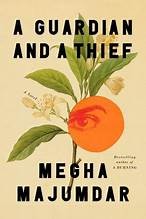
A Guardian and a Thief
A Guardian and a Thief is a 2025 novel by Indian author Megha Majumdar, set in a near-future Kolkata buckling under climate catastrophe. Over seven days, two families become entangled: Ma, who manages a homeless shelter and is days from emigrating to the United States with her elderly father and toddler daughter, and Boomba, a young man at her shelter who breaks into their home seeking food and inadvertently steals their climate visas. As their desperate paths intersect and diverge, the novel interrogates the moral boundaries of survival, the ferocity of parental love, and the human toll of a collapsing climate. Majumdar's spare, compressed prose moves with the urgency of a thriller while sustaining the moral ambiguity characteristic of literary fiction, grounding a global crisis in the intimate stakes of two households.
Where to buy or borrow
Are you selling this book? Bookstores, publishers, authors and libraries can be listed here for free. Request a listing
About this book
Deep Overview
The climate catastrophe in the novel is not a backdrop but an active antagonist. Kolkata is shown not in the dramatic spectacle of a single flood or storm but in the slow, grinding erosion of daily life: fish that no longer appear in Bengali cooking, black-market egg prices, a city that feels simultaneously future and past. Majumdar draws on her own recollection of walking through Kolkata in oppressive heat, the tar on roads soft enough to stick to her feet, as a kind of sensory anchor for the novel's climate world. The result is a form of climate fiction that trades spectacle for the quiet horror of insufficiency—of a world where the system still technically functions but can no longer sustain the people inside it.
The immigration dimension gives the novel its geopolitical stakes. The climate visas Ma and her family carry are not a metaphor; they are a specific, hard-won document that represents a pathway out of a country whose systems are failing. The novel situates this within the broader anxiety of global South citizens navigating the bureaucracies of the Global North, rendering the helplessness of even privileged Indians before a consular officer. Babu, Ma's husband in Ann Arbor researching mosquito-borne diseases, exists largely as a phone voice, a reminder that the family's future depends on a system that can cancel a flight with a single political shift. The worldwide protests against climate refugees that ground Ma's plane near the novel's end crystallize this dependency.
Majumdar is also working within a literary tradition of moral parables—stories that compress complex ethical questions into a single, escalating scenario. The seven-day structure, the small cast, the closed setting of one apartment and its immediate neighborhood, all serve to intensify the moral pressure. The billionaire who floats a hexagonal residence in the river and donates food from a position of untouchable wealth functions as the novel's single, pointed critique of class. The homeless shelter, the black-market food sellers, the forger who sells fake passports, the street-corner philosophers Dadu celebrates: together they sketch a social ecology in which every layer is failing and every person is forced to improvise a moral code in real time.
The novel's emotional core, which Majumdar has said was shaped by the birth of her own son in 2021, is the question of what a parent will do, and how far that doing extends. When Boomba temporarily takes Mishti to gain entry to a billionaire's feast, when Ma hides the truth of the passport theft from her husband, when Dadu strikes Boomba and then dies that night, each act is justified by love and simultaneously a violation. Majumdar does not offer a verdict. She offers the experience of watching love do terrible things and calling it protection, which is, she suggests, what love has always done in a world that provides too little.
Key Themes
Parental love as both justification and blindness: Ma, Boomba, and Dadu each act to protect a child, and each act simultaneously harms someone else. The novel examines how the imperative to protect a child can override every other moral consideration, and how that override is both the most human and the most dangerous force in the story.
Climate change as slow violence: Rather than depicting a single catastrophic event, the novel shows climate collapse as the quiet disappearance of food, of fish, of the rhythms that made daily life legible. The horror is in the banal arithmetic of not having enough.
Immigration and global inequality: The climate visas, the consular process, the research position in Michigan, and the political protests that cancel Ma's flight together construct a picture of a world in which geography determines survival and the right to leave is a privilege, not a birthright.
Class and the social contract: The billionaire's floating hexagon, the homeless shelter, the black market, and the forger map a social hierarchy in which each tier depends on the one below it for labor and dignity, and the one above it for legitimacy.
The dissolution of community: Dadu's grief for the street-corner philosophers, the gossips, the rickshaw drivers, and the neighborly networks of Kolkata captures what is lost when a city can no longer sustain the casual, reciprocal relationships that hold a community together.
Historical Context
The novel's immigration storyline is rooted in the real experience of Indian professionals and their families navigating United States visa processes. Majumdar moved from Kolkata to the United States in 2006 at the age of nineteen to study social anthropology at Harvard University. She has described this personal migration as a shaping influence on the novel's emotional logic. The novel extends this real-world framework into a speculative context in which climate visas become a distinct category of immigration, a logical extension of current debates about climate refuge that are intensifying in legal and political discourse.
The novel arrives in a moment when climate fiction has moved from the speculative and distant to the near and specific. Where earlier climate novels often imagined a single, dramatic tipping point, A Guardian and a Thief is aligned with a newer current that depicts the grinding, unglamorous aftermath: not the flood itself but the week after, when the rice is gone and the fish will not come back. This positions the novel within a broader literary turn toward what might be called climate realism, in which the crisis is not an event but a condition.
Majumdar's debut, A Burning (2020), established her as a writer concerned with the intersection of politics, social media, and individual agency in contemporary India. A Guardian and a Thief represents a shift in both setting and scope: from the present-day public sphere of social media and protest to a near-future private sphere of hunger, family, and moral compromise. The two novels share a commitment to the specific and the local as the truest scale on which to read large political forces.
Intended Audience
Book clubs will find rich material here: the novel's dual perspective, its refusal to assign moral blame, and its tight seven-day structure all lend themselves to sustained group discussion. The book was selected for Oprah's Book Club and shortlisted for the 2025 National Book Award for Fiction, and its compact length makes it accessible to readers who prefer shorter novels.
The novel may be less suitable for readers who prefer plots driven by external action or who find sustained moral ambiguity frustrating without a clear protagonist to root for. The emotional intensity is unrelenting; there are very few moments of relief or lightness, and the final pages are genuinely harrowing. Readers sensitive to themes of child endangerment, parental death, and violence may want to approach the book with care.
Those with a personal connection to Kolkata, to the Indian diaspora experience, or to the specifics of immigration and visa processes will find additional layers of resonance. The novel is written in English and set in India, but its moral questions are deliberately universal, and readers from any background should find the core dilemma—what will you do, and who will you hurt, to keep the person you love alive—directly accessible.
Reading Difficulty
The difficulty of the novel is emotional and moral rather than linguistic. The pacing is relentless, moving at the speed of a thriller, and the moral stakes intensify without pause. Readers who prefer a breathing room between scenes of tension may find the compression exhausting. The novel is approximately two hundred pages, which means the emotional weight is delivered in a concentrated package without the longer runway that a full-length novel provides for recovery.
No prior knowledge of climate science, Indian politics, or immigration law is required. Majumdar provides just enough context for the reader to understand the stakes—food is scarce, visas are hard to obtain, the city is failing—without requiring the reader to fill in a broader political or economic framework. This is both a strength and a limitation: the novel trusts its own internal logic and does not pause to explain the systems that produce it.
The ending is abrupt and eventful, and some readers have found it harder to process than the rest of the book. It does not resolve the moral questions it raises; it closes them. A reader who expects a neat thematic statement at the end may find the actual conclusion more unsettling and less conclusive.
Helpful Background Knowledge
A basic understanding of how United States immigration visas work, and the sense of bureaucratic helplessness that many applicants describe, will make Ma's journey to the consulate and her anxiety about the flight feel more immediate. The novel does not explain the visa process; it assumes the reader can supply the frustration and the dependency.
Readers who have followed the climate crisis in news and journalism will recognize the novel's depiction of food scarcity, black-market dynamics, and the failure of institutional responses. The novel does not cite statistics or policy; it shows the consequences in a single apartment. A reader who has watched the discourse around climate migration in 2024 and 2025 will find the novel's treatment of climate visas and the political protests at the airport a direct dramatization of those debates.
Knowledge of A Burning, Majumdar's first novel, is not necessary but may sharpen the contrast. A Burning is sprawling, multi-threaded, and set in the present day. A Guardian and a Thief is compact, dual-perspective, and set in a near future. The shift in form is as significant as the shift in subject.
No knowledge of literary theory or moral philosophy is required. The novel's ethical questions are posed through action and consequence, not through argument. The reader is invited to feel the dilemma, not to solve it.
Why Read This Book?
The dual-perspective structure is a genuine formal achievement. By giving equal narrative weight to the thief and the guardian, the novel prevents the reader from settling into a comfortable moral position. You root for Ma, and then you understand Boomba, and then you realize that the boundary between them is thinner than you wanted it to be. This is not a trick; it is the point. The novel's value lies in its refusal to let you be the jury.
Majumdar's prose is among the most efficient in contemporary literary fiction. Every sentence works. There is no padding, no authorial commentary, no moment where the narrative pauses to tell you what to feel. For readers who are tired of literary fiction that mistakes length for depth, this is a refreshing reminder that compression is a form of respect for the reader's intelligence.
Finally, the novel is short. At roughly two hundred pages, it can be read in an evening or over a weekend, and its impact is immediate rather than cumulative. It does not ask for a long investment; it asks for your full attention for a few hours, and the return is substantial.
Reader Takeaways
The novel also reframes climate change from an abstract, global problem into a specific, domestic one. After reading, the phrase "climate change" will carry the weight of a fish that no longer appears in the market, a road whose tar is too hot to walk on, a flight that is cancelled because a border is being protested. The takeaway is not a policy position but a sensory one: the crisis is not a graph; it is an empty plate.
The immigration storyline will leave a mark on readers who have never thought about the specific mechanics of leaving a country. The novel makes visible the dependency of one family's survival on the bureaucratic goodwill of another nation's government, and the fragility of a visa in the hands of a political shift. This is a reminder that the right to move, to leave, to start over, is not a universal human right in practice.
For readers who are parents or who have parents, the novel's treatment of parental love will linger. The idea that love is both the greatest justification and the greatest blindfold, that it can make a person capable of extraordinary generosity and extraordinary harm, will be hard to set down. The novel does not resolve this tension. It asks the reader to hold it.
And for readers who follow literary craft, the novel is a masterclass in structural economy. How do you tell two stories, in two voices, over seven days, in a city that is dying, without a single wasted line? Majumdar's answer is worth studying.
Strengths
Majumdar's prose is a form of restraint that reads as confidence. She eliminates semicolons, digressions, ornamental description, and authorial commentary. What remains is a clear, direct, third-person voice that trusts the reader to feel what is happening without being told. This efficiency is a deliberate aesthetic choice, and it pays off: the novel never over-explains, never hammers its themes, and never mistakes the reader's discomfort for confusion.
The moral complexity is sustained throughout, not just in the climax. Both characters are given full interior access, and neither is reduced to a symbol. Ma is flawed, stubborn, and capable of self-deception. Boomba is desperate, resourceful, and capable of acts that terrify even him. The novel holds both of them in full moral ambiguity across all seven days, which is a harder achievement than it sounds.
The specifically Indian context is a genuine strength, not a limitation. The novel captures the helplessness of navigating Western bureaucratic systems from the inside, the class divides that make even the middle class feel powerless, and the particular social texture of Kolkata in a way that a generic "developing country" setting could not. The billionaire's floating hexagon, the street-corner philosophers, the specific foodways: these details give the novel a groundedness that elevates it above allegory.
The novel's brevity is also a strength. At roughly two hundred pages, it is a complete, concentrated argument. There is no bloat, no padding, no subplot that exists only to fill space. Every scene serves the moral engine. This makes it an accessible entry point for readers who are new to Majumdar's work or to climate fiction as a category.
Limitations and Cautions
The concept of "climate visas" as a functioning, government-issued immigration pathway is speculative and, as one critic observed, raises questions about how plausible the mechanism is in a world where much of the planet is uninhabitable. The novel does not explore the political or legal machinery that would produce such a visa; it simply assumes its existence. This is a reasonable choice for a novel, but it limits the work's engagement with the actual policy debates around climate migration.
The ending is the most contested element. Several reviewers noted that the final sequence of events is dense and rapid, and that the novel's emotional architecture, which has been built on slow, accumulating moral pressure, shifts in the last pages to a series of abrupt, high-stakes incidents. Some readers will find this intensification fitting; others will feel that it undercuts the careful, controlled tone that preceded it. This is a matter of taste, but it is a genuine point of division among readers and reviewers.
The novel's moral framework, while rich, is also somewhat contained. The world it depicts is small: one city, one apartment, one week, a handful of characters. The systems that produce the scarcity—the governments, the corporations, the international institutions—are present as background rather than as active forces. A reader who wants a novel that engages with the structural causes of climate injustice, not just its human consequences, may find the scope narrowing.
The emotional intensity is unrelenting. There are very few moments of lightness, humor, or recovery. This is a deliberate choice that serves the novel's themes, but it means the reading experience is consistently heavy. Readers who prefer a balance of tension and release may find the sustained pressure exhausting.
Important Concepts, People, and Places
Ann Arbor, Michigan: The destination. Babu, Ma's husband, works here researching mosquito-borne diseases. It represents the family's future, the life that the visas are meant to unlock, and the geopolitical distance between the two families' fates. It is present only as a phone voice, which makes its distance feel acute.
Climate visas: The fictional immigration documents that Ma, Dadu, and Mishti carry. They represent a speculative but plausible extension of current immigration frameworks, and they are the MacGuffin that drives the plot. Their theft sets the entire novel in motion, and their unavailability at the end—when Ma's flight is cancelled—underscores the fragility of the system they depend on.
The homeless shelter: Managed by Ma, it is the site where the novel's central moral tension originates. Ma steals food from the shelter for her family; Boomba, a resident, observes this and later breaks into her home. The shelter is the physical and moral hinge between the two characters' stories.
Ma: The novel's first protagonist. A woman of uncertain age who manages the shelter, cares for her elderly father and toddler daughter, and is trying to leave a collapsing city. She is defined by her ferocity, her self-deception, and her love. She is both a guardian and, by her own actions, a thief.
Boomba: The novel's second protagonist. A twenty-year-old homeless young man who lives at Ma's shelter. He breaks into her apartment looking for food and takes their passports. His story runs in parallel to Ma's, and his escalating crimes are driven by his own family's desperation. He is also both a thief and a guardian.
Dadu: Ma's elderly father. He is the emotional anchor of the novel, carrying a love for Kolkata and its social fabric that contrasts with the city's collapse. His death, which occurs near the novel's end, is the pivotal loss that reshapes the remaining plot.
Mishti: Ma and Babu's two-year-old daughter. She is the child both parents are trying to protect, and she is the novel's emotional center in the most literal sense. Her brief abduction by Boomba is the incident that breaks the fragile peace between the two families.
Babu: Ma's husband, in Ann Arbor. He is present only through phone calls, which Ma manipulates by omitting the truth. His absence is a structural element: the novel is a story of a family in transit, and one member is already on the other side.
A Burning (2020): Majumdar's debut novel, a New York Times bestseller that won the Sahitya Akademi Yuva Puraskar and a Whiting Award. It established her as a major voice in contemporary literary fiction. A Guardian and a Thief is her second novel, and the shift in form—from sprawling, multi-threaded present-day fiction to compact, dual-perspective near-future fiction—marks a significant evolution in her craft.
National Book Award: A Guardian and a Thief was a finalist for the 2025 National Book Award for Fiction, one of the most recognized honors in American letters. This recognition situates the novel within a broader conversation about what literary fiction is for, and what it owes to the communities it depicts.
Oprah's Book Club: The novel's selection for Oprah's Book Club in 2025 brought it to a wide, mainstream readership and underscored its accessibility despite its moral complexity.
The billionaire: An unnamed wealthy man who lives in a floating hexagonal structure in the river and donates food to the poor. He is the novel's single, pointed figure for class inequality. His feast, to which Boomba gains entry by holding Mishti hostage, is the novel's most explicitly satirical scene.
Questions the Book Explores
What does it mean to be a guardian? The novel interrogates the identity of protection. Ma calls herself a guardian, and in her own eyes she is. But her actions—stealing from the shelter, lying to her husband, hiding the truth from her daughter—complicate that identity. The novel suggests that guardianship is not a fixed status but a continuous, exhausting, and sometimes self-deceiving practice.
How does scarcity change the moral landscape? When food is abundant, theft is a crime. When food is scarce, it is survival. The novel does not argue for or against this shift; it simply shows it, and lets the reader feel the discomfort of a world where the boundary between the two has become arbitrary.
What is owed to the people who are left behind? The novel's immigration storyline raises the question of whether those who can leave have a moral obligation to those who cannot, and whether the act of leaving is a form of abandonment or a form of survival. Ma's departure is justified by love for her daughter, but it is also an abandonment of the city, the shelter, and the people in it.
Can a system create thieves? The novel's world is one in which the social contract has broken down: the government cannot provide food, the consular process is slow and arbitrary, the billionaire hoards while the poor starve. In that world, the distinction between a thief and a citizen becomes less clear. The novel asks whether the person who steals is the root of the problem or the symptom.
What do we lose when a city stops being a community? Dadu's grief is not for the physical city but for the social one: the street-corner philosophers, the gossips, the rickshaw drivers, the casual reciprocity of neighborhood life. The novel asks what is lost when a city can no longer sustain those relationships, and whether a family can carry that loss into a new country or whether it dies with the place.
Reading Group Guide
A productive way to begin is to ask each member to identify the moment in the novel where they stopped thinking of Boomba as a villain, or the moment they stopped thinking of Ma as the moral center. These moments are different for each reader, and comparing them will open up the novel's central ambiguity.
The dual-perspective structure invites the group to track how much information each character has and how much they choose to share. Ma lies to Babu on the phone. Boomba lies to his parents. The group can map these omissions and discuss what each lie protects and what it costs. This is a concrete, text-based exercise that avoids abstract moralizing.
The food is a through-line that rewards close attention. Ask the group to list every instance of food in the novel—what is present, what is absent, who is eating, who is not. The pattern will reveal the novel's moral architecture more clearly than any thematic summary.
The billionaire's feast scene is the novel's most overtly political moment. The group can discuss whether this scene feels earned or whether it disrupts the novel's otherwise restrained tone. This is a genuinely open question, and reasonable readers will disagree.
Finally, the ending is the most likely source of group disagreement. Some readers will find the rapid sequence of events in the final pages a fitting intensification; others will feel it undercuts the controlled tension of the preceding six days. Let the group sit in that disagreement without resolving it. The novel does not resolve it either, and that is part of its point.
Discussion Questions
The title presents two identities: guardian and thief. Does the novel suggest that these are two sides of the same person, or two roles that a person can occupy simultaneously? Can you think of a moment in your own life where you held both identities at once?
Majumdar has said she wanted to explore the question of whether an adult stealing an orange from a child to feed their own child is an erosion of humanity or its fullest expression. Does the novel answer this question? If so, how? If not, is that a strength or a limitation?
How does the novel's treatment of the climate crisis compare to other climate fiction you have read? Does the absence of a single dramatic event—no flood, no storm, just the slow disappearance of food—make the crisis more or less believable? More or less frightening?
Babu is present only as a phone voice. What does his absence do to the novel's emotional dynamics? Would the story be different if he were physically present in Kolkata? If he were physically absent for a different reason—say, a work assignment in a different country—would the moral stakes change?
The novel is set in a near future that is not far from the present. How much of what it depicts feels plausible, and how much feels stretched? Does the concept of "climate visas" hold up under scrutiny, or does it feel like a narrative convenience? Does that matter to the novel's impact?
Dadu's relationship to Kolkata is one of the novel's emotional anchors. What does his love for the city's social fabric—the philosophers, the gossips, the barbers—tell you about what a community is, and what happens when the material conditions that sustain a community collapse?
The billionaire's floating hexagon and his feast are the novel's most pointed images of class inequality. Do you find them effective, or do they feel like the novel's one moment of direct commentary? Does the novel's otherwise restrained tone make this scene more or less powerful?
The ending is abrupt and eventful. Does it feel like the novel's conclusion, or like a scene from a different, more action-driven book? Does the rapidity of the final sequence serve the novel's themes, or does it undercut the careful moral pressure that built them?
If you had to assign a moral verdict to Ma, to Boomba, and to Dadu, what would it be? Can you do it? Does the novel make it possible, or does it make it impossible? Which outcome do you find more honest?
Sources and Verification
Comments
No published comments yet.
Available editions
Hardcover
First edition
- Publisher
- Alfred A. Knopf
- ISBN-13
- 9780593804872
- Publication date