
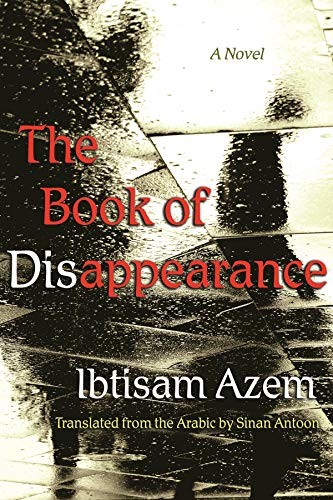
The Book of Disappearance
The Book of Disappearance is a speculative novel by Palestinian writer Ibtisam Azem, published in Arabic in 2014 and rendered into English by Sinan Antoon in 2019. Set over a single forty-eight-hour period, the novel imagines a world in which every Palestinian Arab within Israel vanishes without explanation. The story unfolds through two perspectives: the diary of Alaa Assaf, a Palestinian man in Jaffa who grieves his grandmother and wrestles with a city whose name has been overwritten, and the account of Ariel Levy, an Israeli journalist and neighbor who discovers Alaa's empty apartment and slowly begins to inhabit it. What begins as a story about mass absence becomes a meditation on presence, memory, ownership, and the politics of erasure. The novel operates between literary fiction and speculative fiction, pressing directly on questions of Palestinian identity, colonial memory, and what it means to be rendered invisible.
Where to buy or borrow
We don’t list any stores or libraries for this book yet.
Are you selling this book? Bookstores, publishers, authors and libraries can be listed here for free. Request a listing
About this book
Deep Overview
All of the action takes place in the two days after the vanishing. The book opens inside Alaa Assaf's diary, where he is mourning his grandmother, who has recently died. His entries are written to her, so a private conversation with the dead becomes the main way the reader hears a Palestinian voice. Through her memories of Jaffa before 1948, and of relatives scattered by the war, his grief for one woman widens into grief for a city whose old streets and neighborhoods have been absorbed into Tel Aviv and given new names. The diary does more than supply background. In a book where Palestinians have disappeared, it becomes the clearest evidence that they were ever there.
Ariel Levy's chapters move this private record into the public world. He is a journalist and a self-described liberal, and he watches Israeli society go through a series of reactions it cannot control. Some people are openly relieved. That relief quickly gives way to suspicion, and Mizrahi Jews start to draw hostile attention. The government then passes a registration law that ties citizenship to compliance. The novel suggests that removing a group seen as other does not settle the nation's anxieties; it pushes them onto new targets. Ariel's own conduct mirrors this on a small scale. He uses his spare key to enter Alaa's apartment, starts sleeping there and spending most of his time there, thinks about changing the lock, and decides to translate the diary as material for a book of his own. He can explain each step as practical or even caring. Together they add up to a takeover, carried out so gradually that it never feels like one to him.
Letting these two voices sit side by side creates the book's moral pressure. Alaa's entries are intimate and rooted in memory. Ariel's account is watchful and full of self-justification. The reader moves back and forth between grieving with one man and seeing through the other. Ariel reads Alaa's words, which the novel itself presents as a form of testimony, and the reader watches him do it, so the ethics of reading become part of the subject.
Azem's personal ties to Jaffa and to her family's history of displacement in 1948 inform the way she treats place. She has described the book as an effort to establish Palestinian presence even in a story built on its absence. The speculative premise is what makes this possible: removing everyone at once makes the gap they leave impossible to ignore.
The ending offers no resolution. Ariel hears a rattling and whispering from outside that he cannot place, and the diary still lies open. Neither the source of the sound nor what comes next is explained. The book closes on a mood of things unresolved rather than an answer, and that open ending matches its view of erasure as something that never fully finishes.
Key Themes
Memory and displacement: Alaa's grandmother's recollections of pre-1948 Jaffa anchor the novel in personal, multigenerational memory. The city's renaming and restructuring are felt as domestic loss, not just political fact.
Incremental dispossession: Ariel's slow takeover of Alaa's apartment—spare key, sleeping over, changing the lock, translating the diary—mirrors larger patterns of occupation and ownership, showing how small, rational steps accumulate into erasure.
The politics of absence: The novel interrogates what it means for a community to be made invisible, and how the structures that enable that invisibility (law, language, urban planning, media) continue to operate after the 'event.'
Translation and ownership: Ariel's decision to translate Alaa's diary raises questions about who has the right to another person's story, and whether translation can be a form of possession as easily as it is a form of preservation.
Historical Context
The novel also enters a literary conversation opened by C.P. Cavafy's 1949 poem 'Waiting for the Barbarians,' in which the citizens of an unnamed city anxiously prepare for an invasion that may never come, raising questions about how the expectation of an external 'other' shapes internal social order. In the English translation's afterword, Sinan Antoon explicitly draws this parallel, situating Azem's speculative premise within a long tradition of literature that uses the figure of the absent or arriving 'other' to examine the self that defines itself against that absence. The novel has also been compared to The Leftovers, another mass-disappearance narrative, though its political specificity sets it apart from that work.
Intended Audience
Readers who prefer straightforward plot-driven narratives or who seek clear resolution and moral closure may find the novel's open ending and deliberate, meditative pacing less satisfying. The text does not offer a traditional action arc, and its power depends on the reader's willingness to sit with ambiguity and to engage with the political subject matter without expecting the novel to resolve it.
Reading Difficulty
The main conceptual challenge is sustaining attention on the novel's slower, more meditative sections, particularly Alaa's diary passages, which are rich in personal memory and sensory detail but do not advance a traditional plot. Readers will benefit from a basic understanding of the Israeli-Palestinian context, particularly the history of Jaffa, the 1948 Nakba, and the distinction between Palestinian and Mizrahi identities within Israel. The vocabulary is not difficult, and the prose does not demand a literary-critical toolkit, but the novel rewards readers who are comfortable with thematic density and who can hold multiple political and emotional registers at once.
Helpful Background Knowledge
Why Read This Book?
The dual-voice structure means the reader is never simply aligned with one perspective: we grieve with Alaa and watch Ariel's small rationalizations accumulate, and the novel makes us uncomfortable in both directions. It is also a strong example of translated fiction, with an afterword by Sinan Antoon that adds a valuable layer of literary and political context. The novel's longlisting for the 2025 International Booker Prize places it among the Booker Prize books that have drawn international attention in recent years, and its compact length—forty-eight hours of narrative matched to a reading experience that can be completed in a day or two—gives it a particular force. For anyone seeking a novel that bridges literary quality and political urgency without reducing one to the other, this is a text that delivers on both.
Reader Takeaways
Readers may also find themselves questioning their own assumptions about who gets to tell a story and under what conditions. The open ending resists the satisfaction of a clear moral, forcing the reader to sit with ambiguity and to decide, for themselves, what the final whispering means. The novel also offers a specific, grounded picture of Palestinian life in Jaffa—its memories, its losses, its daily texture—that exists as a record of presence distinct from any political argument. After reading, a reader is likely to notice, in their own environment, the small administrative and linguistic acts by which places and people are quietly made to vanish, and to feel the weight of those acts more acutely than before.
Strengths
The speculative premise is deployed in service of emotional and political clarity rather than plot complexity, which gives the novel a coherence that many politically engaged fictions lack. The translation by Sinan Antoon is widely noted as a strength, and the afterword adds a valuable layer of literary context that enriches the reading. The novel's compact scope—two characters, one apartment, forty-eight hours—gives it a concentrated force that a longer, more sprawling text might have diluted. Its reception, including the longlisting for the 2025 International Booker Prize and positive reviews in speculative fiction and literary press, confirms that it has found its readers.
Limitations and Cautions
The open ending, while thematically justified, may leave some readers feeling unresolved or frustrated. The novel also presupposes a degree of familiarity with the political context; while it is not inaccessible to a reader new to the subject, the full resonance of Alaa's diary and Ariel's world is enhanced by prior knowledge. The text does not provide footnotes or a glossary, so readers unfamiliar with terms like Mizrahi, Nakba, or liberal Zionism may need to pause and look them up.
Important Concepts, People, and Places
The Nakba (1948): The displacement of hundreds of thousands of Palestinians during the creation of the State of Israel. Alaa's grandmother was internally displaced in this event, and her memory of the loss structures the novel's emotional core. The Nakba is not merely backstory; it is the living wound from which the novel's themes of erasure and memory grow.
Alaa Assaf: The Palestinian protagonist, whose diary constitutes the first voice of the novel. He is a man in Jaffa grieving his grandmother and wrestling with the layered history of a city that has been overwritten. His voice is the novel's claim that presence must be established before absence can be fully felt.
Ariel Levy: The Israeli journalist, neighbor, and 'liberal Zionist' who reads Alaa's diary after the disappearance. His gradual appropriation of Alaa's space is the novel's second narrative thread, and his character embodies the quiet, rationalized dispossession that the novel critiques.
Sinan Antoon: The translator of the English edition and Azem's husband. His afterword connects the novel to C.P. Cavafy's poetry and to the broader tradition of literature about absence and the 'other,' adding a layer of literary context that deepens the reading.
C.P. Cavafy: The Greek poet whose 1949 poem 'Waiting for the Barbarians' is explicitly invoked in the novel's reception and in Antoon's afterword. The poem's theme—an anxious city preparing for an invasion that defines its own identity by opposition to an external threat—resonates with the novel's exploration of how absence shapes the present.
Dar al-Jamal: The Beirut-based publisher of the original Arabic edition (2014), establishing the novel's position within Arabic-language literary production.
Syracuse University Press: The publisher of the 2019 English translation, bringing the novel to a wider audience.
The 2025 International Booker Prize: The novel's English translation was longlisted for this award, a recognition that places it within the broader international conversation about translated and literary fiction.
Questions the Book Explores
Reading Group Guide
The speculative premise gives the group a safe entry point into a politically charged subject. A productive discussion can center on whether the 'what if' frame helps the group engage with the politics or whether it distances them from the real-world conditions the novel addresses. The final image—the open diary, the unexplained whispering—is a strong anchor for a closing discussion about what the novel is asking of its reader and whether it answers its own questions. Groups that have read C.P. Cavafy's 'Waiting for the Barbarians' or The Leftovers may find useful points of comparison. The novel's compact length means it does not require extensive rereading, but the diary passages are worth a second, slower pass.
Discussion Questions
Ariel is described as a liberal Zionist. Does the novel give his perspective enough interiority to be sympathetic, and does that sympathy complicate or strengthen the novel's political argument?
The disappearance is never explained. Does this absence of cause strengthen the novel's argument about erasure, or does it risk making the event feel more like a plot device than a political metaphor?
Ariel's decision to translate Alaa's diary for a book he plans to write: is this an act of preservation, ownership, or both? Can translation ever be neutral when the translator also stands to benefit from the original author's absence?
The novel ends with Ariel hearing a whispering he cannot locate, and Alaa's diary left open. What do you think the whispering is, and does the novel need you to decide?
The registration law that threatens Israeli citizenship for those who do not comply: how does this echo or diverge from the novel's broader theme of who gets to belong in a place?
In what ways does the novel's structure—establishing presence before removing it—shape the reader's experience of the Palestinian characters compared to the Israeli ones?
Does the speculative frame help or hinder the novel's political argument? Would a realist version of the same material have felt different, and if so, how?
Sources and Verification
Comments
No published comments yet.
Available editions
Other format
English translation, 2019
- Publisher
- Syracuse University Press