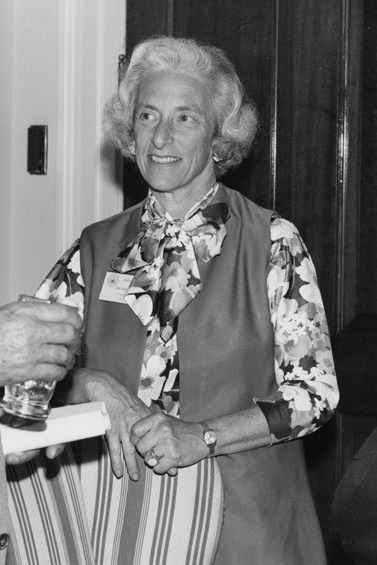
Photo of Barbara W. Tuchman
Photo: The U.S. National Archives · Public domain · via source

Author profile

Barbara W. Tuchman

Barbara W. Tuchman was an American historian celebrated for vivid narrative histories of war, diplomacy, political failure, and societies under strain.

1 published book 0 published articles

About Barbara W. Tuchman

Barbara W. Tuchman (1912–1989) was an American historian and journalist. Her early work included reporting on the Spanish Civil War and serving on the Far East desk of the U.S. Office of War Information. She later built a wide-ranging career outside the academic profession, moving from medieval Europe to revolutionary America and twentieth-century China.

Tuchman wrote narrative history with a strong eye for character, decision, and consequence. Rather than treating events as abstract forces, she followed political and military leaders as plans collided with pride, fear, institutional habit, and events on the ground. Her prose is lucid and carefully paced, often turning diplomatic meetings and troop movements into scenes of mounting pressure.

The Guns of August, her account of the outbreak and opening weeks of the First World War through the First Battle of the Marne, received the 1963 Pulitzer Prize for General Nonfiction. She won the same prize again in 1972 for Stilwell and the American Experience in China, 1911–1945. Her other major books include The Proud Tower, A Distant Mirror, The March of Folly, and The First Salute. In 1980 she delivered the National Endowment for the Humanities’ Jefferson Lecture.

Begin with The Guns of August. Its focus is tight enough for a newcomer, yet its portraits of commanders, governments, rigid war plans, and the German advance through Belgium show Tuchman’s full method: large history made immediate through human choices.

Published books

Author

The Guns of August

Barbara W. Tuchman reconstructs the opening of the First World War, moving from the assumptions and military plans formed before 1914 to the German advance through Belgium and France, the Allied retreat, and the Battle of the Marne. Her central concern is not simply who won or lost particular engagements. She examines how rigid timetables, institutional habits, personal rivalries, faulty intelligence, nationalism, and misplaced confidence narrowed the choices available to political and military leaders. The result is a closely observed account of strategy colliding with reality. Although concentrated chiefly on Europe’s western theater, the book also considers Russia’s invasion of East Prussia and the resulting pressures on German planning. Published in 1962, it became an influential work of narrative history and received the 1963 Pulitzer Prize in General Nonfiction. Its vivid storytelling remains compelling, while its interpretations are best read alongside later scholarship on the…

View book