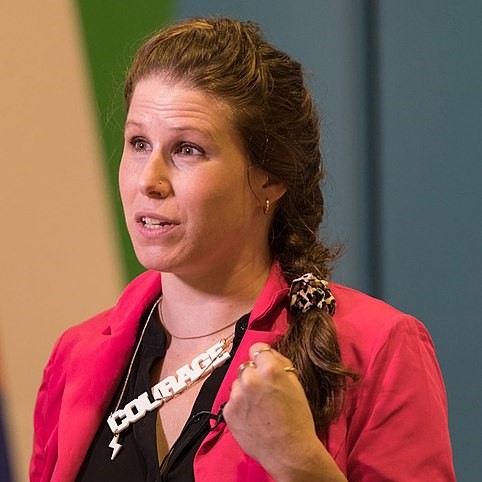
Photo of Caroline Criado Perez
Photo: Sintegrity · CC BY-SA 4.0 · via source

Author profile

Caroline Criado Perez

British writer and feminist campaigner whose nonfiction examines gender inequality, missing data and the consequences of treating men as the human default.

1 published book 0 published articles

Official website

About Caroline Criado Perez

Caroline Criado Perez is a British writer, broadcaster and feminist campaigner. Her public work has repeatedly addressed women’s absence from institutions and public life. She co-founded the Women’s Room, which promotes female experts in the media, and led campaigns connected with Jane Austen’s appearance on the Bank of England’s £10 note and the statue of suffragist Millicent Fawcett in Parliament Square. She was appointed OBE in 2015 for services to equality and diversity.

Her nonfiction combines social criticism with extensive evidence. Do It Like a Woman, published in 2015, profiles women challenging expectations around the world. Invisible Women, her second book, widens the argument: it examines how gaps in sex-disaggregated data shape medicine, transport, technology, workplaces and public policy. Criado Perez moves between research and concrete examples, showing how an apparently neutral standard often assumes a male body or male pattern of life.

Invisible Women won both the 2019 Royal Society Science Book Prize and the 2019 Financial Times and McKinsey Business Book of the Year Award. Its central idea, the gender data gap, gave readers a clear framework for recognizing bias in systems that may appear objective.

New readers should start with Invisible Women. It is her broadest and most influential book, and its examples—from medical research to smartphone design—make an abstract problem immediate without losing sight of the evidence.

Published books

Author

Invisible Women

Invisible Women examines what happens when institutions treat male bodies, routines, and experiences as the human norm. Caroline Criado Perez calls attention to a “gender data gap”: missing, unreported, or insufficiently separated information about women. Her central argument is not merely that women are absent from datasets. It is that decisions made from incomplete evidence can turn that absence into material disadvantages—including unsuitable products, ineffective public services, distorted economic measurements, and avoidable health and safety risks. The book moves from ordinary environments to increasingly consequential systems. Its six parts address daily life, employment, design, medicine, public life, and disasters. Examples involving transportation, toilets, unpaid care, workplace practices, protective equipment, phones, medical research, government spending, refugee assistance, and disaster recovery allow the same underlying pattern to be observed across otherwise unrelated…

View book