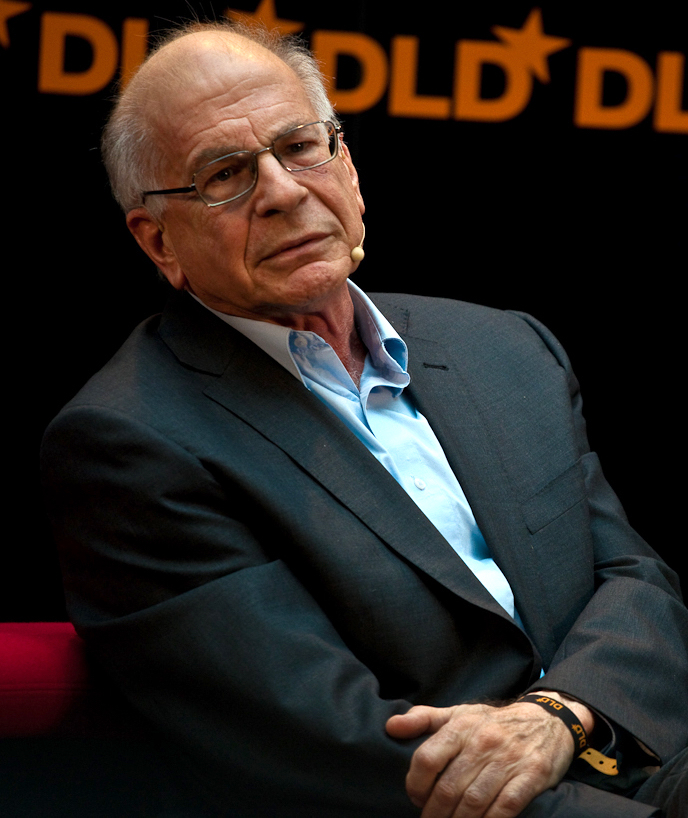
Photo of Daniel Kahneman
Photo: nrkbeta · CC BY-SA 2.0 · via source

Author profile

Daniel Kahneman

Daniel Kahneman was a Nobel Prize-winning psychologist who wrote about judgment, cognitive bias and decision-making, bringing behavioral science to a broad readership.

1 published book 0 published articles

Official website

About Daniel Kahneman

Daniel Kahneman (1934–2024) was an Israeli American psychologist whose research altered how psychology and economics describe human choice. Educated at the Hebrew University of Jerusalem and the University of California, Berkeley, he later taught at several universities and joined Princeton in 1993. His long collaboration with Amos Tversky was central to his career.

His nonfiction examines judgment under uncertainty: why intuition can be useful, where it fails and how framing, loss aversion and overconfidence shape decisions. Kahneman explains experiments and abstract ideas through compact problems and familiar situations, asking readers to notice the shortcuts operating in their own minds.

He received the 2002 Sveriges Riksbank Prize in Economic Sciences in Memory of Alfred Nobel for integrating psychological research into economics, especially in the study of judgment and decision-making under uncertainty. In 2013, he received the Presidential Medal of Freedom. His later book Noise, written with Olivier Sibony and Cass R. Sunstein, considers unwanted variability in professional judgments.

Begin with Thinking, Fast and Slow. It gathers decades of research into a sustained account of fast, automatic System 1 and slower, effortful System 2, then connects that distinction to biases, forecasting, choice and remembered experience. It is the clearest entry point to both Kahneman’s work and his influence on behavioral economics.

Published books

Author

Thinking, Fast and Slow

Thinking, Fast and Slow is a wide-ranging account of how people form judgments, estimate probabilities, make choices under uncertainty, remember experiences, and evaluate their lives. Kahneman organizes much of this material around two personified modes of cognition. System 1 represents rapid, automatic, associative, and usually effortless processing; System 2 represents more deliberate, attention-demanding reasoning. These are explanatory characters rather than literal anatomical divisions of the brain. The book’s five-part structure moves from cognitive machinery to practical consequences. Part I introduces the two-system vocabulary and examines attention, mental effort, associative memory, cognitive ease, and the mind’s tendency to construct coherent interpretations from limited evidence. Part II turns to heuristics: useful shortcuts that can also produce predictable errors involving small samples, anchors, availability, stereotypes, base rates, conjunctions, regression to the mean…

View book

Articles about Daniel Kahneman's books