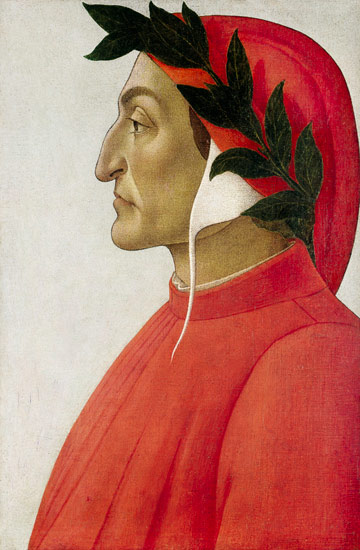
Photo of Dante Alighieri
Photo: Sandro Botticelli · Public domain · via source

Author profile

Dante Alighieri

Florentine poet (1265–1321) who wrote the Divine Comedy, a journey through hell, purgatory and heaven. He also wrote love poetry and Latin treatises, and his choice of Italian over Latin helped shape the written language.

1 published book 0 published articles

About Dante Alighieri

Dante Alighieri was born in Florence in 1265 into a noble family, in a city torn between the Guelfs and the Ghibellines, the partisans of pope and emperor. In 1302, after a rival wing of his own Guelf party took control, he was exiled. He never saw Florence again and died in Ravenna in September 1321.

He began as a love poet. La Vita Nuova, from the 1290s, alternates short lyrics with prose commentary and centers on Beatrice Portinari. Exile pushed him toward argument. The Convivio and De vulgari eloquentia, the second written in Latin, are both unfinished. The latter makes the case for an elevated Italian vernacular. Monarchia, a Latin treatise on the emperor's independence from the pope, was later placed on the Church's Index of Forbidden Books. Sin, justice, love and the state of Italy run through all of it.

The Divine Comedy, written roughly between 1308 and 1321, is the work that made him permanent. He called it simply Commedia. The word divine came later, with a Venice edition of 1555. In the poem Dante is guided by the Roman poet Virgil through hell and purgatory, then by Beatrice into Paradise. Writing in Italian rather than Latin, he did much to make it a literary language. Boccaccio gave public lectures on the poem in 1373 and 1374, an early sign that it was being treated as a classic.

Start with Inferno, the first of the poem's three parts. It is the most vivid and the easiest way in. On WebToTell the poem is listed in Mark Musa's Penguin translation, which has an introduction and commentary by the translator. Read the three volumes in order, and pick up La Vita Nuova afterward if you want to see where Beatrice comes from.

Published books

Author

The Divine Comedy

Inferno, the first of the three parts of Dante Alighieri's Divine Comedy, follows a lost pilgrim named Dante as he descends through an imagined Hell under the guidance of the Roman poet Virgil. Along the way he meets lovers, politicians, popes, advisers, thieves and traitors, each placed in a torment that mirrors the sin. This Penguin Classics paperback presents Mark Musa's English verse translation of that first volume, together with his introduction and commentary on each canto. Written in the early fourteenth century by a Florentine exile, the poem is at once a Christian moral drama, a bitter commentary on Italian politics and a foundation of Italian vernacular poetry. It is one of the classic books that most readers first meet in translation, and among the poetry books that shape discussion of world literature.

View book