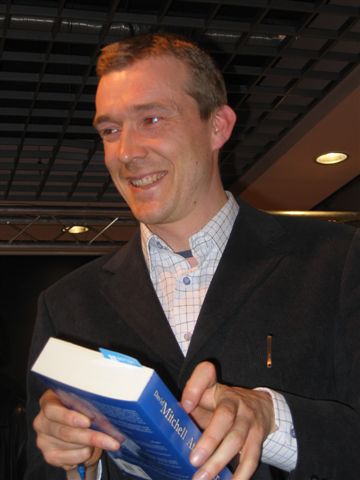
Photo of David Mitchell
Photo: Mariusz Kubik, http://www.mariuszkubik.pl · CC BY 2.5 · via source

Author profile

David Mitchell

British novelist David Mitchell writes historical, speculative and literary fiction, often shifting between eras, genres and voices. His books include Cloud Atlas and The Thousand Autumns of Jacob de Zoet.

1 published book 0 published articles

Official website

About David Mitchell

Born in 1969 and raised in Malvern, Worcestershire, David Mitchell studied English and American literature and comparative literature at the University of Kent. He later taught English in Japan, a country that became important to novels including number9dream and The Thousand Autumns of Jacob de Zoet.

Mitchell moves freely among historical fiction, science fiction, fantasy and coming-of-age stories. His novels often use multiple narrators, nested structures and sharp changes of setting or style. Cloud Atlas links six stories across centuries, while Black Swan Green follows one year in the life of an English boy. Characters and imagined histories sometimes recur across otherwise distinct books.

His debut, Ghostwritten, won the John Llewellyn Rhys Prize. Both number9dream and Cloud Atlas were shortlisted for the Booker Prize, and Cloud Atlas was adapted as a 2012 film. The Thousand Autumns of Jacob de Zoet, longlisted for the 2010 Booker Prize, unfolds around the Dutch trading post of Dejima in Nagasaki harbour in 1799, where commerce, medicine and political power bring Europeans and Japanese into uneasy contact.

Start with The Thousand Autumns of Jacob de Zoet. Its story of the clerk Jacob de Zoet and the midwife Orito Aibagawa offers a direct route into Mitchell’s work: richly built historical fiction that gradually opens into stranger territory. Readers ready for a more formally intricate book can follow it with Cloud Atlas.

Published books

Author

The Thousand Autumns of Jacob de Zoet

In 1799, Jacob de Zoet arrives at Dejima, the tightly controlled Dutch trading post in Nagasaki Harbor, intending to earn enough money to marry his fiancée at home. Employed as a clerk, he is expected to investigate corrupt accounts without becoming entangled in the colony’s rivalries. His plans change after he meets Orito Aibagawa, a gifted Japanese midwife and medical student whose intelligence attracts him across formidable boundaries of language, law, class, and custom. When Orito is taken to an isolated religious estate governed by the powerful Lord Enomoto, the novel widens from commercial intrigue and constrained courtship into a darker struggle over coercion, belief, and political influence. David Mitchell uses Jacob’s moral awakening, Orito’s fight for autonomy, and interpreter Uzaemon Ogawa’s divided loyalties to explore contact between societies that exchange goods and knowledge while remaining deeply suspicious of one another.

View book