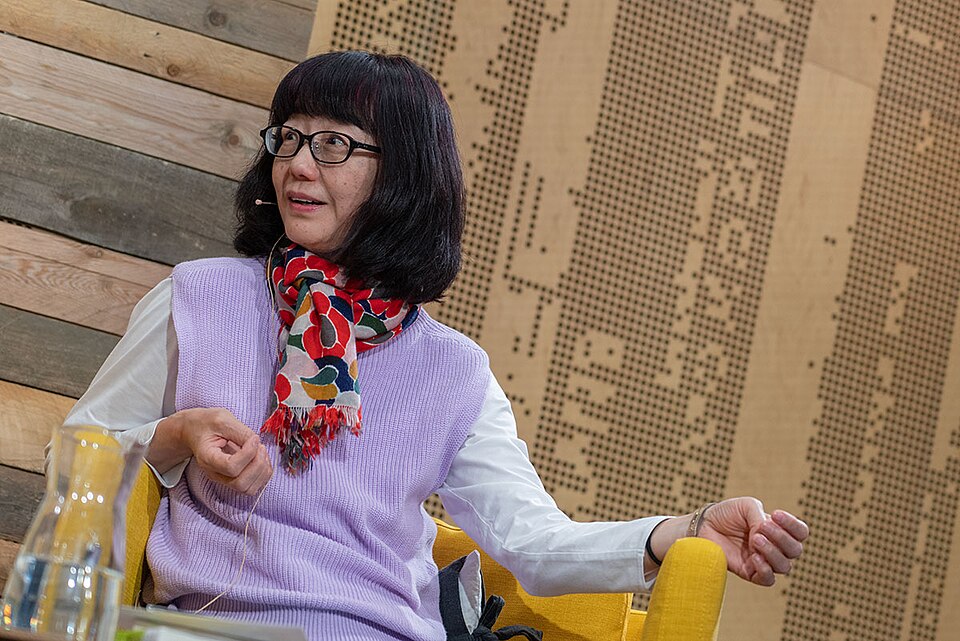
Hiromi Kawakami was born in Tokyo in 1958 and graduated from Ochanomizu Women's College in 1980. She came to writing through science. She edited and wrote for the science fiction magazine NW-SF and also taught science at a middle school. Her first book, the story collection Kamisama (God), appeared in 1994.
Most of her fiction starts on ordinary ground: meals, drinks, small talk, an awkward silence. Then it tilts. In Strange Weather in Tokyo, a woman and her old schoolteacher keep meeting over sake and beer, and a slow, unlikely romance grows between them. In the story Tread on a Snake, a snake moves into a woman's home and claims to be her mother. Kawakami rarely explains the strangeness. She lets it sit beside the everyday.
Tread on a Snake won the Akutagawa Prize in 1996, and the novel Sensei no kaban, published in English as Strange Weather in Tokyo, won the Tanizaki Prize in 2001. That novel was also shortlisted for the Man Asian Literary Prize in 2013. Her collection Ōkina tori ni sarawarenai yō won the Izumi Kyōka Prize in 2016. Asa Yoneda's English version, Under the Eye of the Big Bird, was shortlisted for the International Booker Prize in 2025.
Start with Under the Eye of the Big Bird. It follows a far-future humanity close to extinction, looked after by figures called Mothers, and its stories ask what changes in bodies, families and communities across vast stretches of time. Her science background shows in the way she handles evolution. If you want her quieter side afterwards, read Strange Weather in Tokyo, or Record of a Night Too Brief for her Akutagawa-winning short fiction.