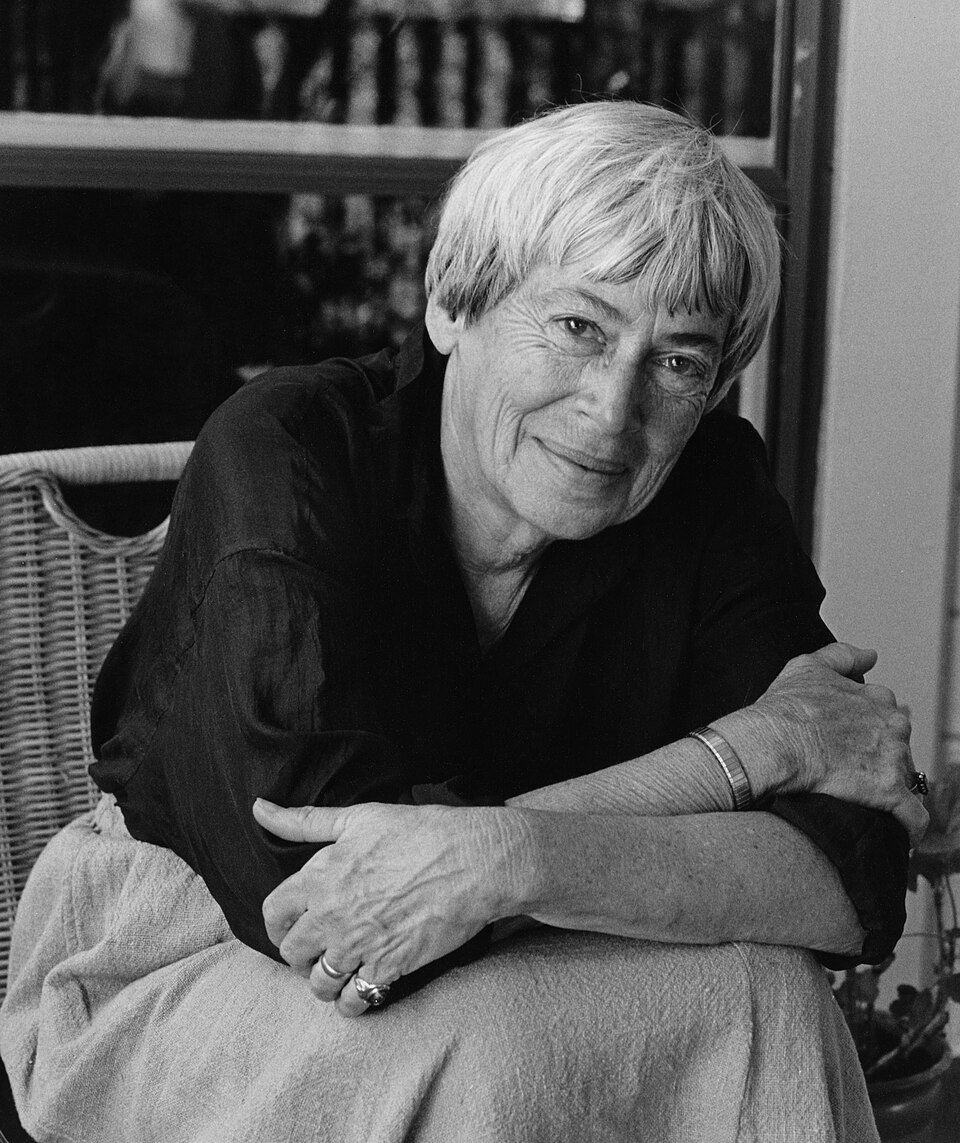
Photo of Ursula K. Le Guin
Photo: Marian Wood Kolisch, Oregon State University Restored by Adam Cuerden · CC BY-SA 2.0 · via source

Author profile

Ursula K. Le Guin

American author of science fiction and fantasy whose imagined societies test ideas about power, gender, freedom and responsibility. Her work includes the Earthsea books and the Hainish novels.

3 published books 0 published articles

Official website

About Ursula K. Le Guin

Ursula K. Le Guin (1929–2018) was an American novelist, short-story writer, poet, essayist and translator. Born in Berkeley, California, she studied at Radcliffe College and Columbia University. She began publishing novels in the 1960s and became a central figure in modern science fiction and fantasy.

Le Guin used invented cultures to examine familiar arrangements of power. Gender and estrangement shape The Left Hand of Darkness; competing forms of freedom and coercion animate The Dispossessed. In Earthsea, magic depends on true names and balance, while Ged’s struggle with the shadow he releases turns a wizard’s education into a study of pride and self-knowledge. Her prose is measured and clear, often drawing on myth, anthropology and Taoist thought.

The Left Hand of Darkness and The Dispossessed each won both the Hugo and Nebula awards for best novel. The Farthest Shore, the third Earthsea novel, won the 1973 National Book Award for Children’s Books. Le Guin was named a Grand Master by the Science Fiction and Fantasy Writers of America and received the National Book Foundation’s 2014 Medal for Distinguished Contribution to American Letters.

Start with A Wizard of Earthsea. It is brief, absorbing and the proper entrance to a six-book sequence whose ideas grow more complex with each return to the archipelago. For a first taste of Le Guin’s social science fiction, choose The Left Hand of Darkness and its demanding journey across the ice of Gethen.

Published books

Author

A Wizard of Earthsea

On the mountainous island of Gont, a gifted boy called Duny discovers an unusual power over words, weather, and living things. Renamed Ged by the mage Ogion, he enters the school of wizardry on Roke but allows pride and rivalry to outrun judgment. A forbidden act releases a shadow that pursues him across the island world of Earthsea. What begins as a tale of magical education becomes a searching account of responsibility: Ged must understand that strength does not mean domination and that an enemy cannot always be defeated by violence. Ursula K. Le Guin builds the novel around true names, equilibrium, and the moral consequences of action. Its voyages, dragons, spells, and ancient lore give it epic range, while its deepest conflict remains internal. First published in 1968, it opens the Earthsea sequence and stands independently as a compact coming-of-age novel about recognizing and accepting the whole self.

View book

Author

The Dispossessed

The Dispossessed follows Shevek, a physicist raised on Anarres, an arid moon settled by revolutionaries seeking to build a stateless, non-proprietary society. Convinced that intellectual isolation is obstructing both his scientific work and meaningful contact between worlds, Shevek travels to Urras, the wealthy planet from which the Anarresti founders departed generations earlier. His journey places him between societies that define freedom in radically different ways. The novel develops along two alternating timelines. One traces Shevek’s life on Anarres: his education, scientific vocation, partnership with Takver, experience of famine, and conflicts with institutions that exercise power despite officially rejecting hierarchy. The other follows his visit to Urras, where he receives material comfort and professional recognition but gradually recognizes the political interests surrounding his research. The timelines illuminate each other, turning his journey into both a political compa…

View book

Author

The Left Hand of Darkness

The Left Hand of Darkness combines diplomatic science fiction, speculative anthropology, political intrigue, and an arduous survival journey. Genly Ai, an envoy from a loose interplanetary association called the Ekumen, travels alone to Gethen—also known as Winter—to invite its nations into wider contact with other human worlds. His assignment is complicated by political rivalry, his limited understanding of Gethenian customs, and his difficulty perceiving the planet’s inhabitants outside the gender categories he brings with him. The novel initially follows Genly’s uncertain dealings in Karhide, where indirect communication, personal influence, ceremonial behavior, and political suspicion make straightforward diplomacy nearly impossible. His relationship with the statesman Estraven becomes central: Genly repeatedly misreads Estraven’s motives, while Estraven acts from a conception of loyalty larger than allegiance to a single ruler or nation. The story later moves through the bureaucr…

View book

Articles about Ursula K. Le Guin's books