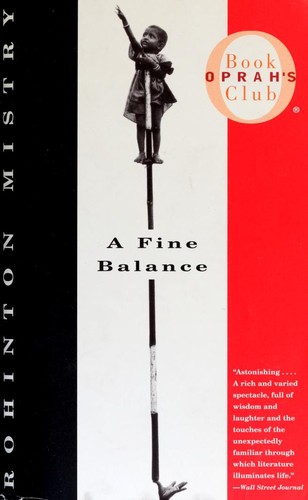
Deep Overview
The novel's engine is a forced domestic experiment. Dina Dalal is a Parsi widow who is determined to stay independent of her overbearing brother, and she takes in sewing work for an export company. To keep that income going she needs help, so she rents a room to Maneck Kohlah, a student sent to the city from a quiet mountain town. She also hires two tailors, Ishvar Darji and his nephew Omprakash. The tailors belong to a family that defied the caste order of its village, and they paid heavily for it. Wary and ill-matched at first, the four slowly turn the flat into a makeshift family. Mistry takes his time over this. He gives the small rituals of tea, quarrels, jokes, thrift and shared chores the same weight as the political events outside.
Mistry does not treat these lives as separate from the nation. The backstories show how caste hierarchy, communal tension, family pressure and ambition shaped each character long before the Emergency began. When the state starts its drive for order and modernisation, with slum clearance, arbitrary detention and population-control campaigns, the pressure lands on people who have no protection. Mistry makes clear that the authorities' abstractions have private costs. A policy is a clearance crew arriving at dawn. A target is a man pulled from the street.
The structure counters despair with texture. Minor figures, such as a rent collector, a landlord's agents, a proofreader, and the organised beggars who work the streets, are drawn with enough detail to feel like neighbours. Their presence shows a city whose informal economies and small loyalties keep people alive. It also shows how those same networks can be exploited. The tone moves between farce and tragedy, and the later chapters grow bleak. Mistry's refusal to offer easy consolation is part of his argument. The title points to the narrow ground between hope and ruin on which the characters live. Dignity, humour and mutual care give them balance, and the story shows how easily that balance can be removed.
The novel is not only about suffering. It is about what people build in spite of it. Mistry keeps asking what holds a person up when institutions, family and law fail, and how long ordinary kindness can bear a weight that was never meant to fall on it. Because he refuses to turn the poor into symbols, the book succeeds as political fiction. His characters can be petty, stubborn, funny and wrong, and they are never merely victims.
Key Themes
Survival and dignity under pressure runs through the whole book. Mistry shows how people hold on to self-respect through work, humour and routine when the larger world gives them none. Caste and class are treated as lived structures that decide where a person may live, what trade they may enter and how much violence can be done to them without consequence. State power appears as both ideology and everyday bureaucracy. It claims to bring order and progress, but it operates through quotas, informers, raids and paperwork. Chosen family is a central counterweight: the four protagonists form obligations to one another that neither blood nor law required. The novel also examines hope as a moral and practical resource, and asks whether it is a form of courage or a luxury. Smaller themes include migration from village and hill town to the city, the fragility of Parsi community life, and the unequal ways ambition and loss are distributed.
Historical Context
The story is anchored in the Emergency, the roughly 21-month period from 1975 to 1977 when Prime Minister Indira Gandhi's government ruled under emergency powers. Sources describing the period note that Gandhi imposed it on 26 June 1975, that many opponents were jailed, and that the press was censored. They also describe a forced sterilisation campaign associated with her son Sanjay Gandhi and the clearance of slum dwellings. Detention without trial under security legislation was widespread. The Emergency remains one of the most contested periods of independent India's history, so the novel's depiction should be read as fiction rooted in documented events, not as a history textbook.
Mistry's frame is wider than those two years. His characters' earlier lives reach back toward India's independence and its aftermath, when promises of equality collided with entrenched caste and communal divisions. The author himself was born in Bombay in 1952 into the Parsi community, studied at the University of Bombay, and emigrated to Canada in 1975. His distance from India while writing, and his closeness to Bombay's textures, shape the book's perspective. It belongs to a wave of 1990s English-language fiction from the Indian subcontinent and its diaspora that revisited the post-independence decades.
Intended Audience
The book suits readers who enjoy long, character-rich novels and are willing to spend several weeks inside one setting. It will appeal to those drawn to social realism, to modern Indian history told through ordinary lives, and to anyone who has read nineteenth-century novels of poverty and wants a modern counterpart. It works well for reading groups because the characters' choices invite argument. Readers who want a fast plot, a consistently hopeful tone or a brief introduction to Indian politics may find it less suitable. The same goes for readers who are sensitive to depictions of violence, humiliation and loss, which become heavy in the later chapters.
Reading Difficulty
The prose is clear and the sentences are not complicated, so difficulty comes from length and emotional load rather than style. This paperback runs to 624 pages, and the story builds slowly through detailed backstories before the main strands converge. Readers will meet a large cast, family histories that interleave, and untranslated words from Indian languages, along with references to food, religious practice and local institutions. Context usually makes these understandable. The pace is deliberate, and the final stretch is difficult material. Many readers do best by reading in sessions of moderate length and keeping a short list of names. An audiobook version also exists for those who prefer to listen, but this profile concerns the printed paperback.
Helpful Background Knowledge
No specialist knowledge is required, but a few basics make the book richer. A short outline of India's independence in 1947 and of Indira Gandhi's time in office will help with the political frame. A general understanding of caste, and of the Dalit experience in particular, clarifies why the tailors' village history matters. It also helps to know that Parsis are a small community descended from Persian Zoroastrians who have long been concentrated in Bombay, because Dina's family world and Maneck's background draw on that identity. A brief reading about the Emergency's slum clearances and sterilisation drives is optional. Some readers prefer to meet them first in the novel, then check the history afterward.
Why Read This Book?
Choose it for the way it makes policy feel personal without becoming a lecture. Many accounts of the Emergency stay at the level of leaders and institutions, while this novel lingers over the effect of a decree on a single room, a single trade or a single body. It is also unusually fair-minded about its characters. Their small vanities and prejudices are on display alongside their generosity, so the reader has to judge them as people rather than symbols. The book has been widely honoured, including with the Giller Prize and the Commonwealth Writers Prize for Best Book, and it later became a popular choice for book club books. Its reputation rests on actual craft: the pacing of the household scenes, the humour that makes the later grief hit harder, and the sense of a city with its own economy and social order.
Reader Takeaways
A careful reader may come away with a more concrete picture of how sweeping state campaigns reach ordinary lives, and how those campaigns fall unevenly on people according to caste, class and religion. You may notice how often the novel's turning points depend on small acts of trust or betrayal rather than grand events. You may also reconsider what a good ending means in fiction, and whether honest storytelling owes the reader comfort. On a craft level, the book shows how backstory can be used to make later suffering feel earned and specific. It also gives readers a vocabulary for talking about hope as something that must be practised and not simply felt.
Strengths
The characters are the main strength. Even minor figures have habits, speech patterns and private logic, which gives the city a convincing social density. Mistry balances comedy and tragedy skilfully, so humour is not a distraction from the political material but a way of making the people real. The structure, with its slow convergence of separate histories, makes the central household feel inevitable once it forms. The historical setting is integrated into the story rather than explained from the outside. Finally, the novel addresses caste, class and state violence together, which gives it a wider moral range than many books on the same period.
Limitations and Cautions
The book's pacing can feel slow, and some readers find the sequence of misfortunes relentless or even contrived. One contemporary critic, writing in the Chicago Tribune, admired the storytelling but judged the portrait of Indian society too negative and the despair excessive. Others defend the bleakness as proportionate to its subject, so this is an interpretive disagreement and not a settled flaw. The novel is a work of fiction, so details of the Emergency should be checked against historical sources, and the period itself remains politically contested in India. The viewpoint is that of a diaspora writer looking back from Canada. Readers should expect depictions of violence, caste cruelty, bodily harm and despair, and some may want to prepare for them before starting.
Important Concepts, People, and Places
Rohinton Mistry: the Bombay-born, Canada-based author, whose Parsi background and knowledge of Bombay inform the book's texture.
The Emergency (1975–1977): the period of emergency rule under Prime Minister Indira Gandhi that forms the political backdrop and drives the plot's crises.
Indira Gandhi and Sanjay Gandhi: the leader and her son associated with the era's authoritarian measures, including forced sterilisation and slum clearance, which the novel shows through their effect on ordinary people.
Dina Dalal: the Parsi widow who starts a small tailoring enterprise and anchors the household at the centre of the story.
Ishvar Darji and Omprakash Darji: the uncle and nephew tailors whose family history exposes the cost of defying caste hierarchy.
Maneck Kohlah: the student from a hill town whose view of the city allows Mistry to show change and disillusionment.
Caste system: the hereditary social order that shapes the tailors' past and limits their options.
Parsis: the small Zoroastrian community to which Dina and Maneck belong, which Mistry portrays with both affection and critical distance.
The unnamed seaside city: a setting the novel never names but which evokes Bombay, used as a stand-in for urban India under pressure.
Questions the Book Explores
How do people preserve their moral and emotional bearings when the law becomes arbitrary? What do ideas of progress cost, and who pays? To what extent are the characters' fates shaped by caste and class, and to what extent by chance and personal choice? Can a chosen family offer protection that institutions fail to? What is the difference between hope that sustains and hope that blinds? And what does it mean to bear witness to suffering through fiction, rather than through reporting or history?
Reading Group Guide
Because of its length, many groups divide the book into three or four meetings and discuss the household's formation before turning to the later political events. At the first meeting, it can help to ask each member to describe the character they trusted most and the one they understood least. Compare how Mistry treats the main characters' backstories with how he treats the Emergency itself, and ask which feels more vivid. Groups may want to agree in advance on how to handle the book's difficult scenes, since reactions will differ. It also helps to bring a little historical reading on the Emergency and on caste, then separate what the novel documents from what it invents. Finally, consider how the title works as an idea you can test against each chapter.
Discussion Questions
1. Why might Mistry have chosen to leave the city unnamed, and what does that choice change about how the story reads?
2. How does the novel make the shared flat feel like a refuge, and what pressures expose its limits?
3. Which character changes most, and which do you think changes least? What does the contrast suggest?
4. How do the characters' backstories alter the way you judge their later decisions?
5. Where does humour appear, and how does it affect your response to the darker material?
6. In what ways does the novel link private prejudice to public policy?
7. Is the title an accurate description of how the characters live, or does it suggest an optimism the story does not share?
8. Does the book's bleakness strengthen or weaken its argument, and why?
9. What responsibility do the more comfortable characters have to those who are less protected?
10. How might this story differ if it were told from the point of view of the officials who carry out the policies?
Sources and Verification
Bibliographic details for this edition come from the publisher's own page and a bookseller's record, which agree on the ISBN, the paperback format, the Vintage imprint, the 2001 date and the 624-page count. The publication history, prizes and critical reception draw on the publisher's description, a reference article on the novel and a reading guide. Background on the author comes from an established encyclopedia. The historical material on the Emergency draws on encyclopedic and academic summaries. All interpretation and prose are original. Page counts and dates differ between the 1995 Canadian first edition and later printings, so the figures here apply only to the 2001 Vintage paperback.