
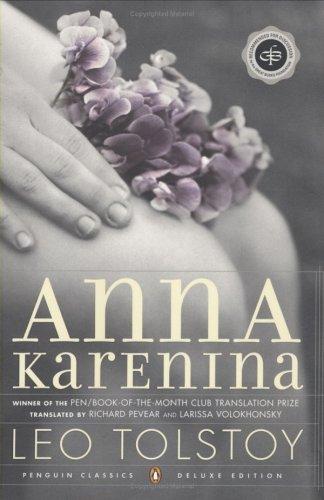
Anna Karenina
Anna Karenina follows two intertwined stories in 1870s Russia. In one, Anna, a married St. Petersburg aristocrat, enters a passionate relationship that her society will not forgive. In the other, the landowner Konstantin Levin searches for love, purpose and a workable way to live, in the countryside and in marriage. Tolstoy surrounds them with a wide circle of relatives and friends, using their marriages, ambitions and failures to examine fidelity, social judgment, faith and the meaning of ordinary days. This Penguin Classics Deluxe Edition presents the Richard Pevear and Larissa Volokhonsky translation of a landmark of Russian literature. It is also a sensible pick among classic novels to read for anyone ready for a long, absorbing realist novel.
Where to buy or borrow
Are you selling this book? Bookstores, publishers, authors and libraries can be listed here for free. Request a listing
About this book
Deep Overview
Tolstoy's design is comparative. Instead of a single heroine and a single villain, he builds a series of households: the Oblonskys, the Karenins, the Levins, and the unofficial union of Anna and Vronsky. Readers can then see how similar desires lead to very different outcomes. Stepan (Stiva) Oblonsky, Anna's genial brother, is repeatedly unfaithful and is still forgiven and welcomed everywhere, while Anna's transgression is treated as unforgivable. That contrast is among the sharpest observations in the book about how a society distributes moral consequences unevenly, especially along lines of gender.
The narrative method matters as much as the plot. Tolstoy moves close to each character's perceptions without handing the book to one viewpoint. We see Anna's growing suspicion and isolation, Karenin's attempt to turn pain into a legal and Christian formula, Vronsky's wounded pride and Kitty's recovery from humiliation. Small gestures, physical details and passing thoughts carry great emotional weight. Set pieces such as a horse race, a day of mowing in the fields, a provincial election among the nobility and a death in Levin's family move the book between private feeling and public institution.
The eight-part structure supports this alternation. Early parts establish the parallel stories. Later parts pull them apart, as Anna's life narrows into dependence, jealousy and despair while Levin's widens into agriculture, politics and the question of how to live when intellectual answers fail. The final part is given over largely to aftermath and to Levin's reflection, which invites readers to ask what kind of book they have been reading: the tragedy of one woman, a survey of a society, or a search for moral orientation that continues after the tragedy ends.
A brief biblical epigraph about judgment and retribution frames the whole. Readers and critics have long argued over who is judging whom in the novel, and the book does not settle the question. Part of Tolstoy's achievement is that sympathy is spread widely. Karenin can be cold and still be pitiable. Vronsky can be shallow and still be loyal. Anna can be sympathetic and still be unfair to those around her.
Key Themes
Social judgment and double standards run through Anna's story. The book asks who is allowed to break rules, who pays for it, and how reputation works as a form of discipline.
Passion and self-deception form a second line of inquiry. Characters tell themselves comforting stories about love, honour, forgiveness or reform, and the narrative regularly lets those stories be tested by events.
Faith, meaning and mortality are carried mainly by Levin, whose practical life on the land is entangled with doubts about why anything matters.
City and country are set against each other as moral environments. Urban society is shown as a world of performance and appearance, while rural labour offers Levin a form of purpose, though never an easy one.
Progress and change appear in the background through new technology, administrative reform and arguments about how Russia should be run. These forces unsettle old certainties without supplying new ones.
Historical Context
The novel belongs to the great age of nineteenth-century Russian literature and to the wider tradition of European realism, in which adultery and marriage were common vehicles for examining social structure. It first appeared in installments in a Russian periodical between 1875 and 1877, with the final part published separately, and then as a book in 1878. According to one reference account, Tolstoy was in an anguished state of mind while finishing the final installments. Readers should also bear in mind that the Pevear and Volokhonsky text is a modern English rendering, first issued in 2000, so it brings the reader into a nineteenth-century world through a twenty-first-century translation choice.
Intended Audience
Readers who want a fast plot, a simple moral or a single central narrator may find it demanding. It may also frustrate those who expect the Levin chapters to resemble the romance of Anna's story, since they deal with farming methods, politics and philosophy at length. Anyone who prefers to be surprised should be aware that the book's outline is widely known.
Reading Difficulty
Conceptual difficulty is moderate. Tolstoy rarely states his views directly, so readers must infer how scenes comment on one another. The edition includes an introduction and explanatory notes, which are useful for unfamiliar customs, ranks and references. The Deluxe paperback format has French flaps and deckle-edged paper, which look handsome but may feel less sturdy for heavy daily carrying. A digital edition exists under a separate ISBN.
Helpful Background Knowledge
It is wise to read the first few chapters without outside summaries, then consult the introduction and notes afterwards so as to preserve the effect of the opening situation. If you want a historical anchor, read about the 1861 emancipation and the reforms that followed.
Why Read This Book?
This specific edition is useful because it pairs a widely used modern translation with an introduction and notes, and because the translators have a reputation for staying close to Tolstoy's repetitions and abruptness rather than smoothing them away. That choice has admirers and critics, so a reader comparing translations has something real to compare. For anyone assembling classic novels to read, this one rewards patience with a sense of how a whole world can be built from small incidents.
Reader Takeaways
The Levin chapters may prompt reflection on the relationship between daily work, family responsibility and the search for meaning. Readers often reconsider their first impressions of minor characters, who turn out to carry much of the moral intelligence of the book. Finally, the book can change expectations about what a novel can contain, since a single volume holds romance, satire, agriculture, politics and metaphysics.
Strengths
This edition adds an introduction and explanatory notes, a translation that received the PEN Translation Prize according to the publisher, and a Deluxe paperback format that makes a very long text feel inviting. The book's moral ambivalence is also a strength: it avoids a tidy lesson and leaves room for debate.
Limitations and Cautions
The moral reading is contested. Critics and readers disagree about whether the book condemns Anna, pities her, or indicts the society around her, and about how fully Tolstoy's own views are present in Levin's thinking. Translation is also a debatable matter: the Pevear and Volokhonsky approach is praised by many for fidelity, and others find it too literal or stylistically stiff in places. Compare a sample from another translation if the style matters to you. This edition is a modern translation, so it should not be treated as a reproduction of the nineteenth-century Russian text. Finally, discussions of the book often reveal major plot developments, so spoilers are easy to encounter.
Important Concepts, People, and Places
Alexei Karenin: Anna's husband, a high-ranking official whose rigid sense of duty shapes his responses to the crisis.
Count Alexei Vronsky: an officer whose love for Anna alters both of their lives and tests his ambitions.
Konstantin Levin: a landowner whose search for meaning forms the second major plot, often read as closest to Tolstoy's own concerns.
Kitty Shcherbatskaya: a young woman whose changing relationships with Vronsky and Levin link the two stories.
Stepan (Stiva) Oblonsky and Darya (Dolly) Oblonskaya: Anna's brother and his wife, whose marital crisis opens the book and illustrates unequal social standards.
St. Petersburg and Moscow: the official capital and the older, more domestic city, which represent different social atmospheres. The countryside estate is the third setting and Levin's moral ground.
The Russian Messenger: the periodical in which most of the novel first appeared as a serial.
Richard Pevear and Larissa Volokhonsky: the translators of this edition, whose version was an Oprah Book Club selection and was noted by the publisher as winning the PEN Translation Prize.
Realism: the literary approach that dominates the book, favoring detailed observation of everyday life and social structure.
Questions the Book Explores
Reading Group Guide
It may be useful to agree beforehand how to handle spoilers, since some members will know the ending and others will not. If several members have different translations, short comparisons of the same passage can make a lively session, as can a look at the introduction and notes to decide whether they changed anyone's view. For book club books of this size, a final meeting devoted to impressions of the whole is more productive than debating the ending in isolation.
Discussion Questions
2. Which character did your sympathies shift toward or away from as you read, and what scenes caused the change?
3. In what ways are Anna and Levin parallel figures, and where do they diverge?
4. How does Tolstoy portray public opinion, and what does it cost the characters who ignore or defy it?
5. What role do the city and the country play in the characters' ideas of happiness?
6. How does the book's epigraph affect the way you judge events and characters?
7. Do you read Levin's spiritual search as a continuation of the novel's central story or as a separate argument?
8. Which small details, gestures or objects seemed most revealing to you, and why?
9. If you have read another translation, what differences in tone or rhythm did you notice?
10. Does the novel feel like a tragedy, a social portrait, a philosophical work, or some combination?
Sources and Verification
Comments
No published comments yet.
Available editions
Paperback
Penguin Classics Deluxe Edition (Pevear and Volokhonsky translation)
- Publisher
- Penguin Classics
- ISBN-13
- 9780143035008
- Publication date
- Pages
- 864