
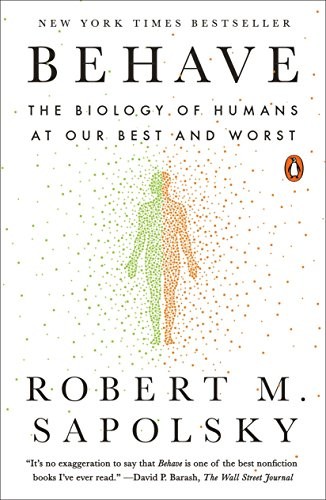
Behave
The Biology of Humans at Our Best and Worst
Why can the same species commit calculated cruelty, protect strangers, cooperate at enormous scale, and sacrifice for principles? In Behave, neuroendocrinologist and primatologist Robert M. Sapolsky investigates human conduct by tracing its causes backward through time. He begins with neural activity in the instant before an act, then moves through sensory cues, hormones, earlier experiences, childhood development, genes, culture, and evolutionary history. This structure allows him to challenge explanations that isolate a single cause—testosterone, an aggressive brain region, a supposed “violence gene,” upbringing, or social environment. Behavior instead emerges from interacting biological and social processes whose effects depend on context. Sapolsky applies this framework to empathy, hierarchy, competition, tribalism, prejudice, punishment, war, reconciliation, and moral responsibility. The result is a broad scientific synthesis that treats humanity’s generosity and brutality not as…
Where to buy or borrow
Are you selling this book? Bookstores, publishers, authors and libraries can be listed here for free. Request a listing
About this book
The approach reflects Sapolsky’s background in neuroendocrinology, stress research, primatology, and behavioral biology. Neuroscience supplies only one part of the account; the book also draws on endocrinology, genetics, developmental psychology, social psychology, anthropology, primatology, and evolutionary biology. Its distinctive contribution is integrative: it repeatedly shows why a valid finding at one level can become misleading when treated as a complete explanation. Although written for nonspecialists and enlivened by humor, it is closer in scale and density to an ambitious survey course than to a brief introduction or a practical self-help guide.
Deep Overview
The inquiry then widens. Sensory information in the preceding seconds or minutes can alter conduct before conscious interpretation catches up. Hormones influence aggression, affiliation, stress, and sexual behavior, but Sapolsky resists simple formulas such as “testosterone causes violence.” Hormonal effects are conditional: they may amplify sensitivity to status or an established social pattern rather than dictate one fixed response. The discussion of stress similarly connects physiology to rank, predictability, control, and social support.
Moving further backward, the book considers neural plasticity, adolescence, childhood, fetal development, genes, culture, and ecological conditions. Adolescence matters because reward systems, peer sensitivity, and regulatory capacities mature on different schedules. Early experience can shape later stress responses and expectations, yet development remains plastic rather than mechanically preprogrammed. Genes influence behavior through pathways that depend on environments, while environments affect which biological tendencies become relevant. Culture, in turn, is not positioned outside biology: it changes development, institutions, habits, and the situations repeatedly encountered by individuals.
Evolutionary explanation adds another timescale but not a master key. Sapolsky uses comparative primate behavior, kin selection, reciprocal cooperation, sexual selection, and debates about group conflict to examine why humans possess capacities for both competition and care. Evolution supplies flexible potentials, not a moral instruction manual. A behavior’s evolutionary history does not make it inevitable, desirable, or resistant to change.
The later synthesis centers on “us” and “them.” Humans classify others rapidly, attach emotion to those classifications, and alter moral concern according to perceived membership. Yet group boundaries can be redrawn, crossed, or made less important. The same flexibility appears in hierarchy, punishment, empathy, war, and reconciliation. Context can bring out parochial aggression, but it can also support cooperation across entrenched divisions.
This layered account leads to the book’s most provocative philosophical implication. If every action has a biological and environmental history, conventional ideas of freely chosen desert become difficult to preserve. Sapolsky therefore asks how justice might protect society and change behavior without relying on hatred or retribution. Behave does not reduce people to one hormone, gene, or brain region. Its larger claim is that taking causation seriously should make judgments more informed, more cautious, and potentially more humane.
Key Themes
**Context changes biological effects:** A hormone or neural circuit does not carry a fixed behavioral meaning. Social setting, prior learning, status, perceived threat, and cultural interpretation help determine its effect.
**Plasticity within constraint:** Biology constrains what humans can do, but biological systems are themselves altered by experience. The book rejects both genetic fatalism and the idea that culture operates independently of bodies and brains.
**The instability of “us” and “them”:** Group categories can be formed quickly and defended fiercely, yet they are also flexible. Changing which identity is salient can change sympathy, trust, and aggression.
**Hierarchy and inequality:** Rank affects stress, health, opportunity, and behavior. The character of a hierarchy—whether it is stable, coercive, culturally justified, or open to change—matters as much as rank alone.
**Moral judgment and causal understanding:** As knowledge of behavioral causes expands, blame, praise, punishment, and responsibility become harder to treat as self-evident. Sapolsky presses readers to distinguish protection and behavior management from retribution.
**Human contradiction:** Extreme violence and extraordinary cooperation draw on overlapping capacities for social learning, loyalty, emotional intensity, abstraction, and collective organization.
Historical and Intellectual Context
Behave appeared in 2017 amid intense public arguments about polarization, nationalism, racial bias, inequality, policing, criminal responsibility, and political violence. Its treatment of tribalism and dehumanization consequently has significance beyond laboratory psychology. Sapolsky also enters the much older philosophical dispute over free will and determinism. His scientific synthesis supports a strongly causal view of action, but the philosophical consequences remain contested, especially by thinkers who argue that meaningful agency can coexist with causal determination.
Readers should also recognize the influence of postwar research on obedience, conformity, prejudice, bystander behavior, and intergroup conflict. Sapolsky revisits this intellectual inheritance while combining it with evidence from neuroscience and animal behavior.
Intended Audience
It may also reward judges, lawyers, educators, clinicians, policymakers, and others whose work involves assumptions about intention, blame, development, or behavioral change. No professional training is required, but sustained curiosity and patience are. Readers seeking a concise primer, a neutral introduction to free-will philosophy, or a step-by-step program for changing personal habits may find its length and scientific density less suitable.
Reading Difficulty
The larger challenge is cumulative. Arguments introduced in early discussions of neural circuitry or hormones become important hundreds of pages later when the book addresses morality and justice. The chronological movement backward through causal timescales is logical, though readers may need to pause when the text shifts disciplines. At 800 pages, this edition rewards sectional reading and note-taking more than rapid consumption. The audiobook is possible for general comprehension, but the print or ebook editions make it easier to revisit terms, qualifications, and references.
Helpful Background Knowledge
Familiarity with the nature-versus-nurture debate helps, provided the reader is willing to abandon that binary. A preliminary understanding of kin selection, reciprocal altruism, neural plasticity, stress physiology, and experimental design will make some chapters easier. For the closing arguments, basic exposure to the difference among determinism, fatalism, and philosophical accounts of moral responsibility is helpful because the book’s scientific case does not settle every philosophical definition automatically.
Why Read This Book?
The book also offers a scientifically grounded way to examine morally charged subjects without flattening them into slogans. Its discussions of prejudice, hierarchy, aggression, empathy, and punishment demonstrate why causal explanation need not amount to excuse or inevitability. Even readers who reject Sapolsky’s conclusions about free will can use the evidence and framework to sharpen their own views of agency, justice, and social change.
Reader Takeaways
Readers may also become more alert to the speed with which social categories alter perception and empathy. “Us” and “them” are powerful, but neither category is biologically permanent. Institutions, repeated experiences, incentives, and shared identities can strengthen or weaken boundaries.
Finally, the book encourages humility in moral judgment. Knowing that conduct has causes does not eliminate the need to prevent harm, set boundaries, or build safer institutions. It does challenge the assumption that condemnation itself explains anything. The practical lesson is to ask which conditions produced a behavior and which interventions might change its recurrence.
Strengths
A second strength is the sustained attack on simplistic biological claims. The book repeatedly distinguishes influence from inevitability and mechanism from moral justification. Its treatment of genes, hormones, aggression, and group differences is attentive to interaction and context.
Sapolsky is also an effective teacher. Humor, memorable examples, and explicit acknowledgment of scientific disputes make difficult material more approachable without removing its complexity. The movement from basic mechanisms to prejudice, war, peace, punishment, and responsibility gives the scientific survey ethical and civic importance.
Limitations and Cautions
Sapolsky’s argument against free will is more philosophically controversial than his case for multilevel causation. Readers who accept his biological account may still dispute whether it rules out every defensible form of agency or responsibility. His treatment should therefore be read alongside compatibilist and other philosophical perspectives.
The book ranges widely across societies and historical cases, but its center of gravity remains modern behavioral science. Moral philosophy, legal theory, and culturally distinct accounts of personhood do not receive equally extensive independent treatment. Its breadth also means that specialized readers may find some sections more introductory than others.
Important Concepts, People, and Events
**Prefrontal cortex:** A collection of frontal brain regions important to planning, regulation, abstraction, social evaluation, and delaying responses. It matters because its operation depends on development, stress, learning, and signals from other neural systems.
**Amygdala:** A brain structure involved in detecting emotionally significant stimuli, including possible threats. Sapolsky uses it to show why calling a structure a simple “fear center” obscures context and network interactions.
**Dopamine and reward prediction:** Dopamine is treated not merely as a pleasure chemical but as part of learning, motivation, anticipation, and the difference between expected and received outcomes.
**Testosterone:** Its relationship to aggression is a central example of conditional causation. Rather than mechanically producing violence, it can reinforce status-related behavior whose form depends on social norms and circumstances.
**Glucocorticoids and stress:** Stress hormones connect immediate challenges with rank, control, predictability, health, and previous experience. They illustrate how social conditions become embodied.
**Neuroplasticity:** The nervous system changes in response to experience. Plasticity undermines any sharp opposition between a biological trait and an acquired one.
**Gene–environment interaction:** Genetic effects vary across environments, and organisms help create the environments in which genes operate. The concept counters both genetic determinism and blank-slate explanations.
**Kin selection and reciprocal altruism:** Evolutionary frameworks used to explain forms of cooperation among relatives and nonrelatives. Sapolsky also examines where such models are insufficient for distinctively human moral behavior.
**“Us” and “them”:** A recurring framework for understanding rapid classification, in-group preference, dehumanization, empathy, and the possibility of recategorizing former outsiders.
**Henri Tajfel:** The social psychologist associated with minimal-group experiments, which showed how even arbitrary categorization can generate in-group favoritism.
**Muzafer Sherif:** The psychologist behind the Robbers Cave experiment, relevant to the book’s treatment of group competition and the capacity of shared goals to reduce hostility.
**Stanley Milgram:** His obedience experiments figure in broader questions about authority, situation, personal responsibility, and the interpretation of destructive conduct.
**Philip Zimbardo and the Stanford prison experiment:** The experiment is part of the history of situational explanations of behavior, though its methods and conclusions have been heavily disputed and should not be treated as uncontested evidence.
**My Lai massacre and Hugh Thompson Jr.:** The 1968 killing of Vietnamese civilians by U.S. soldiers, and helicopter pilot Hugh Thompson Jr.’s intervention to protect civilians, provide a stark comparison of obedience, group pressure, moral resistance, and individual action within the same event.
**World War I Christmas Truce:** The temporary fraternization between opposing soldiers illustrates how supposedly absolute enemy categories can weaken under direct human contact and altered local norms.
**Free will and determinism:** The book argues that behavior arises from preceding biological and environmental causes, raising difficult questions about desert, punishment, praise, and the design of justice.
Questions the Book Explores
• Why do the same neural and hormonal systems contribute to both aggression and cooperation?
• How do childhood, adolescence, social rank, stress, and culture become biologically embedded?
• When do group identities produce solidarity, and when do they produce prejudice or dehumanization?
• Why are humans capable of violence at enormous scale and care extending far beyond relatives or direct reciprocity?
• How much explanatory weight should be assigned to genes, environments, conscious reasoning, and institutions?
• Can punishment be justified without belief in freely chosen moral desert?
• Which conditions make reconciliation, resistance, and moral change possible?
Reading Group Guide
Track the book’s use of words such as “cause,” “influence,” “constraint,” and “inevitable.” Many productive disagreements will turn on distinctions among these terms. Give special attention to examples in which identical biology produces different conduct under different social conditions.
For the chapters on groups, compare arbitrary laboratory categories with durable identities based on nationality, ethnicity, religion, class, or political allegiance. Ask what can legitimately be inferred from one setting to another.
When discussing justice, separate four goals: protecting others, deterring harm, rehabilitating people, and inflicting deserved suffering. Consider how Sapolsky’s causal framework affects each goal rather than debating “responsibility” as a single undivided concept.
Finally, revisit examples of moral courage and reconciliation. Discuss whether they support Sapolsky’s determinism, complicate it, or reveal a difference between explaining agency and denying agency.
Discussion Questions
2. Does Sapolsky successfully avoid biological reductionism, or does his overall causal argument ultimately return to it?
3. How does context alter the meaning of testosterone, stress responses, or activity in a particular brain region?
4. What is the difference between explaining harmful behavior and excusing it?
5. Which group boundaries in contemporary life seem most flexible, and which are reinforced by institutions or material interests?
6. Can knowledge of automatic bias reliably change conduct, or are structural changes more important than awareness?
7. What do the My Lai massacre and Hugh Thompson Jr.’s intervention reveal about situation, character, and moral resistance?
8. If free will is rejected, what reasons remain for praise, blame, punishment, and reward?
9. Would a justice system organized around prevention and rehabilitation be more humane, or could it create new dangers?
10. Where does Sapolsky’s evidence end and his philosophical interpretation begin?
11. How should readers evaluate studies from unfamiliar disciplines when those studies support a very broad synthesis?
12. Does the book’s account of plasticity justify optimism about social change? Why or why not?
Sources and Verification
The interpretive sections synthesize the book’s documented structure, topics, and arguments in original editorial language. Because behavioral neuroscience, genetics, and social psychology continue to develop, individual scientific findings should not be treated as permanently settled. The book’s rejection of free will is presented as Sapolsky’s argued position rather than as an uncontested scientific conclusion.
Comments
No published comments yet.
Available editions
Hardcover
hardcover
- Publisher
- Penguin Press
- ISBN-13
- 9780735222786
- Publication date
- Pages
- 800