
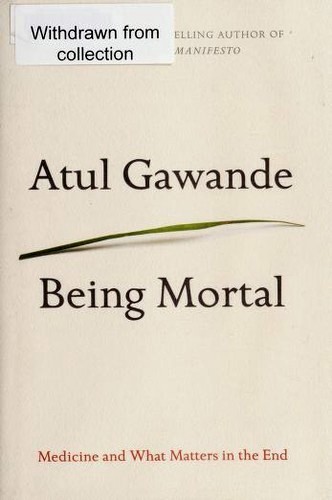
Being Mortal
Medicine and What Matters in the End
In Being Mortal, surgeon and writer Atul Gawande examines how modern medicine responds when cure, recovery, or indefinite independence is no longer possible. Moving between medical history, reported case studies, conversations with patients and families, and the illness of his own father, Gawande argues that care should be organized around the life a person still wishes to live—not only around safety, treatment, or survival. The book explores aging, frailty, nursing homes, assisted living, serious-illness conversations, palliative care, and hospice while asking how autonomy, purpose, dignity, and human connection can be preserved near the end of life.
Where to buy or borrow
Are you selling this book? Bookstores, publishers, authors and libraries can be listed here for free. Request a listing
About this book
The book begins with the changing experience of old age. Longer lives and smaller or more dispersed families have shifted much elder care from households into specialized institutions. Gawande considers how nursing homes developed around medical supervision and physical safety, then examines alternatives influenced by the assisted-living movement. These experiments seek to preserve privacy, choice, meaningful activity, and a sense of home even when residents require substantial help.
The later chapters turn toward life-limiting illness and end-of-life medicine. Through patients, clinicians, and Gawande's family, the book shows why discussions about prognosis and trade-offs are often postponed. Its central practical insight is that good decisions begin by asking what a person understands about the situation, what outcomes matter most, what fears and unacceptable conditions shape the decision, and what sacrifices the person is willing to make for the possibility of more time.
Gawande's larger argument is not against medical treatment. It is against allowing treatment to become an end in itself. Medicine remains valuable when cure is impossible, but its purpose must broaden from repairing the body to helping people live as well as possible within the limits they face.
Aging, Serious Illness, and the Limits of Medical Control
Gawande combines social and medical history with intimate narratives. He follows older people navigating housing and care, innovators attempting to reform long-term care, patients facing advanced disease, and physicians learning to speak more honestly about prognosis. His father's spinal-cord tumor makes the investigation personal and exposes Gawande himself to the uncertainty, hope, fear, and divided responsibilities he describes professionally.
The book's argument develops cumulatively. Physical security matters, but security alone cannot define a life worth living. Longevity matters, but additional time cannot be evaluated apart from the condition in which that time will be lived. Expertise matters, but clinicians cannot determine another person's priorities without sustained conversation. The proper aim of care, Gawande suggests, is to support the individual's own conception of a meaningful life while responding honestly to biological limits.
Autonomy, Purpose, and the Meaning of a Life Worth Living
Purpose is equally important. Gawande describes approaches to elder care that combat boredom, loneliness, and helplessness by restoring relationships, responsibilities, spontaneity, and contact with living things. These examples support a larger claim: people continue to need reasons to participate in life even when illness or disability narrows what they can do.
The book also considers courage under uncertainty. Patients and families must face incomplete information, while physicians must acknowledge both the limits of treatment and the limits of prediction. Honest care does not eliminate uncertainty; it helps people make choices within it.
From Family Care to Nursing Homes and Assisted Living
The American nursing home emerged partly as a solution to genuine medical and social needs, but its institutional inheritance favored standardized routines, supervision, and risk reduction. Being Mortal contrasts this model with the assisted-living movement associated with reformers such as Keren Brown Wilson, whose work emphasized private space, personal choice, and help that adapts to a resident's life rather than replacing it.
The discussion also belongs to the history of hospice and palliative medicine. These fields challenge the assumption that acknowledging incurable illness means abandoning care. Their focus on symptom relief, communication, family support, and patient-defined goals provides Gawande with an alternative to treatment-centered medicine near the end of life.
Readers Facing Aging, Caregiving, or Difficult Medical Choices
Physicians, nurses, social workers, chaplains, therapists, long-term-care staff, health administrators, and students in the health professions may find it valuable as an introduction to patient-centered communication and the nonmedical dimensions of care. Readers interested in medical ethics, public health, aging, and institutional design will also find substantial material.
Those seeking a technical clinical manual, a comprehensive guide to advance-care planning, or detailed legal and financial instructions will need additional resources. The book is an inquiry through narrative and reporting rather than a step-by-step handbook.
Accessible Medical Narrative with Emotionally Demanding Material
The principal difficulty is emotional rather than technical. The book describes frailty, loss of independence, cancer, treatment complications, family conflict, dying, and bereavement. Readers currently caring for someone with advanced illness—or grieving a recent death—may prefer to read it slowly or with others.
Useful Preparation for Reading Being Mortal
Readers may also benefit from knowing that nursing homes, assisted-living communities, home care, and hospice differ in purpose, regulation, eligibility, services, and financing. Being Mortal concentrates on the values these arrangements embody rather than providing a current guide to navigating every part of the American care system.
Because individual preferences differ, the cases should be read as prompts for reflection rather than universal prescriptions. One person's minimum acceptable quality of life may be very different from another's.
Why Being Mortal Remains a Valuable Conversation Starter
Being Mortal also connects health care with the design of everyday life. Its examination of long-term care shows that food, privacy, animals, relationships, responsibilities, schedules, and physical surroundings are not decorative extras. They can determine whether assistance supports a life or merely manages a body.
Finally, Gawande writes as a physician confronting his profession's limitations and his own family's vulnerability. That combination of clinical insight and personal uncertainty keeps the book from becoming a simple accusation directed at doctors or institutions.
Practical Lessons About Conversations and Trade-Offs
Readers may also reconsider the assumption that maximizing safety is always compassionate. For a person living with frailty, freedom and meaningful activity may require accepting some possibility of falls, mistakes, or other harm. The ethical task is not to disregard safety but to balance it against autonomy and purpose.
Another takeaway is that comfort-focused care need not represent surrender. When cure is no longer realistic—or when treatment burdens exceed likely benefits—medicine can still relieve symptoms, support families, clarify choices, and help protect the experiences that matter most.
Narrative Clarity and a Patient-Centered Framework
Gawande also avoids presenting medicine as simply harmful or futile. He acknowledges its power while examining the circumstances in which technical success can cease to serve the person receiving treatment. His distinction between fighting disease and helping someone live according to personal priorities offers readers a durable framework for thinking about difficult choices.
The treatment of elder-care reform is another strength. By looking at concrete alternatives to conventional institutional life, the book demonstrates that dignity depends partly on organizational decisions rather than goodwill alone.
Scope Boundaries and Perspectives the Book Does Not Fully Develop
The book is not a comprehensive policy analysis. Financing, insurance rules, workforce shortages, racial and economic inequality, disability perspectives, dementia-specific care, and the practical burdens placed on unpaid caregivers could each sustain a much fuller treatment. Readers seeking current legal or eligibility information about hospice, long-term care, advance directives, or medical aid in dying will need jurisdiction-specific sources.
Gawande gives only limited attention to physician-assisted dying. His central concern is how ordinary care can better support people before the final moment, not a complete presentation of the legal and ethical arguments surrounding assisted death.
The narrative method is persuasive but necessarily selective. Memorable cases can reveal patterns without establishing how frequently every outcome occurs. Readers should distinguish the book's reported experiences and ethical reasoning from comprehensive evidence reviews or clinical guidelines.
Frailty, Palliative Care, Hospice, and Goal-Concordant Decisions
Palliative care is specialized care directed toward relief from symptoms, distress, and the burdens of serious illness. It can accompany disease-directed treatment and is not restricted to the final days of life. Hospice generally serves people approaching the end of life when comfort and quality of remaining time have become the principal priorities.
Goal-concordant care is not a term around which Gawande formally organizes the entire book, but it captures a central principle: medical choices should correspond to the patient's informed goals and acceptable trade-offs. This requires conversations about prognosis, fears, essential abilities, family responsibilities, and what outcomes would make further treatment no longer worthwhile.
Assisted living, in the book's reform-oriented sense, is not simply a less medical building. It is an effort to combine practical assistance with privacy, autonomy, continuity, and the freedom to accept reasonable risks.
What Should Medicine Do When It Cannot Cure?
Gawande also asks what older adults lose when care is organized for institutional convenience rather than human flourishing. Can dependency coexist with autonomy? What makes a place feel like home? Which relationships, routines, and responsibilities continue to give life meaning after physical abilities decline?
Underlying these questions is a challenge to technological optimism. The availability of an intervention does not settle whether it should be used. Decisions require judgments about burdens, benefits, time, uncertainty, and the particular life the patient wants to protect.
How a Reading Group Can Discuss Mortality Constructively
Participants should be free to discuss the ideas without disclosing private medical histories. A facilitator can remind the group that preferences about risk, dependence, treatment, and dying vary widely; the purpose is not to establish one correct end-of-life plan.
Useful companion activities include comparing the book with the PBS FRONTLINE documentary, examining a local advance-directive form, or discussing how nearby elder-care settings balance safety with autonomy. Legal and medical questions raised by the conversation should be checked against qualified, current sources rather than resolved from the book alone.
Discussion Questions About Medicine, Autonomy, and the End of Life
2. When can an effort to protect someone become an unjustified restriction of that person's autonomy?
3. Which examples of elder-care reform seem most convincing, and what obstacles might prevent them from working elsewhere?
4. Why are conversations about prognosis and declining health so often postponed by clinicians, patients, and families?
5. How should hope change when recovery is unlikely? Is hope always tied to survival?
6. What abilities, relationships, or activities would be essential to your own sense that life remains worth living?
7. How does Gawande's experience with his father alter the authority or emotional force of his argument?
8. Does the book place enough responsibility on institutions and public policy, or does it focus too heavily on individual conversations?
9. What is the difference between abandoning treatment and changing the goal of treatment?
10. Which voices or experiences are underrepresented, and how might their inclusion complicate the book's conclusions?
Edition Verification and Supporting Sources
The profile's account of the book's scope was checked against official author and publisher material, bibliographic descriptions, established critical discussion, and the PBS FRONTLINE documentary produced in conjunction with the book. Interpretive assessments of audience, strengths, and limitations are editorial judgments grounded in that verified scope rather than claims made by the publisher.
Comments
No published comments yet.
Available editions
Hardcover
First U.S. edition; hardcover
- Publisher
- Metropolitan Books
- ISBN-13
- 9780805095159
- Publication date
- Pages
- 304