
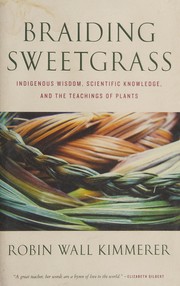
Braiding Sweetgrass
Indigenous Wisdom, Scientific Knowledge and the Teachings of Plants
Braiding Sweetgrass is a collection of connected nonfiction essays in which Robin Wall Kimmerer brings together botany, personal experience, Potawatomi teachings, environmental history, and reflections on language and ethics. Rather than presenting Indigenous knowledge and Western science as interchangeable, the book explores what each way of knowing can perceive and what may become possible when they enter a respectful conversation. Plants provide the book’s recurring subjects and organizing teachers. Pecans, strawberries, maples, asters, goldenrod, black ash, beans, corn, squash, sweetgrass, and other beings become points of entry into ecology, family history, land use, gratitude, restoration, and responsibility. Scientific explanations are embedded in stories about parenting, teaching, gathering, gardening, field research, and participation in community life. The book gradually expands in scale. Early essays establish creation, gift, attention, and relationship as guiding ideas. Mi…
Where to buy or borrow
Are you selling this book? Bookstores, publishers, authors and libraries can be listed here for free. Request a listing
About this book
Plants provide the book’s recurring subjects and organizing teachers. Pecans, strawberries, maples, asters, goldenrod, black ash, beans, corn, squash, sweetgrass, and other beings become points of entry into ecology, family history, land use, gratitude, restoration, and responsibility. Scientific explanations are embedded in stories about parenting, teaching, gathering, gardening, field research, and participation in community life.
The book gradually expands in scale. Early essays establish creation, gift, attention, and relationship as guiding ideas. Middle sections consider cultivation, harvesting, citizenship, and practical reciprocity. Later essays confront forced assimilation, environmental contamination, extractive economies, species loss, and climate disruption. The movement is therefore not simply from nature appreciation to environmental concern; it is from receiving the living world as a gift toward accepting obligations to restore and defend it.
Its central ethical proposition is that gratitude should lead to reciprocity. Human beings depend upon gifts they did not create, and acknowledgment alone is insufficient if it does not shape conduct. Through narrative rather than a conventional step-by-step argument, Kimmerer asks readers to reconsider land as a community of living relations rather than property or an inventory of resources.
Deep Overview
Plants provide the book’s recurring subjects and organizing teachers. Pecans, strawberries, maples, asters, goldenrod, black ash, beans, corn, squash, sweetgrass, and other beings become points of entry into ecology, family history, land use, gratitude, restoration, and responsibility. Scientific explanations are embedded in stories about parenting, teaching, gathering, gardening, field research, and participation in community life.
The book gradually expands in scale. Early essays establish creation, gift, attention, and relationship as guiding ideas. Middle sections consider cultivation, harvesting, citizenship, and practical reciprocity. Later essays confront forced assimilation, environmental contamination, extractive economies, species loss, and climate disruption. The movement is therefore not simply from nature appreciation to environmental concern; it is from receiving the living world as a gift toward accepting obligations to restore and defend it.
Its central ethical proposition is that gratitude should lead to reciprocity. Human beings depend upon gifts they did not create, and acknowledgment alone is insufficient if it does not shape conduct. Through narrative rather than a conventional step-by-step argument, Kimmerer asks readers to reconsider land as a community of living relations rather than property or an inventory of resources.
Key Themes
• Gratitude as discipline: Thanksgiving is presented not merely as an emotion but as a repeated practice that can influence perception and behavior.
• Multiple ways of knowing: Botanical science, lived observation, story, language, ceremony, and inherited cultural teaching illuminate different dimensions of the living world.
• Plants as teachers: Plants are treated as active participants in ecological communities and as sources of instruction about generosity, restraint, adaptation, and mutual flourishing.
• The grammar of relationship: Language affects whether people encounter other beings as objects or as living presences. The book considers what English habits of speech can obscure and what Indigenous languages may disclose.
• The honorable harvest: Taking from the natural world should be governed by restraint, respect, permission, need, gratitude, and restoration rather than entitlement.
• Colonialism and ecological damage: The disruption of Indigenous cultures, dispossession from land, extractive economics, and environmental degradation appear as interrelated histories.
• Restoration: Ecological repair is joined to cultural renewal and the rebuilding of reciprocal relationships.
• Gift economies versus commodification: The book contrasts relationships created by gifts with market systems that encourage possession, accumulation, and detachment from sources.
Historical and Intellectual Context
A crucial historical background is the colonization of Indigenous lands in North America. The essays address forms of dispossession and forced assimilation, including educational systems that attempted to sever Indigenous children from family, language, culture, and land. These histories matter because the book’s emphasis on restoration includes more than repairing damaged habitats: it also concerns recovering suppressed languages, responsibilities, stories, and relationships.
Kimmerer writes from the combined position of a trained botanist and an enrolled member of the Citizen Potawatomi Nation. The book challenges an intellectual history in which Western institutions have often treated scientific knowledge as the sole authoritative description of nature while dismissing Indigenous knowledge as folklore. Its alternative is not an uncritical fusion of traditions but a sustained demonstration that evidence, story, ethics, and relationship can ask different yet mutually illuminating questions.
Intended Audience
No advanced scientific education is required. Readers who normally avoid science writing may appreciate its narrative and sensory approach, while scientifically trained readers may value its challenge to disciplinary assumptions about objectivity, language, and relationship.
It may be less suitable for readers seeking a botanical textbook, a comprehensive introduction to Potawatomi history, or a policy-centered analysis of environmental problems. Its essayistic method favors accumulation, recurrence, and reflection over a linear thesis-and-evidence structure.
Reading Difficulty
The essays vary in pace and can often be read individually, though their full force comes from noticing how images and ideas recur across the collection. The deliberate, meditative style rewards slow reading. Some sections address cultural suppression, ecological destruction, contamination, and species loss and may be emotionally demanding.
The book also includes words and teachings connected to Indigenous languages and traditions. Readers should approach these as culturally situated knowledge rather than detachable concepts to be casually generalized or adopted.
Helpful Background Knowledge
It is useful to distinguish Indigenous knowledge from generic spirituality or a single universal worldview. Kimmerer writes from particular personal, familial, professional, and Potawatomi contexts while also discussing teachings with broader implications. Readers should preserve that specificity rather than treating the book as permission to collapse distinct Indigenous nations and traditions into one category.
Why Read This Book?
The book is valuable for readers dissatisfied with environmental writing built entirely around catastrophe. It does not minimize damage, but it repeatedly asks what people can return, repair, cultivate, teach, or protect. Its account of reciprocity provides a richer standard than merely reducing harm.
It also demonstrates how form can carry an argument. The braiding of memoir, science, story, and cultural teaching enacts the intellectual relationship the book advocates. Readers encounter not a detached theory of interdependence but many examples of how knowledge grows from sustained involvement with places and living communities.
Reader Takeaways
The book may prompt readers to distinguish gratitude from reciprocity. Gratitude recognizes a gift; reciprocity asks what response the gift requires. This distinction can reshape everyday decisions about food, land, consumption, waste, restoration, and community participation.
Readers may also become more attentive to language. Describing a plant as an object, a resource, a relative, a citizen, or a teacher directs attention toward different qualities and obligations. The book encourages scrutiny of the assumptions carried by ordinary grammar and economic vocabulary.
Finally, it offers a model of hope grounded in practice rather than optimism alone. Planting, tending, teaching, restoring habitat, learning local natural history, supporting Indigenous sovereignty, and limiting what one takes are presented as meaningful forms of participation in repair.
Editorial Strengths
Its plant-centered examples give abstract ethical ideas a material basis. Reciprocity, gift, restraint, and restoration are examined through harvesting practices, ecological relationships, gardening, teaching, and damaged landscapes rather than discussed only as ideals.
The essay structure creates many entry points for readers and groups. Individual chapters can sustain discussion, while recurring concepts invite comparison across the collection. The prose combines explanation with close sensory attention, making the book useful both as environmental thought and literary nature writing.
Another strength is its movement between intimate and systemic scales. Family life and personal memory coexist with colonial history, industrial extraction, contamination, and climate change, showing how large systems enter ordinary relationships with land.
Limitations and Reading Cautions
Its recursive structure may feel repetitive to readers who prefer tightly linear argument. Key ideas return through different plants, stories, and circumstances; this repetition is part of the book’s method but can slow its pace.
Because the work moves among memoir, cultural teaching, science, and moral reflection, readers must attend to shifts in evidentiary mode. A story may communicate ethical or relational knowledge without functioning like an experimental scientific claim. Conversely, scientific observations should not be generalized beyond their stated context.
The book’s influence has encouraged broad use of terms such as reciprocity and honorable harvest. Readers and discussion groups should avoid extracting these concepts from their Indigenous and historical contexts or turning them into generalized lifestyle branding.
Important Concepts
• Reciprocity: A mutual relationship in which receiving creates an obligation to respond through care, restraint, restoration, or another appropriate gift.
• Honorable harvest: An ethic governing how people take from living systems, emphasizing need, respect, limits, gratitude, and continuation of the source.
• Gift economy: A system in which gifts create and maintain relationships and responsibilities, contrasted with commodities that can be detached from giver, source, and obligation.
• Grammar of animacy: The idea that grammatical habits can recognize or conceal the living agency and personhood of beings beyond humans.
• Traditional ecological knowledge: Place-based understanding developed through long observation, practice, cultural transmission, and relationship. The book presents such knowledge as intellectually and ethically significant, not as raw material awaiting scientific validation.
• Restoration: Repair of ecological communities alongside renewal of relationships, responsibilities, and cultural continuity.
• Windigo: A figure and framework through which the book examines insatiable consumption, greed, and systems that take without reciprocal return.
• The Three Sisters: Corn, beans, and squash grown together; their ecological complementarity also supports reflection on cooperation and mutual provision.
• Seventh Fire: A teaching connected in the book to historical choice, cultural renewal, and possible pathways away from destructive relations with the land.
Questions the Book Explores
• Can scientific practice become more attentive to relationship, responsibility, and cultural context without abandoning empirical rigor?
• What responsibilities accompany the gifts of food, water, knowledge, beauty, and habitat?
• How does language influence which beings people recognize as alive, active, or worthy of moral consideration?
• What is the difference between sustainable use and genuine reciprocity?
• How are cultural restoration and ecological restoration connected?
• Why do extractive economies encourage endless taking, and what practices might interrupt that pattern?
• How can gratitude become collective conduct rather than remain a private feeling?
• What would it mean for human communities to live in ways that benefit the land?
Reading Group Guide
Invite participants to select one plant-centered essay and identify its scientific, autobiographical, historical, and ethical layers. Discuss where those layers reinforce one another and where they remain distinct.
Keep a shared list of recurring terms such as gift, reciprocity, gratitude, restoration, citizenship, language, and harvest. Revise the group’s working definitions as the reading progresses.
For a place-based activity, participants can learn the names, ecological relationships, and human histories of a few plants near the meeting location. The activity should emphasize observation and responsible learning, not unauthorized harvesting or imitation of culturally specific practices.
When discussing Indigenous teachings, distinguish appreciation from appropriation. Ask what the book requests of readers in terms of responsibility, historical understanding, support, and changed behavior rather than focusing only on adopting appealing symbols.
Discussion Questions
2. How does Kimmerer use scientific explanation differently from a conventional textbook or popular-science account?
3. Which essay most clearly changed your understanding of a familiar plant or landscape, and how?
4. What is the difference between receiving something as a gift and acquiring it as a commodity? What obligations arise in each case?
5. Can gratitude influence institutions and economies, or is it mainly an individual practice? What would collective gratitude look like?
6. How does the concept of the honorable harvest challenge common assumptions about ownership and consumption?
7. What does the book gain by treating language as an ecological issue?
8. Where does Kimmerer connect damage to land with damage to culture, family, or identity?
9. How does the Windigo framework explain forms of consumption that conventional economic language may normalize?
10. Does the book offer hope? If so, is that hope emotional, ethical, practical, political, or some combination?
11. What responsibilities do non-Indigenous readers have when learning from this work?
12. After reading the book, what would it mean in practical terms to return a gift to a place that supports your life?
Sources and Verification
Comments
No published comments yet.
Available editions
Hardcover
First edition, hardcover
- Publisher
- Milkweed Editions
- ISBN-13
- 9781571313355