
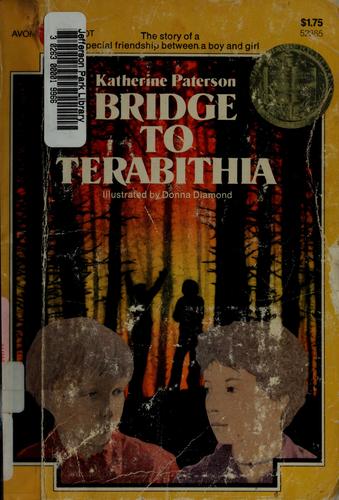
Bridge to Terabithia
Bridge to Terabithia, Katherine Paterson's 1977 novel, follows Jess Aarons, a fifth-grader in rural Virginia who feels out of place in his struggling family and at school. His life changes when Leslie Burke, a bookish and fearless new neighbor, moves in next door. Together they invent Terabithia, a secret kingdom in the woods across a creek, and the friendship opens Jess's eyes to art, imagination and his own worth. The story then turns toward grief, and the book asks how a young person can carry loss without losing what the friendship gave him. It won the 1978 Newbery Medal and remains one of the most widely read award winning books for young readers, valued for its plain, compassionate treatment of friendship, class and death.
Where to buy or borrow
Are you selling this book? Bookstores, publishers, authors and libraries can be listed here for free. Request a listing
About this book
Deep Overview
Leslie's family differs from his in nearly every outward way. The Burkes are educated, writers by trade, uninterested in television, and relaxed about money in a way Jess cannot imagine. Leslie reads widely, talks easily to adults, and treats imagination as a serious tool. At her suggestion the two cross a creek on a rope swing into a patch of woods and declare it a kingdom they name Terabithia. They rule it together, draw up rules, fend off imagined enemies, and use it as a place to be unafraid. The book is careful to show that Terabithia works because it is shared and because both children need it, not because anything supernatural occurs.
Alongside the friendship, Paterson builds a realistic portrait of Jess's world. His younger sister May Belle idolizes him, his older sisters are indifferent or irritating, and his father is worn down by work and worry. At school Jess finds an unexpected ally in his music teacher, Miss Edmunds, who notices his talent and treats him as someone with promise. Her attention matters because it comes from outside his family, and one outing she arranges gives Jess a glimpse of a larger world than the one he has known. Meanwhile, Leslie's openness stretches him, sometimes uncomfortably, in matters of religion, class and courage.
The novel then moves into its most discussed passage. A sudden loss, which this profile does not detail for readers who have not yet arrived there, throws Jess into shock, denial and guilt. Paterson follows the stages of his reaction through behavior rather than commentary: anger at the wrong people, avoidance, an awkward encounter with his father, and the gradual recognition that his friend's gift to him was a way of seeing that does not disappear with her. In the closing chapters Jess decides what to do with that inheritance, and the act he chooses gives the title its meaning.
What Paterson is demonstrating is that imagination is neither escapism nor mere play. In the book it is a practice that lets a child rehearse courage and compassion, and that can be handed on to someone else. The novel also insists that grief is not tidy and that adults often handle it clumsily. In her Newbery acceptance speech, reprinted in reference works, Paterson discussed how young readers interpret the ending, a reminder that the book's final movement is open to reflection rather than reduced to a single moral.
Key Themes
The uses and limits of imagination. Terabithia offers courage, dignity and shared authority, yet the book is clear that it cannot protect anyone from real danger.
Class and belonging. Jess's rural, money-tight household and the Burkes' more cosmopolitan habits create tension, envy and admiration on both sides.
Gender expectations. Leslie's speed, intellect and independence unsettle the assumptions of the boys around her, and Jess must decide what he thinks about girls who do not stay in their assigned places.
Grief and guilt. The novel treats shock, denial, blame and eventual acceptance as a process shaped by family, religion and a child's limited power to understand.
Art and being seen. Jess's drawing and Miss Edmunds's encouragement show how a single attentive adult can change a young person's sense of possibility.
Inheritance. What a friend leaves behind is not an object but a way of paying attention, and the story ends on the question of how to pass it forward.
Historical Context
The immediate spur was personal. In August 1974, eight-year-old Lisa Hill, the close friend of Paterson's son David, was struck by lightning and killed. David later became a screenwriter and producer and worked on the 2007 film adaptation. Reference sources describe the book as inspired in part by that loss; the novel itself is fiction rather than a retelling of what happened.
The book also reflects the 1970s climate around gender roles, since Leslie's confidence and competence were fresh in children's fiction of the period, and a rural Southern setting in which television, church attendance and conventional expectations shape daily life. Today's readers should remember that the story predates the internet and mobile phones; the children's isolation and dependence on one another are partly products of that world. Adaptations include a 1985 television film directed by Eric Till and a 2007 feature film, both of which interpret the story with their own emphases.
Intended Audience
Readers who want fast plots, battles or an elaborate fantasy world may be disappointed, since the imaginary kingdom is a small part of a mostly realistic story. Children who are currently grieving, or who have recently lost a friend or relative, may benefit from an adult reading alongside them. Sensitive readers should be told in advance that the book contains a sudden, upsetting death.
Reading Difficulty
The challenge is emotional and interpretive. The book relies on implication, on what Jess does not say, and its central turn can be painful. Readers benefit from pausing to talk after the later chapters. Older mass-market paperbacks may use smaller type than newer reissues, which can matter for some younger readers; ebook and audiobook versions of other editions appear to exist but were not checked for this profile.
Helpful Background Knowledge
For adults sharing the book with children, it is worth reading it first and thinking about how you want to respond to questions about death, religion and blame. Reading Paterson's Newbery acceptance speech afterward, rather than beforehand, preserves the story's surprises while adding useful context about its origins.
Why Read This Book?
It is also a rare example of a short novel that gives class difference real weight without turning either family into a villain. Jess's parents are limited by circumstance, not by cruelty, and the book lets readers see both the strain and the love.
Finally, it gives families and classrooms a shared text for conversations that are otherwise hard to begin. Because the death is handled through character and consequence rather than lecture, readers of different ages can find different things in it.
Reader Takeaways
Readers may also reflect on practical questions: what it means to honor a friend after she is gone, why people sometimes become angry when they are grieving, and how generosity can be passed to someone younger. For adult readers, the book can prompt a reassessment of how they talk with children about loss.
Strengths
Character depth: Jess is a believable, sometimes petty and frightened boy whose growth is not sentimentalized. The supporting characters, from May Belle to Miss Edmunds, serve distinct purposes.
Honesty about grief: the narrative portrays confusion, denial and misplaced guilt without offering a quick resolution.
Social texture: the story shows how class, gender expectations and rural life shape childhood without turning into a lecture.
Discussability: its plain structure and strong turning point make it practical for classrooms, family reading and group discussion.
Limitations and Cautions
The story reflects the 1970s and a particular rural American setting. Some attitudes toward gender, religion and family life, and some word choices, may feel dated, and the representation of the community is narrow and seen through one boy's limited perspective.
Religion is treated through Jess's family and through a conversation about what happens after death; readers have interpreted these passages in different ways, and the book has drawn objections in some school settings, which is one reason adults may want to preview it. The imaginative kingdom is brief and lightly sketched, so readers expecting a full fantasy will not find one.
Film adaptations differ from the novel in emphasis, and viewers who encounter the movie first may expect a more fantastical story than the book delivers.
Important Concepts, People, and Places
Leslie Burke: the new neighbor whose imagination, confidence and independence reshape Jess's outlook; the novel's emotional center.
Terabithia: the secret kingdom in the woods beyond a creek, reached by a rope swing; it embodies the children's shared imaginative practice.
Miss Edmunds: Jess's music teacher, who recognizes his talent and gives him an experience of art outside his usual world.
May Belle: Jess's younger sister, who admires him and whose relationship with him matters to the ending.
Katherine Paterson: the author, who has said the novel was prompted by the death of her son's friend Lisa Hill, and who later received the Hans Christian Andersen Medal and the Astrid Lindgren Memorial Award for her body of work.
Lisa Hill and David L. Paterson: the real child and the author's son whose friendship and loss in 1974 inspired the book; David later helped bring it to film.
Newbery Medal: the American Library Association's award for distinguished children's literature, which the novel received for 1978.
Donna Diamond: the illustrator of the original Crowell edition, whose drawings accompanied the first printing.
The Chronicles of Narnia: C. S. Lewis's fantasy series, which Leslie knows and which gives a literary model for the idea of a hidden land.
Film adaptations: the 1985 television film directed by Eric Till and the 2007 feature film starring Josh Hutcherson as Jess.
Questions the Book Explores
Can imagination be a form of courage, and when does it fall short of protecting us?
What does a child owe a friend who has died, and where does guilt come from when no one is truly to blame?
How do adults, including parents and teachers, help or fail children facing loss?
What counts as strength, and who is allowed to display it, in a community with firm ideas about boys and girls?
How can a private creative world become something that is shared rather than hoarded?
Reading Group Guide
Starting points: compare Jess's home with the Burkes' home; trace how Jess's feelings toward Leslie change from rivalry to trust; look at the role of Miss Edmunds; and consider why Paterson chooses a restrained narrative voice for the hardest scenes. Mixed-age groups may enjoy a short drawing or writing activity in which each person describes a place of their own that functions like Terabithia. If time allows, reading Paterson's Newbery speech or watching a small portion of an adaptation can prompt a conversation about how the same material is shaped by different forms.
Discussion Questions
2. How does Paterson use Jess's family, school and church life to show what he is up against?
3. Terabithia is invented rather than discovered. What does the way the children build it tell us about them?
4. Why might Miss Edmunds matter so much to Jess, even though she appears in only some chapters?
5. How do the adults respond to Jess when he is grieving, and which responses seem most or least helpful?
6. What does Jess's decision at the end suggest about how he understands his friendship with Leslie?
7. How do gender expectations shape the way other children and adults view Leslie, and how does Jess's attitude evolve?
8. Should a book for young readers soften or avoid tragedy? What does this novel gain or risk by including it?
9. If you have seen a film adaptation, which choices differ from the book, and how do they change the meaning?
Sources and Verification
Comments
No published comments yet.
Available editions
Paperback
- Publisher
- Avon Books
- ISBN-13
- 9780380432813